Meet a new American, from Mexico
Its not cheap or quick, but the U.S. authorizes more immigrants from Mexico than anywhere else.
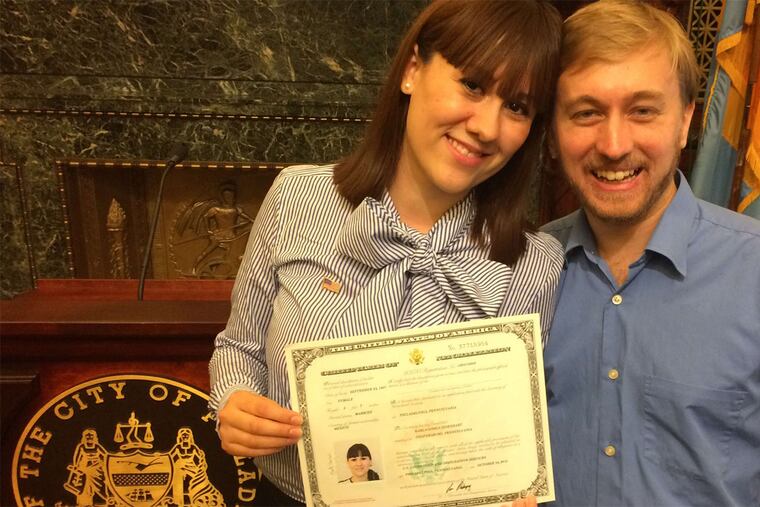
BEFORE Karla Marquez came to America, she had no idea how bad things were in Mexico.
This was 2006, she was 18 and scored an internship for international students at Disney World in Orlando, Fla. When she arrived, she thought she knew how to speak English, "but I really didn't," she discovered, so she took classes and learned.
Her job was in hotel food and beverage, and that's where she met Penn State student Michael Eisenhart, but I am getting ahead of the story.
"When I came to the U.S.," she says, "I realized that I was happy."
She also learned of the millions of her compatriots who came here illegally. "I didn't realize the extent of the poverty," says Karla, who comes from a middle-class family and attended the Technology University of Mexico. After her internship, Karla went back to Mexico.
Five years later, in 2011, she returned to the U.S., to Disney - and to Michael. What had been a friendship over the few years apart ignited "real quick," says Michael.
How quick?
They were married the next year.
Always here legally, Karla applied for citizenship. The process took three years (it can take longer; she might have been helped as the spouse of an American) and cost $7,000 - for a lawyer and government processing.
The financial cost weighs heavily on the poor. Even worse, there's an express lane for the rich. Under one visa program, foreigners with a minimum of $500,000 to invest are granted conditional residency for two years, during which they must create 10 full-time jobs. If successful, they can apply for full citizenship.
Other countries have similar programs, and it has a desirable goal, but it just feels wrong, an admission that cash talks, B.S. walks.
I met Karla and Michael on Wednesday at City Hall in the impressive Mayor's Reception Room, where Karla joined 32 other foreigners taking an oath of citizenship, becoming Americans.
They were called candidates, the process is called naturalization and their 19 home countries ranged from Albania to Ukraine.
If you ever tire of hearing what a bad, nasty, mean place America is, attend a naturalization and see America through their eyes.
I get a sense of renewal and pride from new Americans who are asked only for allegiance, never to renounce who they are.
In my grandparents' day, in New York City, new arrivals were called greenhorns - meaning they were unfamiliar with American customs. Some immigrants are still called names. Thinking of you, Donald Trump, but most Americans have positive feelings toward immigrants, at least those here legally.
After the ceremony, I asked Karla to tell me her story, and she did, followed by a brief phone chat Saturday, moments before she flew to Milan, Italy, to study for her master's in international marketing. That's how small the world is today: Study in Mexico, intern in the States, get an advanced degree in Italy.
Karla came here the right way, as do most Mexicans. Since immigration laws changed in 1965 to no longer favor Europeans, Mexico has sent us more immigrants than any other nation - 16 million, according to Pew Research.
Although getting a visa is difficult - and became more so after 9/11 - Mexico accounts for more new Americans than any other country. In 2013, we welcomed 135,028 from Mexico, way more than second-place China, with 81,784. Mexico accounts for one in four of all foreign-born immigrants. These numbers dispute the people who complain that it's "impossible" to get here legally. It is not quick; it requires waiting your turn, as Karla did.
During the naturalization ceremony, Leon Rodriguez, the director of U.S. Citizenship and Immigration Services, told the candidates that their children would be more likely to go to college and will be involved in fewer crimes than the native-born. Thinking of you, Donald Trump.
Rodriguez said he is the son of Cuban immigrants, as was another speaker, Philadelphia managing director Richard Negrin.
When Karla took the oath of citizenship, she was adding to what she is, not subtracting. She still loves her native Mexico, but loves America because it offers her "interaction with other cultures" in what is - yes, she said it - a melting pot and an "experiment."
Her husband, Michael, grew up in the Lancaster area, and works in information science and technology. Until Karla left for Milan, they made their home in Lititz. Michael is of German descent, and Germans comprise America's largest ancestry group.
They were early immigrants, Hispanics were later immigrants and by 2065, thanks mostly to immigration, the largest immigrant group will be Asian.
Doesn't matter, as long as they feel themselves American.
Thinking about you, Donald Trump.
Email: stubyko@phillynews.com
Phone: 215-854-5977
On Twitter: @StuBykofsky
Blog: ph.ly/Byko
Columns: ph.ly/StuBykofsky