Phila. photographer: 'In Iceland, nature rules'
Feodor Pitcairn had been to Iceland seven times with his trusty Hasselblad cameras, capturing a wild landscape of glaciers, steaming geothermal gases, and vivid green mosses. But what he really wanted was an active volcano.
Feodor Pitcairn had been to Iceland seven times with his trusty Hasselblad cameras, capturing a wild landscape of glaciers, steaming geothermal gases, and vivid green mosses. But what he really wanted was an active volcano.
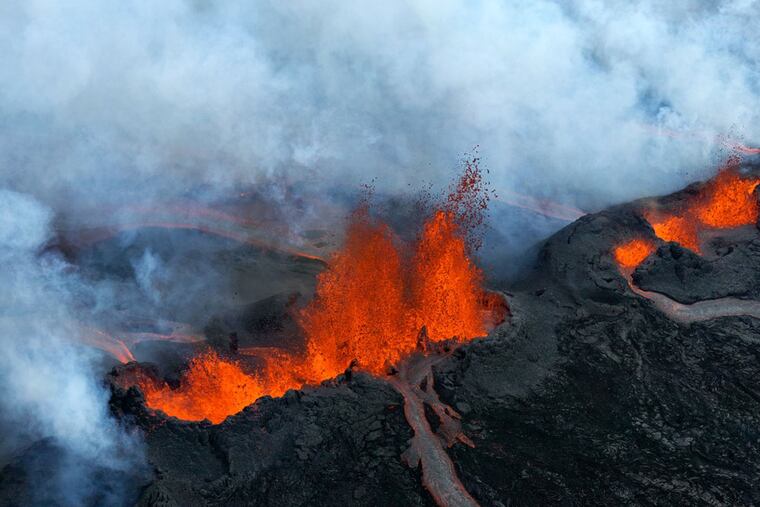
Pitcairn, of Bryn Athyn, had just about given up when he got the call in late August 2014. Within days he was leaning out the side of a helicopter, orange lava spurting below.
Images from that trip and the others are featured in an exhibit at the Smithsonian National Museum of Natural History in Washington through April 2017. More than 100 of the photos are reproduced in a companion book, along with scientific descriptions and poetry written by an Icelandic geophysicist, Ari Trausti Gudmundsson.
The project was just one of a lifetime's worth of adventures for Pitcairn, 81, who took up filmmaking full time in 1991 after a 25-year career in finance.
His first foray into nature photography came with a 1951 trip to South Africa during high school, and he remains full of youthful energy, said Gudmundsson.
"He has this boyish charm," the geophysicist said. "You sense he is a very forceful, very resourceful and strong character."
Tall, trim, and quick to smile, Pitcairn shared stories of his camera work recently in the dining room of his 1962 modernist house, designed by the famed architect Richard Neutra.
The dining area features floor-to-ceiling windows that overlook part of an 800-acre Montgomery County preserve managed by the Pennypack Ecological Restoration Trust - a group that Pitcairn, who was a longtime member of the county planning commission, helped to create.
All of Pitcairn's camera projects are fueled by a passion for the environment. That is what drew him to the rugged remoteness of Iceland.
"In Iceland, nature rules," he said.
He has exhibited works at the Smithsonian on several occasions, starting with a 1981 series from the Galápagos Islands.
The Iceland project began in 2011. Each of the eight trips spanned more than a week, with the assistance of local guide Einar Erlendsson. Gudmundsson joined the team toward the end, adding suggestions for good locales. He wrote a description to accompany each image, explaining such phenomena as bubbling mud pots and the northern lights.
And, of course, the volcano, named Bárdarbunga.
The source of the 2014 eruption lay deep beneath the Earth's surface, so the streams of lava traveled laterally through cracks in the Earth's crust before spouting into the air several dozen miles away.
After getting the aerial shots, Pitcairn captured more images from the ground, just 15 feet away from flowing lava. Last week, he moved his hands slowly across his dining-room table to demonstrate the speed of the fiery flow - perhaps a few inches per second.
"It was like being by a really hot fireplace," Pitcairn said. "We all said you feel very small in that kind of environment."
Though nature may rule Iceland, several of the photos depict an increasing human influence on the island's environment, such as glaciers and ice caps dwindling due to climate change.
In an interview, Gudmundsson said the impacts go beyond the retreat of ice. Warming seas have pushed some of Iceland's native fish species northward, while mackerel - previously unheard of in the island nation's waters - are now common and are disrupting the ecosystem, he said.
Pitcairn's Hasselblads are so-called medium-format cameras, meaning they can capture images about four times the size of a traditional 35-millimeter device. One of his cameras yields images with a resolution of 40 million pixels; the other, 60 million - enabling him to render the Icelandic landscape in hyper-real detail.
At the Smithsonian exhibit, the images are accompanied by audio recordings of creaking glaciers, bubbling geysers, and rumbling volcanoes, as well as the voice of Gudmundsson reading several of his poems in Icelandic.
Though Pitcairn's passion for nature photography was ignited by his teenage trip to South Africa, he studied economics at the University of Pennsylvania and went to work for his family's financial management company, at his father's behest.
But he still found time to pursue filmmaking, primarily underwater. His 2001 series, Ocean Wilds, aired on public television.
Pitcairn has now moved on to his next project, installing photographs in health-care settings to lift the spirits of patients. The first location is Abington Hospital-Jefferson Health, where he has hung dozens of images from the ocean depths, African safaris, and other locales.
Always, his subject is nature.
Whether it means leaning out of a helicopter or waiting for hours by a rocky hillside to get just the right light, that is the object of Pitcairn's focus.
"It's the ephemeral moments in time that are the special photographic opportunities," he said. "It means you've got to be really patient."
215-854-2430@TomAvril1