Forever Family: Radnor shelter helping animals become adoptable
When Farrah, a German shepherd stray, came to Francisvale Home for Smaller Animals in 2012 with a tumor on her right eye, she refused to live anywhere in the no-kill shelter except its bustling kitchen.
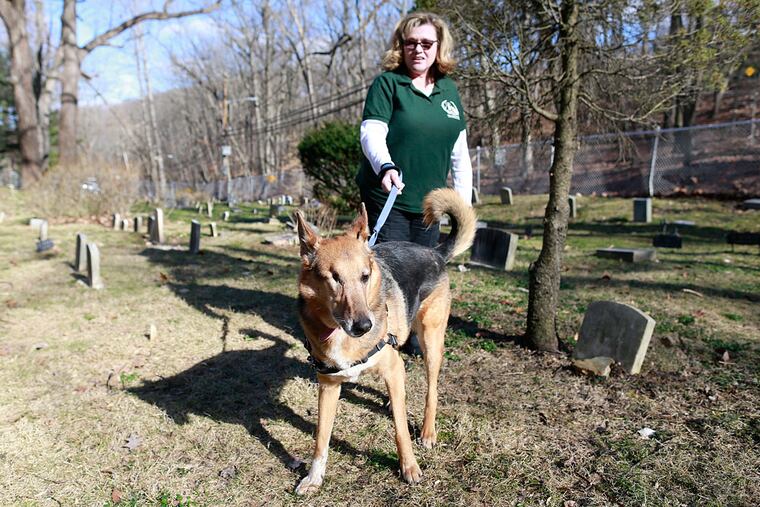
When Farrah, a German shepherd stray, came to Francisvale Home for Smaller Animals in 2012 with a tumor on her right eye, she refused to live anywhere in the no-kill shelter except its bustling kitchen.
There, she fell in love with everyone but went ballistic every day when staffers prepared to feed Francisvale's 65 cats. The sounds of kibble being poured into metal bowls sent Farrah into a frenzy of jumping, barking, spinning in circles, and biting her tail.
Bright sunlight streaming through a kitchen window and the moving shadow of a ceiling fan were equally powerful triggers.
After her right eye was surgically removed, Farrah, still insisting on living in the kitchen amid her worst stresses, became even more frantic.
Francisvale's executive director, Dorothy Claeys, knew that if she couldn't help Farrah and the nearly two dozen other dogs at the Radnor Township shelter learn to be less anxious and more adoptable, they would never find what she calls their "forever families."
So Claeys did something unprecedented in the 106-year history of Francisvale: She sought a veterinarian scientifically trained in canine and feline behavior psychology.
"I wanted a behaviorist as opposed to a trainer," Claeys said, "because I felt it was a better way to get to the bottom of what was troubling these animals and a better way to fix it."
Claeys is an animal-loving attorney who quit her law practice in 2014 to take the reins of the shelter and adoption house, which occupies an old farmhouse along Upper Gulph Road in Radnor.
Nestled on a picturesque, 16-acre hillside, Francisvale also maintains a cemetery where 2,000 dogs, cats - and the occasional guinea pig - are buried. But the nonprofit's main mission remains the same since its founding in 1909: finding homes for its homeless residents, many of whom have behavioral problems that are hindering their adoption.
Claeys' search for a specialist - an angel of mercy with the patience of a saint - seeded what has since become an unprecedented partnership with the University of Pennsylvania's School of Veterinary Medicine.
"There is a lot of pop culture about dog training. You turn on the TV and everybody talks to you about positivity and energy and blah blah blah," said Carlo Siracusa, the veterinarian who directs animal behavior medicine at PennVet and who engineered the jointly funded partnership.
"Love is overrated," he said. "It's not enough that we love animals. We have to be empathic. We have to understand their point of view, what they are trying to tell us through their behavior and body language. In animal behavior medicine, we try to stick with information that has been validated by science."
Last July, Siracusa sent M. Leanne Lilly to Francisvale, where the animal behavioral specialist quickly became the answer to Claeys' prayers and Farrah's desperate dance.
Lilly put translucent contact paper on the kitchen window, eliminating the glare and the moving shadows that frightened Farrah.
She felt that Farrah's anxiety over not being fed before the cats had triggered her panic behavior when she heard or saw their bowls being filled.
Lilly stuffed a hollow rubber dog toy with semi-frozen food to keep Farrah focused on extracting her meal instead of on the clatter from dozens of cat bowls.
Siracusa and Lilly also realized that Farrah needed a place to retreat from the kitchen's sensory overload.
"We created a safe space, Farrah's own little space in which she can retreat," Siracusa said. "Farrah goes into the bathroom and closes the door."
By September, Farrah had overcome her anxiety-driven triggers. "No more circling," Siracusa said. "Much more confidence."
He, Lilly, and Claeys now agree that Farrah is ready for a forever family.
"She's extremely friendly, an absolute sweetheart," Lilly said, as Farrah hugged a reporter with her front legs and tried to exfoliate his winter-chapped hands with her big, rough tongue.
"In a home, most of her triggers would not exist," Lilly said. "Unless there are 65 cats in the home she goes to."
Claeys said that whoever adopts Farrah will receive three free months of Lilly's help, as do all other dog and cat adopters under Francisvale's partnership with PennVet.
Lilly now comes to Francisvale three days a week, and is working with about half of the 20 dogs there. Eight months into the pilot partnership - scheduled to last at least a year - she has helped several of Farrah's longtime kennel mates overcome anxieties and become more adoptable.
Cooper, 3, a fluffy-but-frazzled Cairn terrier mix, was so agitated by other dogs that when Lilly walked him, his focus was solely on barking at them.
Lilly tried luring Cooper with treats, hoping to train him to look at her on command during the walks, regardless of distractions.
"At the sight or sound of another dog, I would lose his attention for up to two hours," Lilly said. "I got him to make eye contact with me six times in six months. I thought, 'Oh, my goodness, Mr. Cooper, what are we going to do with you?' "
But when a New Jersey couple who wanted an apartment dog came to Francisvale and told Lilly they had no interest in taking Cooper to a dog park for social play, Lilly knew she'd found a match.
"For Cooper, going to the dog park is like putting a person afraid of spiders into a room full of tarantulas," Lilly said. "He would not consider that social."
Using Lilly's training techniques in the quiet of their apartment, the couple taught Cooper to check in with them while walking. He learned so well that when Lilly tested him on a Philadelphia street, she had his attention.
So Cooper's found his forever home.
Farrah's still waiting for hers.
"The fluffies go fast," Claeys said. "Everybody likes a cute white fluffy. It's different when you're older and not so fluffy."
610-313-8109