Philadelphia and Cuba occupy common ground in mural
Art is bringing together on one enormous canvas what Cold War-era hatreds had kept apart for more than a half-century.
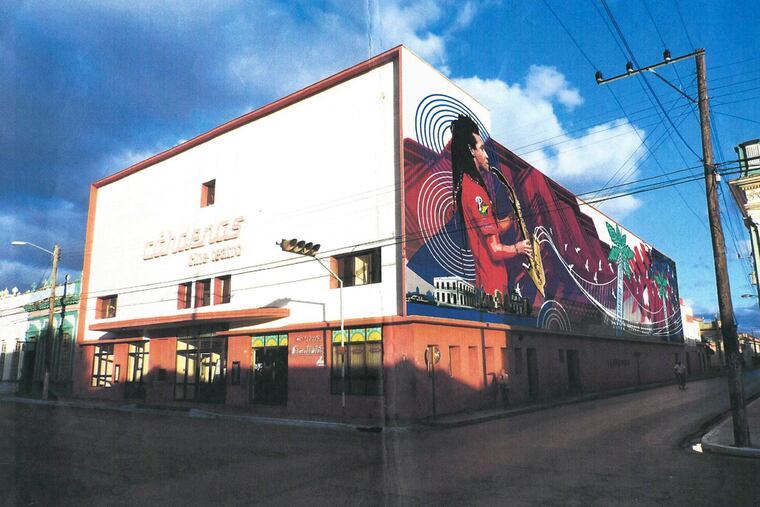
Art is bringing together on one enormous canvas what Cold War-era hatreds had kept apart for more than a half-century.
Within the artwork's borders, the Betsy Ross House is depicted in the same imagined neighborhood as the Hotel Dominica of Cárdenas, where Cuba's flag first flew in 1850.
The Phillies logo is emblazoned beside the emblem of the Crocodiles, a Cuban national team.
The towers of the Ben Franklin Bridge sprout palm trees, while a tocororo, Cuba's national bird, perches on a cable.
The disparate worlds of Philadelphia and Cuba will merge in one 6,000-square-foot mural being produced by the city's Mural Arts Program for the coastal town of Cárdenas - a joint public-arts venture that sets aside history's animosities and celebrates newfound commonalities.
Announced a year ago, the project now has seed money from a U.S. foundation, color renderings of the proposed artwork, and a timeline for applying it to an outside wall of a Cárdenas cinema, with completion in 2017. Mural Arts founder Jane Golden, just back from a week in Cuba, said discussions with collaborators there centered on repositioning elements within the design to more powerfully express the theme, "Culture is the bridge of brotherhood."
They spoke of "collaboration," she said, "and thinking beyond the individual for the greater good."
After the Cuban Revolution of 1959, and the severing of U.S.-Cuba ties two years later, the countries had no diplomatic relations until December 2014, when an initiative by President Obama led to the reopening of embassies in Washington and Havana.
With the easing of some travel restrictions, Mural Arts will be able to send 10 student-artists from Philadelphia to Cuba to instruct people there on painting and installing the mural, and bring a smaller contingent of Cubans here.
The project grew from discussions last year between Golden and Pamela Molina Martin of Ambler, a Cubaphile who has visited the island dozens of times on humanitarian-aid missions. They envision this as the start of an annual cultural exchange.
Mural Arts, established in 1984 as part of the Philadelphia Anti-Graffiti Network, has participated in projects in France, Ireland, Vietnam, and Israel.
"To think about world affairs, world concerns, is absolutely as important as anything we can teach our students," Golden said. "Opening up their worldview is critical."
The Cuban Association of Craft Artists of Cárdenas came up with the concept for the mural, an expansive rectangle comprising various icons of Cárdenas and Philadelphia.
The left side is dominated by a saxophonist, from whose instrument pour musical notes that transform into a stylized representation of the Ben Franklin Bridge. On his right shoulder are logo patches for the Phillies and the Metanzas Crocodiles, Cárdenas' home team.
Golden spoke to about 50 Cubans interested in the project, and the mention of Obama's name and the Phillies drew big applause.
"People were just totally energized," she said. "For these young artists, it's sort of a dream come true. . . . When they see these colors, they are going to flip, because the mural paint is so beautiful. They've never seen anything like it."
The bridge towers mimic One Liberty Place, another hallmark of Philadelphia's skyline. Atop them are impressionistic palm fronds. The arc of the bridge cables is traced by a stream of white doves. Atop one cable is the red, white, and blue tocororo.
The design, expected to be finalized in November, will be traced onto parachute cloth in Philadelphia. Half will be shipped to Cuba, where artists and members of the public will paint it. The process will be repeated here with the other half.
About a year from now, the finished sections of cloth are to be affixed to the theater wall and sealed with a protective coating. A big block party is envisioned.
Plans call for a portion of the cloth painted in Cuba to hang somewhere in Philadelphia, possibly at a school, as "a reminder of the warming relations between our countries and how culture led the way," Golden said.
The complexities of transporting people and shipping materials despite the ongoing economic embargo have yet to be worked out. A $23,000 grant from the Winifred Johnson Clive Foundation, a San Francisco-based philanthropy, jump-started a budget of $50,000 to $80,000, said Golden. How much the project will cost depends on whether installers will have to work from scaffolding or have access to a cherry picker.
Through a contact at American Airlines, Mural Arts is exploring the possibility of travel vouchers. Other potential sources of funding, said Golden, are the U.S. Embassy in Havana and the Christopher Reynolds Foundation, a Boston philanthropy with a history of supporting projects about Cuba.
Golden expects critics to say the U.S. should not engage in a venture with Cuba until the communist nation improves its record on human rights.
"You don't punish people for [their] governments," she said. "What I saw with those artists is extraordinary. Why not build this bridge if we can?"
215-854-2541 @MichaelMatza1