For elder gay Philadelphians, Orlando brings back old dread
Deirdre McLaurin was horrified by the mass shooting at the gay nightclub in Orlando - but, at the same time, not terribly surprised.
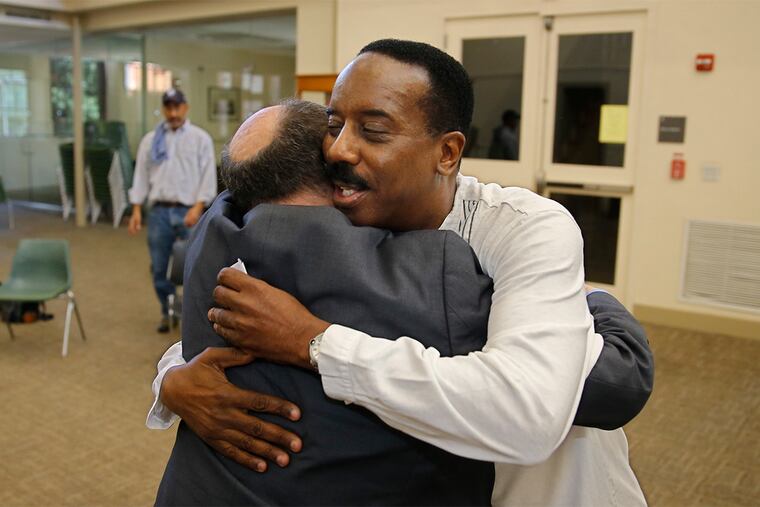
Deirdre McLaurin was horrified by the mass shooting at the gay nightclub in Orlando - but, at the same time, not terribly surprised.
At 64, she grew up when being open about her sexuality could endanger a friendship, a job, or her safety. Even as gay people gained civil rights, she saw the lingering threat and reality of anti-LGBT violence.
"Yes, we've made strides," she said Monday, but added, "The hate is still there."
McLaurin, a former dance teacher, lives at the John C. Anderson Apartments in Center City, the first housing development in the state specifically designed for low-income LGBT seniors. Her neighborhood is known as the Gayborhood, and rainbow stripes mark the street signs and crosswalks.
Yet the residents there may have been among the least surprised by the Orlando shootings, too aware of an era when it could be dangerous to be openly gay and too alert to ongoing dangers.
"There are still people who don't accept gay people," said Robert Curry, 65. "Young people should be aware of that."
The younger generations have become too comfortable, he said, too casual in expressing affection, not seeing that "there are people who will hurt you because of that."
In Orlando on Monday, the last of 49 bodies was removed from the club Pulse as police investigated a gunman who called 911 during the attack to claim allegiance to the Islamic State.
On Monday, the horror that occurred in that gay-friendly city resonated in this one.
Outside Arch Street United Methodist Church sat 49 empty chairs - one for each person murdered - and another for the man who authorities say fired the shots. A few blocks away at the Friends Center, the Rev. Robin Hynicka and other religious leaders gathered with the Council on American-Islamic Relations.
"All of us must commit ourselves to filling the emptiness of those chairs by advocating for strict gun control, by confronting homophobia whether it's in ourselves, in our families, or in our closest friends or in our places of worship," Hynicka said.
Few would argue. But that didn't ease the pain.
"We older people are the people who aren't surprised by this," said Philadelphia Gay News publisher Mark Segal, 65, who led development of the $19.5 million apartments. "This is not new."
The gunman's motivations are still being investigated, but his father told NBC News that the sight of two men kissing angered his son. The shooting took place during Pride Month, when Philadelphia and other cities across the country hold parades.
"It's a reminder," said Malcolm Lazin, 72, the director of Equality Forum in Philadelphia, "that there's a significant number of folks out there, fellow Americans, who still marginalize the LGBT community."
Decades ago, on July 4, 1965, Philadelphia was the site of one of the nation's first major gay rights protests, men and women stepping politely onto Independence Mall to demand equal treatment under the law.
At the time, merely being identified as gay could bring insults and punches. People could be fired from their jobs. Psychiatrists classified homosexuality as a mental illness, one that could be "cured" by electric shock therapy or even lobotomy.
McLaurin said that when she was growing up in Bella Vista, in South Philadelphia, being gay simply wasn't discussed. She was 38 before she came out - and worried about alienating her family.
That changed over time, as gays won rights victories and society became more accepting. Or at least it seemed like it.
She happened to turn on the TV at 4:30 a.m. Sunday and saw the news.
"It seems like we're being taken back, that you have to fight for everything all over again," McLaurin said.
Monday night, the mayor of the nation's fifth-largest city addressed nearly 2,000 people who had gathered outside City Hall to remember the victims. Mayor Kenney started by urging against responding to hate with more hate.
"The LGBT civil rights movement has always been about love, so now in this time of tragedy, we cannot react with hate nor malice towards other marginalized groups," Kenney said, apparently reading from prepared remarks.
Then he went off script.
"I just learned this afternoon that Akyra Murray was," he started, his voice cracking, "one of the people that we lost."
Murray, 18, a star basketball player at West Catholic Prep who was to attend college this fall, had been in Orlando on vacation with her family.
Kenney said through tears that he frequently watched the teen play when West Catholic competed against Neumann-Goretti, the mayor's alma mater team.
"She was a beautiful athlete," Kenney said through tears, calling the news of her death "devastating."
There were prayers, calls for stricter gun laws, and then a reading of the victims' names, with Murray's saved for last.
"Something needs to be done about the hate in this country," said Stevie Martin-Chester, 66, of Norristown, who was there with his husband, Arthur Martin-Chester, 71.
Staff writer Robert Moran contributed to this article, which also contains information from Inquirer wire services.