Gladys Gershenfeld, 91, arbitration pioneer
Gladys Gershenfeld, 91, who as the first female labor arbitrator in the Philadelphia area handled a wide range of labor disputes, including those involving SEPTA and the Philadelphia Police Department, died Thursday, Aug. 25, at the Quadrangle in Haverford after suffering from Alzheimer's.
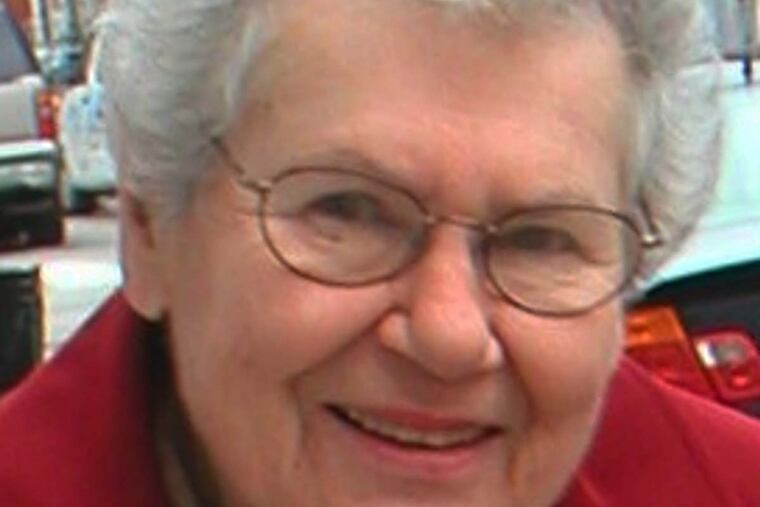
Gladys Gershenfeld, 91, who as the first female labor arbitrator in the Philadelphia area handled a wide range of labor disputes, including those involving SEPTA and the Philadelphia Police Department, died Thursday, Aug. 25, at the Quadrangle in Haverford after suffering from Alzheimer's.
Mrs. Gershenfeld was a pioneer in the field of labor arbitration. There were few women role models, if any, when she decided to pursue a master's degree in industrial relations and labor at Cornell University in 1951, said her son Joel Cutcher-Gershenfeld.
She had graduated with a degree in commerce from Boston University and was advised to go to Cornell because "at the time, labor issues, as they called them, were the biggest issues in society," said Cutcher-Gershenfeld, who also attended Cornell's IRL school, as did his son, Gabe.
She met her husband, Walter, also a labor arbitrator, in Washington when she worked in the Department of Labor for the shipbuilding industry and he was research director for the shipbuilders' union. Their wedding was announced in the Shipping News.
They moved to Philadelphia - first to Center City, then to Plymouth Meeting, then back to Center City when their three children were grown - 60 years ago. To become an arbitrator, Mrs. Gershenfeld apprenticed with five Philadelphia arbitrators (all men). When she began hearing cases herself in 1971, she was the first woman to do so in the area, her son said.
In 1980, she was elected as a member of the National Academy of Arbitrators and later served as a vice president.
The Philadelphia chapter of the Industrial Relations Research Association (now the Labor and Employment Relations Association) was founded at the Gershenfelds' kitchen table, her son recalled. Mrs. Gershenfeld would later serve as president of the Philadelphia chapter and as a board member of the national association.
One of Mrs. Gershenfeld's most high-profile cases came when she was appointed by the White House in 1996 to a Presidential Emergency Board to settle a dispute between SEPTA and the Brotherhood of Locomotive Engineers.
"She was a very good writer and she was particularly careful in the way she wrote her opinions," said Martha Cooper, a friend and fellow arbitrator. "That's not easy to do when you have a dispute and people feel strongly on both sides."
The Gershenfelds both taught college, Mrs. Gershenfeld at the Philadelphia College of Textiles and Sciences (now Philadelphia University) and her husband at Temple University. One time, Mrs. Gershenfeld had her class negotiate a mock collective-bargaining agreement with her husband's class. Ultimately, as in real life, they had to bring in a federal mediator to resolve matters. Walter Gershenfeld died in 2010.
Born in Newport, R.I., Mrs. Gershenfeld was the 1942 valedictorian of Rogers High School. She was still handling arbitration cases in her 80s, her son said.
Besides son Joel, Mrs. Gershenfeld is survived by two other sons, Neil and Alan, and six grandchildren.
Services will be Monday, Aug. 29, at the Kirk and Nice Chapel at George Washington Memorial Park, 80 Stenton Road, Plymouth Meeting. The family will greet guests at 9:30 a.m. and the memorial service will begin at 10, followed by a graveside service.
Donations can be made to the Research and Education Foundation of the National Academy of Arbitrators, the Gladys and Walter Gershenfeld Publications Fund of the Labor and Employment Relations Association, or the New York State School of Industrial and Labor Relations at Cornell University.
610-313-8232 @Kathy_Boccella