Episcopal Academy is prepped for a big change
Set on the highest point of the Merion campus, Christ Chapel is the beating heart of Episcopal Academy, its gabled roofs reaching toward the heavens, its windows the portals for piercing streams of sunlight.
Set on the highest point of the Merion campus, Christ Chapel is the beating heart of Episcopal Academy, its gabled roofs reaching toward the heavens, its windows the portals for piercing streams of sunlight.
It's where students gather for prayer; where budding musicians present their first, rattled-nerve performances; where speakers from organizations as diverse as NASA and the Eagles offer life lessons. It's a place to reflect on Christian ideals and learn about tenets of Judaism, Hinduism and Islam.
And today, parts of it are being boxed up. Like other pieces of the school, elements of the chapel await shipment to a new campus, a move that will take venerable Episcopal Academy 11 miles west - and into a new world.
Two dozen heirloom stained-glass windows already have been removed from the chapel. The huge, free-hanging cross will be moving, along with the altar. The pews will be left behind.
"We've been here for so long," junior Matt Lerman of Villanova said, "but they have to think about the future."
Ah, the future. Not an easy subject for a private day school with a long, illustrious past. Episcopal is nearly as old as the nation. Its founders include two signers of the Declaration of Independence.
Its graduates shine on the world stage: architect Robert Venturi, Watergate prosecutor Henry Ruth, movie-maker M. Night Shyamalan. And they dominate Philadelphia business, philanthropy and sports: late civic leader F. Eugene "Fitz" Dixon Jr., former Rohm & Haas chairman John Haas, Drexel University basketball coach James "Bruiser" Flint.
The Annenbergs sent their son there. Episcopal schooled the children of Mike Schmidt and Julius Erving.
It's a place that demands excellence - and can afford to. Tuition is $17,600 a year for preschool, rising to $24,000 annually for high school. Every student who graduates from Episcopal goes to college, often to the finest schools in the country.
For more than 30 years, Episcopal has lived a split existence, operating on one campus in Merion and another in Devon. Now it's poised to turn two into one, to trade city for farm. In September, in Newtown Square, Episcopal will take over a campus designed and built to meet the needs of the people who will use it.
Episcopal leaders say the move is not just beneficial but also necessary, to provide sorely needed space for classrooms and athletic fields, to ensure the school's ability to expand, to move it closer to the regional growth area.
But others see the move as a desertion of Episcopal's age-old city roots, and wonder how the school can maintain close ties to Philadelphia from a campus in northern Delaware County.
"I'm opposed to this move," said the Rev. James Trimble, a former chaplain at Episcopal. "They are taking a school that abuts Philadelphia and moving it to the boondocks. . . . I hope it does not become just a rich child's private school."
The move is miles in distance, epic in complication and implication, huge in cost at $213 million, a once-in-a-generation event that for Episcopal offers unprecedented opportunity and a certain amount of risk.
For all the money and planning, despite the hopes and doubts, the question remains: If you pick up a Philadelphia institution from over here and put it down over there, will it still be the same institution?
Outgrowing its campuses
Episcopal was built for a much smaller, all-male population.
"The kids," said head of school L. Hamilton Clark Jr., walking across the Merion campus, "are somewhat on top of each other."
Space - the lack of it - drives the gargantuan undertaking of the move. On the Merion campus, which houses the upper and middle schools and part of the lower school, many buildings have been retrofitted. What's now the theater was once the gym. The locker room has become the dining hall. Offices have been turned into classrooms, and the faculty lounge disappeared, devoured bit by bit for other purposes.
That's hardly to say the place is shabby. It's not. And surely, parents whose kids attend some of the public schools in Philadelphia don't worry about whether their children have adequate locker rooms. They worry about their children being killed by gunfire.
But Episcopal operates in a highly competitive private-school environment, one where parents demand that their kids be educated not only by top teachers but in world-class facilities.
The region is rife with elite schools: St. Joseph's Prep, Germantown Friends, Baldwin, George School and Penn Charter, which is older than even Episcopal and at least as storied, established in 1689 by William Penn himself. Not to mention archrival Haverford School, which battles Episcopal in one of the oldest football rivalries in the country.
By the 1990s it was plain that Episcopal's physical plant was stretched and stressed. The move to coeducation in the 1970s had increased the need for amenities like bathrooms and ball fields while creating demand for classes in the arts.
The squash courts, built in the 1930s, were "an embarrassment," said former board member J.B. Doherty, of the Radnor firm MidCoast Capital L.L.C. That might not sound like much of a hardship, but squash is important at Episcopal. Last season the girls' team won the national private-school championship.
Administrators wanted to tear down the courts and build new ones, which would have slightly increased the size of the building. But it became clear that Lower Merion Township officials would not grant permission without a lengthy zoning and permitting process. And that future projects would face similar scrutiny.
It caused some people at Episcopal to think about finding a new home.
"I can't say every trustee was thrilled with the notion of moving the school," said Drinker Biddle partner Rush Haines, coleader of the master-planning committee and a former chairman of the board of trustees. "Fitz Dixon was not crazy about it."
The discussion crystallized at a meeting in May 2001, after the development of a seemingly contradictory strategic plan. It called for a commitment to Merion as "the anchor for the school" - but also for the active pursuit of property in a western suburb, to preserve "future options."
Brian Tierney, then a junior board member - and today chief executive of Philadelphia Media Holdings L.L.C., which owns The Inquirer - spoke forcefully about Episcopal's mission, saying it had to move, that what mattered was not nostalgic attachment to buildings but "the concept of what this school is." To older, more-experienced board members he quoted the school motto, Esse Quam Videri: To be, rather than to seem.
"The facts and data clearly pointed the way, but somebody had to provide the emotion, the passion," recalled former board member Christine Henisee, chief executive officer of Michigan-based Ranir L.L.C.
Not everyone was enthralled. When Tierney finished talking, James "Jay" Crawford, the head of school at the time and a man intimately associated with Episcopal as a student, teacher, coach and administrator, spoke up: He disagreed completely. The school belonged in Merion.
No decision was reached. But that summer a large parcel became available in Newtown Square. Tierney, developer Brian O'Neill, and other board members leading the charge for a new campus put up their own money to hold the land while Episcopal raised money to buy it. Crawford, among others, would change his mind and work hard for the move.
In fall 2001, Episcopal paid $20 million for 123 acres at Whitehorse Road and Route 252. The only neighbors were trees.
A history of moves
This won't be the first time Episcopal has changed locations. It will be more like the sixth. What's different is that hardly anyone alive can remember the last move.
The Academy of the Protestant Episcopal Church was founded on Jan. 1, 1785, by the vestry of Christ Church at Second and Market Streets in Philadelphia, its goal to educate children and train ministers.
The founders were led by the Rev. William White, rector of Christ Church, formerly chaplain of the Continental Congress and soon to become the first Episcopal bishop of Pennsylvania. He was assisted by Thomas Willing, first president of the Bank of the United States, and Edward Shippen, who became the state's chief justice. Others included Robert Morris, financier of the American Revolution, and scholar Francis Hopkinson, both of whom placed their signatures on the Declaration of Independence.
Two years later, the trustees opened a new school near Independence Hall. The curriculum included Greek and Latin, the faculty an outspoken Federalist named Noah Webster, who later would publish his first dictionary.
In 1790 the school moved to Third and Pear, in 1816 to Locust Street, in 1847 to Ninth and Market, in 1850 to a building unique for its central-heating system at Juniper and Locust. As Center City grew, so did the value of land, a sales incentive for a school that often ran deficits. In 1921, Episcopal left for Merion, angering supporters who saw the school abandoning the city.
Episcopal bought what was probably the largest mansion in Merion, a house so big it had its own name - Yorklynne. It had been built at the turn of the century for John Odgers Gilmore, an executive known as "the snuff king" because he worked at W.E. Garrett & Sons, the largest snuff-maker in the world. For half a century, classes were held in former mansions.
In 1973, Yorklynne was demolished after construction of a new, consolidated building. The Devon campus opened the next year, on land given by Haas, and it brought something new to Episcopal: girls, six of them. Today the 1,199-student body is half female and watching the new school rise.
"I'm really excited about it," said senior Lauren Pettit of Berwyn. "We're kind of growing out of this campus."
Pros and cons of moving
For Episcopal, the advantages of a new campus are concrete: State-of-the-art buildings will include a science center and 600-seat theater. There will be a new athletic complex and nine playing fields, two of them artificial turf. Space? The school will grow from 71 acres on two campuses to 123 acres on one.
The disadvantages are perceived, harder to quantify, more attached to tradition. By moving, Episcopal will surrender things inextricably tied to place, said David Zaiser, a partner in KSS Architects, which designs school buildings.
"Sometimes, for an institution to flourish, you have to be willing to give up some of that," he said.
Other ramifications can't be known, said Wake Forest University professor Edwin Hendricks, an authority on the North Carolina school's 1956 move to Winston-Salem. Many alumni were so upset they stopped making donations for a while: 50 years.
"It's only been the last few years we no longer run up against that," he said.
Some Episcopal alumni say they know people so upset about the move that they plan to reduce their giving or stop donating. So far there's no public evidence of that. In 2001, when it needed fast money to buy the land, Episcopal set out to raise $20 million in 20 days - and came darned close. Since then, the "Ever Episcopal" campaign has collected an additional $45 million.
Some things won't change no matter the site. Chapel is central to Episcopal, with upper- and middle-school students required to attend every other day. The purpose is to teach morals, to have students consider their roles in the community and in the plans of a supreme being. At the same time, no one is forced to sing hymns or recite the Lord's prayer.
"We're certainly not trying to convert kids to any particular belief," spokesman Michael Letts said.
The school worries about diversity - 84 percent of the students are white - and moving deeper into white, wealthy suburbs won't help. Episcopal has no affirmative-action program but provides financial aid based on need.
The new campus has a radically different feel. The Merion school sits across bustling City Avenue from St. Joseph's University. The land in Newtown Square looks like the farm it once was. Two silos still stand.
"It's not so far away," scoffed Crawford Hill, head of the science department. "People think it's Siberia."
Besides, he said, faculty, staff and students make a school great. Top facilities enhance a school, certainly, but don't define it.
"I hope that connection with the city doesn't fade," said senior Emma Imbriglia of Swarthmore, "but we won't be sure until we get out there."
When people at Episcopal talk about "connection with the city," they mean the community-service program, actually 30-some programs in which students and faculty help Philadelphians who are young, old or needy: tutoring kids, preparing meals for seniors, feeding the homeless, offering companionship to the sick.
More than 80 percent of seniors volunteer, and many see the program as key. School leaders acknowledge the risk of adding more travel time to kids already juggling heavy homework and athletic requirements.
"If we lose the connection to the city," said Haines, of the master-planning committee, "I will consider it a failure."
Trash and treasures
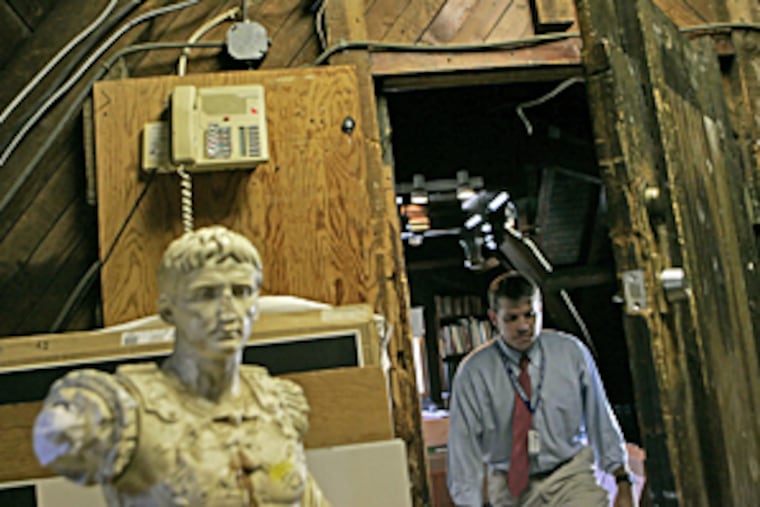
Len Haley, Episcopal's director of plant and operations, is among those in charge of what might be called The Sorting.
It's his task to wade through tons of material accumulated over two centuries, then figure out what must be kept, what can be donated or sold, and what should go in the garbage.
"In my mind, I started this about five years ago," he said.
In reality, he started last summer.
The job is not merely sorting trash from treasure. It's deciding what objects hold emotional resonance - and how to place them on the new campus to evoke a sense of continuity.
The easy choices: Broken chairs and lamps get tossed. The desk and bench of William Henry Klapp, head of school at the turn of the century, go west. Only 10 percent of the furniture will move. Outdated books, worthless to Episcopal, could be donated to other schools.
The carved oak doors from the head of school's office - the same ones that guarded the head at Juniper and Locust - are coming. So, too, the stone pillars that mark the North Latchs Lane entrance. And an 1800s-era plaque bearing the names of alumni who served, and died, in the Civil War. A portrait of Bishop White. Paper money from 1785. The weather vane from atop of the shop-art building.
Officials considered digging up and moving certain trees, but decided to take saplings instead.
"A week before school starts, everything's supposed to be set," Haley said. He paused, then added, "That's the plan."
The new campus
At the Newtown Square property, there is no great stone gate or blue-and-white crest. Just a small sign saying, "Future Home of Episcopal Academy," and beyond that, a construction trailer and a parking lot.
One recent night it poured rain, and the next morning brown streams rippled across the future campus green. On its muddy edges rose the skeletons of new buildings.
"We all believe we can be one of the best schools in the country," board chairwoman Gretchen Burke said.
The Merion property has been sold to neighboring St. Joe's for a reported $90 million. The Devon property is for sale. The new campus will look more like a college than a high school, the layout resembling the University of Virginia, with buildings on both sides of a central lawn.
At the head of the Virginia campus stands the Rotunda. In Newtown Square a new chapel will fill that role. It will be the first building students see when they step onto the campus.