Slavery apology lauded as 'moral statement'
Asked Friday whether New Jersey should apologize for slavery, the Rev. Willie R. James Sr. of Edgewater Park related an anecdote.
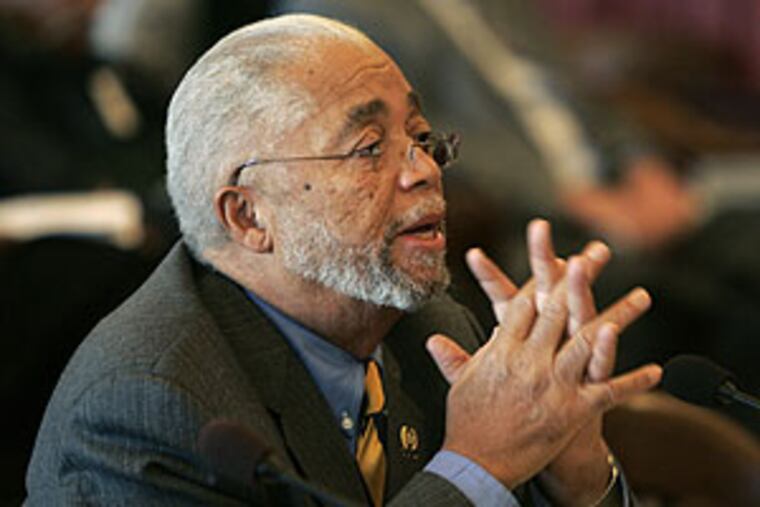
Asked Friday whether New Jersey should apologize for slavery, the Rev. Willie R. James Sr. of Edgewater Park related an anecdote.
James said that at a gathering of a predominantly white organization three or four years ago, an elderly man told him: "I know you. You're the fellow that filed a complaint against Levitt and made him open Willingboro to blacks, but there are too many of them over there now."
That's reason enough for an apology, said James, who won a discrimination suit against the developer Levitt & Sons Inc. after the company refused to sell him a house in 1958. "By the Legislature apologizing, it could send other messages to people who are still prejudiced."
An Assembly committee passed a resolution Thursday expressing regret and apology for New Jersey's role in slavery and its aftereffects. Both legislative chambers must approve the measure by Tuesday, the end of the legislative session, or it will die.
On Friday, James, president of the Willingboro NAACP, and others rebutted opponents of the measure who said it was unnecessary.
"You're still not seeing African Americans with equal rights," said James, 87, a Louisiana native who lost an uncle and a cousin to lynching.
"We know what 'sorry' means," said Mangaliso Davis of the Camden African American Advisory Committee. "It's very important for people."
Gilbert "Whip" Wilson, a Camden councilman, said an apology would not magically improve the lot of black Americans. "You're still going to have poverty. . . . It's not going to change the unemployment."
Still, he said, it's a "moral statement" that's "going to attack the conscience. . . . I think all states that had slaves should do it."
New Jersey's slave population reached as high as 12,000, one of the largest in the northern colonies, the legislative resolution states.
"We have identified Petty's Island as being a slave post," Davis said of the nearly 400-acre spit in the Delaware River that is part of Pennsauken. Slave traders unloaded their cargo there to avoid tariffs in Philadelphia.
Davis has joined with environmentalists to lobby for Petty Island's preservation. He hopes to see an education center there where children would learn about the institution of slavery, as well as the island's natural treasures.
"Education is the key," Davis said. "We need to begin to educate ourselves on history, to these conditions, and to start the healing."
Frank Fulbrook, a white civic activist in Camden, agreed that the resolution could have educational value, and drew on state history to argue its relevancy.
"In 1864, New Jersey voted for the disgraced and fired Civil War Gen. George McClellan for president - against Lincoln. He ran as a Democrat, and the Democrats favored making peace with the South, and the South would remain an independent nation," said Fulbrook.
"If people are more aware of New Jersey history . . . this resolution can have some educational value," he said.
"It's a good thing to let the country know that whoever lived during those times let [slavery] happen," said James.
"My grandparents lived on a plantation. They were sharecroppers, and their parents were slaves," he said. "My grandmother used to tell me about them."
If Davis gets his way, the stories won't fade with James' generation.
"This is America's story, and we've got to face up to that," he said. "The tragedy, it has made America what it is."