Alton "Ace Capone" Coles mistreated women.
He "hung out" with drug dealers.
And he never paid taxes.
But none of that, Coles' defense lawyer told a federal jury Wednesday, makes Coles the drug kingpin that the government contends he is.
In a wide-ranging closing argument at Coles' drug-trafficking trial, Christopher Warren, the defendant's court-appointed lawyer, painted a picture of his client that was decidedly different from the one presented earlier in the day by a federal prosecutor.
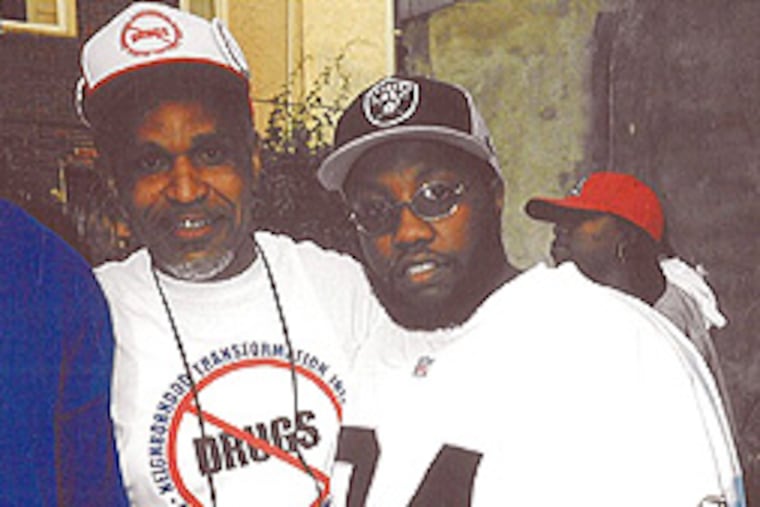
Warren underscored his point by introducing photos of Coles and codefendant Timothy "Tim Gotti" Baukman with then-Mayor John F. Street, then-Police Commissioner Sylvester M. Johnson, and District Attorney Lynne M. Abraham.
The photos, Warren said, were taken at community antidrug, stop-the-violence rallies sponsored by Take Down Records, the Southwest Philadelphia record company Coles and Baukman founded in 2002.
Federal authorities, however, say the company was actually a front for a $25 million cocaine- and crack-distribution network.
"Do you honestly believe that the district attorney, the police commissioner, and the mayor would be oblivious to the fact that this was some front?" Warren asked the jury. "These are the chief law enforcement officers of the city of Philadelphia."
(Contacted by The Inquirer in November about the photos, representatives for Street, Johnson and Abraham said that the officials often had their pictures taken at community rallies and that they had no personal knowledge of who Coles or Baukman were.)
Coles and Baukman, Assistant U.S. Attorney Richard Lloret told the jury, "sold cocaine for years and years and years."
"The evidence in this case is overwhelming," said Lloret in a pointed three-hour closing in which he presented an overview of the case and methodically dissected the testimony Coles gave during two days on the witness stand last week.
Take Down Records was "a device for money-laundering," Lloret said, adding that the only logical explanation for the hundreds of thousands of dollars investigators tracked through bank accounts controlled by Coles and Baukman was drug dealing.
In an analysis sprinkled with low-key sarcasm and occasional incredulity, Lloret repeatedly offered the same explanation for the cash flow and luxurious lifestyle - expensive automobiles, Las Vegas vacations, and, in Coles' case, a fancy, $488,000 South Jersey home - that the two defendants enjoyed.
"They sold cocaine," Lloret said.
Lloret pointed out that Coles, "a guy who flunked out of barber school," claimed he had earned $200,000 from a barbershop he owned in Chester for about a year.
He held up a machine gun found in Baukman's apartment during an August 2005 raid and said: "Every executive of a record company should have a machine gun for . . . oh, I don't know.
"But it would be very useful to a cocaine dealer who's got to defend his turf."
Lloret cited the trial testimony of an IRS agent who analyzed the financial data of Take Down Records and concluded that over a two-year period the record label lost about $157,000.
The company, Lloret argued, was created not to make money, but to hide money.
"It's about hiding . . . the cocaine profits," Lloret said.
The government's case, built around a two-year investigation by the Bureau of Alcohol, Tobacco, Firearms and Explosives, has included more than 300 wiretapped conversations in which Coles and several associates allegedly set up and carried out drug deals.
The jury also heard testimony from two admitted drug dealers who said they routinely purchased cocaine from the Coles organization.
Both of those witnesses testified after pleading guilty to drug-dealing charges in a plea agreement that required their cooperation.
A former Coles girlfriend also testified for the prosecution and said she witnessed drug deals and cash exchanges that were part of Coles' drug operation.
Warren said the girlfriend, Kristina Latney, was "bitter" because Coles had cheated on her with another woman. At least five women, including two codefendants, have been described as girlfriends of Coles'.
Latney is the mother of two of Coles' five children.
Warren also challenged the motivation of the admitted drug dealers, claiming they adopted the government's version of the case in order to curry favor and get out from under serious criminal charges they were facing.
One witness, Desmond Faison, testified that he purchased several kilograms of cocaine a month from the Coles drug organization.
Warren said that Faison, who could be sentenced to 50 years to life in prison, decided to cooperate because he faced the prospect of spending the rest of his life in jail.
Without his cooperating agreement, Warren said, "he leaves federal prison with a toe tag, a corpse in a body bag."
Closing arguments from defense attorneys for Baukman and the four other defendants in the case and the government's rebuttal are scheduled when the trial resumes Thursday.
Jury deliberations could begin Friday.