Library’s cafe underwhelms
When the Free Library of Philadelphia announced five years ago that it would expand its imposing palazzo on the Parkway, it painted a tantalizing picture of a modern addition equipped with a sunlight-drenched reading room, hives of computer terminals, a cozy hangout for teens, free wireless access, and a Starbucks-style cafe.
When the Free Library of Philadelphia announced five years ago that it would expand its imposing palazzo on the Parkway, it painted a tantalizing picture of a modern addition equipped with a sunlight-drenched reading room, hives of computer terminals, a cozy hangout for teens, free wireless access, and a Starbucks-style cafe.
Well, the library can cross the cafe off its to-do list.
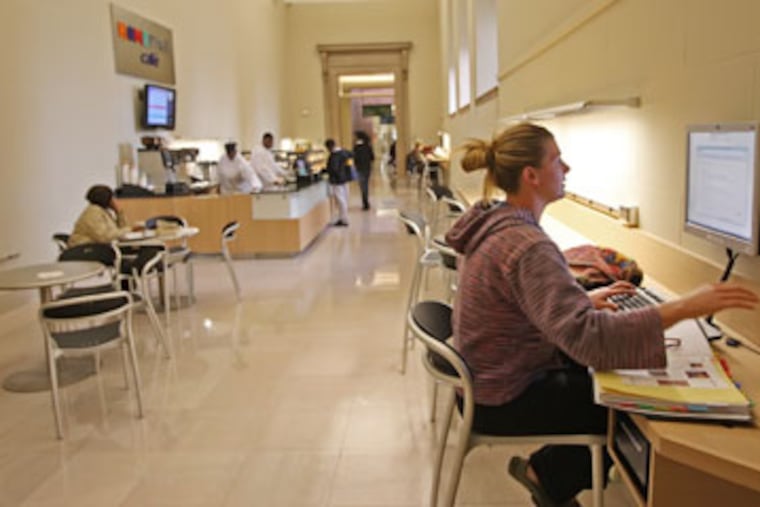
The H.O.M.E. Page Cafe debuted this week, complete with actual Starbucks coffee, Metropolitan Bakery pastries, and the promised wireless access. The shoebox of a cafe is located not in the long-planned, Moshe Safdie-designed addition, but in a corridor off the stately lobby of its Beaux Arts flagship, designed almost 90 years ago by Horace Trumbauer and Julian Abele.
As corridors go, it's palatial, with an intricate plaster ceiling, enormous deep-set windows and shimmering marble floors. But H.O.M.E. Page is essentially a tease. Philadelphia will have to wait three to four more years for its state-of-the-art intellectual rec center to open.
The library says it will break ground in December on Safdie's bowed addition, and this time the promise sounds reliable. H.O.M.E. Page is meant to serve as a taste of what's to come. So it's distressing that the cafe is such a weak brew.
Certainly, having a cafe will be a nice pick-me-up for the library. Museums and bookstore chains discovered an eon ago that such nooks can instantly transform the serious into the social. By making civic spaces feel welcoming, they help bond users to the institution. The library, which shuttered its old-style fourth-floor cafeteria in the 1990s, can now offer patrons a niche that feels a little like home.
Too bad, then, that the decor of H.O.M.E. Page, which was financed with a $200,000 donation from Bank of America and designed with help from Moshe Safdie & Associates, is almost clinical in its spareness. Painted a self-effacing shade of beige, it is seriously underfurnished, and its walls are bare, save for an electronic menu board and the cafe's sign. Hospital waiting rooms have more pizzazz these days.
Perhaps Philadelphians have become inured to such bare-bones spaces in their libraries, which have been underfunded by the city for years. Much of what's wrong with H.O.M.E. Page, which is run in partnership with the advocacy group Project H.O.M.E., can be remedied in an afternoon's shopping trip. But even if the library softens the brittle design with some comfy chairs and flower vases, the concern is that the cafe's excessive modesty will permeate the Safdie addition.
During the information revolution of the last two decades, many big American cities built new central libraries or substantially renovated the old ones, with an eye to creating spaces that felt like public living rooms. The Free Library will be among the last to get an upgrade, in part because of the difficulty raising private funds to expand its gorgeous, but outmoded, Logan Square facility.
The library had the bad luck to plan its expansion just as steel and concrete prices were going through the stratosphere. Originally proposed in 2003 at $100 million, the project is now pegged at $175 million for the 180,000-square-foot addition and a once-over-lightly renovation of the existing structure.
Though the delays have been frustrating, the wait gave the library time to clarify some of its thinking. The project is more than a simple expansion: It's meant to be a reinvention of the traditional library. Initially, the directors envisioned a civic version of a bookstore chain. The primary goal was to bridge the city's digital divide by making computers available to poor Philadelphians.
Over time, however, the library's thinking has grown more nuanced. Rather than simply copy the commercial bookstores and provide computers, the library now sees itself as an "information commons," said Linda E. Johnson, the official coordinating the expansion. More than just being a warehouse for information, she believes, the library of the future will be a place where "content is created."
So the Safdie addition will include rooms where musicians can make digital recordings, filmmakers can edit videos, job hunters can prepare resumes, and book groups can videotape a discussion of the latest best seller - assisted by tech-savvy librarians. There will still be stacks for books, periodicals and DVDs, but Johnson expects those items will take up less space as more material is digitalized and made available on the library's Web site (www.library.phila.gov), which already receives 12 million hits a month.
That brings us back to the look and feel of the addition. Because the same information will be available everywhere, the library will need the marketing skills of a P.T. Barnum to bring people - especially teens - into its building. Its architecture will have to borrow from the language of entertainment and commerce. The library can't merely promise exciting services, it has to look exciting, which H.O.M.E. Page Cafe decidedly does not. Whatever the functional drawbacks of Rem Koolhaas' Seattle Library, you know you've arrived at the hot place in town when you step inside and glimpse its canary-yellow escalators and wildly patterned carpets.
There is much about Safdie's design that is spatially dazzling. His addition is comprised of a sequence of elliptical walls that respectfully embrace the Trumbauer-Abele building. The curves divide the new space into two light-filled atriums that will be impressive volumes.
But then, the Kimmel Center also has a large impressive volume, and it's now struggling to give people reasons to use its public space. The Kimmel's vast internal square suffers from being spatially undefined, architecturally subdued and underfurnished. Sound familiar?
Philadelphia is a city where a deep-rooted impulse for propriety is at odds with modern demands for visual stimulation. We are just not Fun City.
Safdie appears to have made some important architectural revisions in the last five years. The high walls along the Callowhill Street Readers Garden have been removed, so pedestrians will be able to see into, and flow into, the library. An outdoor amphitheater may be incorporated into the garden, as well as a screen for outdoor movies. That sounds like fun.
Now, if only the library could lose some of the beige.
.