SEPTA transit officers on strike
SEPTA transit officers walked off the job this afternoon after contract talks between their union and the transit agency broke down.
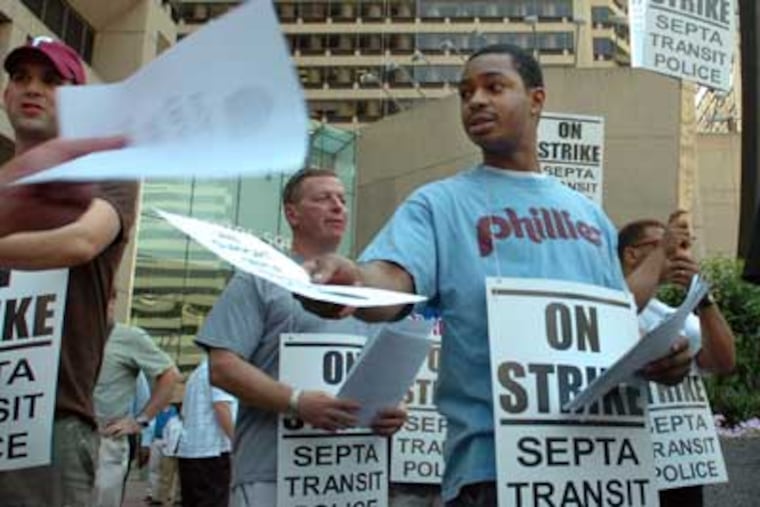
SEPTA transit officers walked off the job this afternoon after contract talks between their union and the transit agency broke down.
SEPTA will now rely on private security guards and Philadelphia police officers to protect riders, agency officials said.
Officers were turning in their equipment around 4 p.m. and heading from seven different areas of the city, via public transportation, to the concourse at 15th and Market Streets.
They plan to rally there before marching to SEPTA's headquarters at 12th and Market Streets.
SEPTA officials earlier this afternoon analyzed a transit police union proposal for a contract that would end the threat of a strike, a union spokesman said.
Anthony Ingargiola, a spokesman for the 220-member Fraternal Order of Police, had said earlier today that transit officers could walk off the job "at any time" if the bargaining hit a dead end.
City police spokesman Lt. Frank Vanore said said city officers would move in immediately if the transit officers left their posts.
"There won't be a gap" in police protection, Vanore said.
The two sides were to meet at 9 a.m., but the transit agency said it needed time to crunch the numbers on the union's latest proposal, according to Ingargiola.
The union had set a deadline of 2 p.m. yesterday to strike if a contract agreement wasn't reached. However, both sides agreed to continue negotiations and talks eventually broke off about 10 p.m. last night.
The transit officers who patrol the Broad Street and Market-Frankford Lines want the same pay as officers in the Philadelphia Police Department, who start at about $39,000 a year.
The starting salary for a SEPTA police officer is $30,752 a year, with a maximum salary after four years of $49,804, including longevity payments.
SEPTA has offered its police a 3 percent annual wage increase over four years, a boost in longevity pay, and a requirement that police contribute 1 percent of their salary to help pay for health care.
The officers' last contract expired Sept. 30, 2005, and was extended for one year. The union membership has rejected three tentative agreements.
Unlike Philadelphia police officers, transit police are not prohibited by law from striking, but they cannot compel binding arbitration to settle wage disputes.
Violent crime on the transit system, after years of decline, is up 81 percent since 2004. On March 26, Sean Patrick Conroy, a 36-year-old Starbucks store manager, collapsed and died after truant high schoolers beat him at the 13th Street Station on the Market-Frankford Line.