Local Kalmyks look forward to Dalai Lama’s visit
The Dalai Lama might not notice 15-year-old Alex Kalatschinow in the sold-out crowd Wednesday at the Kimmel Center.
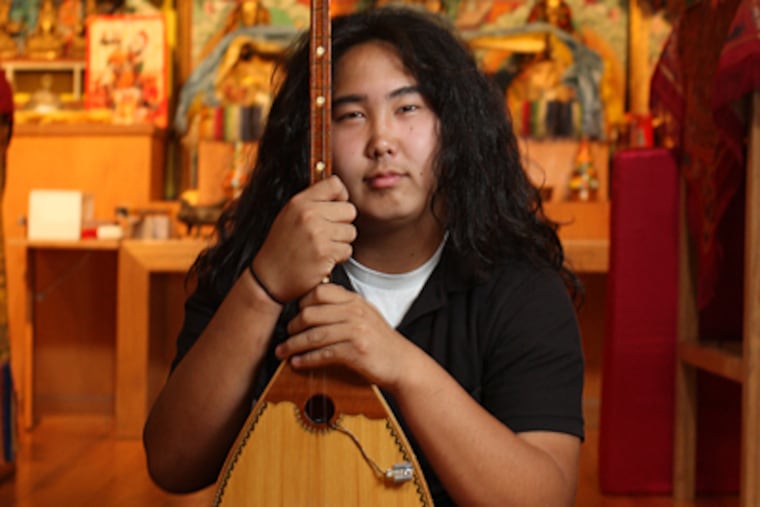
The Dalai Lama might not notice 15-year-old Alex Kalatschinow in the sold-out crowd Wednesday at the Kimmel Center.
But Kalatschinow - with his shoulder-length hair, torn jeans, a Mr. Softee ring tone on his cell and Coors Lite emblems on his boxers - is just the kind of person His Holiness hopes to reach on his daylong visit here: young Buddhists awash in American pop culture.
His appearance will be only the second in Philadelphia for the Dalai Lama, exiled leader of Tibetan Buddhism and one of the world's most revered spiritual figures. He last came here, quietly, 18 years ago.
Kalatschinow, whose Buddhist grandparents came to America from Kalmykia in Russia in the 1950s, called His Holiness' apearance here "pretty damned awesome," but acknowledged he didn't know how it might affect him.
"You can't really comprehend" Tibetan Buddhism "until you get older," he said in an interview last week. His parents keep some Buddhist statues in their Northeast home, he said, and he helps out sometimes at the Kalmyk Buddhist Center.
And while meditation may be an important path to the Buddhist goal of enlightenment, "I know of it but don't do it," Kalatschinow acknowledged. Like many of his friends, he said, he'd rather play computer games than go to religious services.
The boy's experience is not unusual.
"Our culture, our religion, is fading away," said Telo Tulku Rinpoche, a Tibetan Buddhist lama born in Philadelphia; he hand-delivered a letter to His Holiness 2 1/2 years ago, asking him to come.
"I said we needed a figure who could guide us," Telo said last week. "It was an immediate yes."
His Holiness' one-day sojourn will consist mostly of private meetings with the area's small Mongolian and Tibetan American communities, but will include a lecture at the Kimmel Center, titled "Buddhism in the 21st Century."
"We wanted to share his wisdom with the rest of the community," said Telo, 35, who is spiritual head of the worldwide ethnic subgroup of Mongols known as Kalmyks, nearly all of whom are Tibetan Buddhist and live in, or hail from, the Russian republic of Kalmykia.
Founded by refugees from World War II, the local Kalmyk community numbers about 2,000 across three generations.
With the founding generation dying off, however, and the younger generation tuned more into hip-hop and cable and wacky ring tones, elders hope the vivid and enduring memory of the Dalai Lama's visit will sustain members of the younger generation in their religious and ethnic heritage as they grow older.
"It's in the hands of the younger people to fulfill the vision of our grandparents and parents," said Sean Tchourumoff, one of the event's organizers.
For 15-year-old Alex Kalatschinow, an ember of Kalmyk culture still glows within. At age 11 he and his family visited Kalmykia, near the Caspian Sea, and he came home with a dombra, the traditional two-stringed instrument of the Kalmyks.
Kalatschinow took lessons from a relative and "got pretty good," and for several years played at Buddhist and ethnic festivals. His instrument of choice now is an electric guitar. He plays in a rock band but wants to get back to the dombra someday, and he supposes he will grow into Buddhism.
"We all have a belief system," he said, "so why not?"
Telo knows what it means to be young, straddling two cultures.
He was born in 1973 as Erdne Ombadykow, the youngest of nine children in a blue-collar Kalmyk family in Olney. At age 5 he told his parents he wanted to be a Buddhist monk, and left home at 7 to join the Dalai Lama's monastery in Dharamsala, India, the first non-Tibetan to do so.
There the Dalai Lama declared him the reincarnation of a great Buddhist teacher, or rinpoche (pronounced rin-po-shay), and at 18 named him spiritual leader of flat, barren, impoverished Kalmykia, population 170,000, the only state in Europe where the dominant religion is Buddhism.
But Telo spoke no Russian and soon discovered he had none of the administrative or mathematical or pastoral skills he needed to be a leader.
Lonely and depressed, he spent hours at a time with the rock band Smashing Pumpkins blaring on his headphones and smuggled in copies of Newsweek to bone up on his dimly remembered English. He didn't feel at all like a semi-divine "emanation from a precious jewel," which is what his Tibetan name and title means.
In 1994 he returned to his mother's house in Feltonville and decided he didn't want to go back to Kalmykia. He let the hair on his shaved head grow back and fled to Boulder, Colo., and then to California, where he reconnected with a Tibetan woman he had met years earlier in India.
After three weeks, he asked her to marry him. She did, immediately.
It took Telo a long time to face the Dalai Lama, but he was understanding. "You don't have to be a monk to be a lama," or teacher, he explained, and urged him to continue serving the Kalmyk community.
Telo now divides his time between Kalmykia and his home in Boulder, where he and his wife are raising a 10-year-old son.
"As a Buddhist, I believe in cause and effect, which is karma," he explained during a visit to the Feltonville temple last week. "So you accept cause as past, and effect as future, but the most important thing now is future.
"I look toward that and try to make a positive effect. You mature. You learn from your mistakes. You grow up."