Phishing scam has twist: IRS form to fax
Online con artists are always coming up with something new.
Online con artists are always coming up with something new.
Now they're phishing for private information via fax - while pretending to be the IRS.
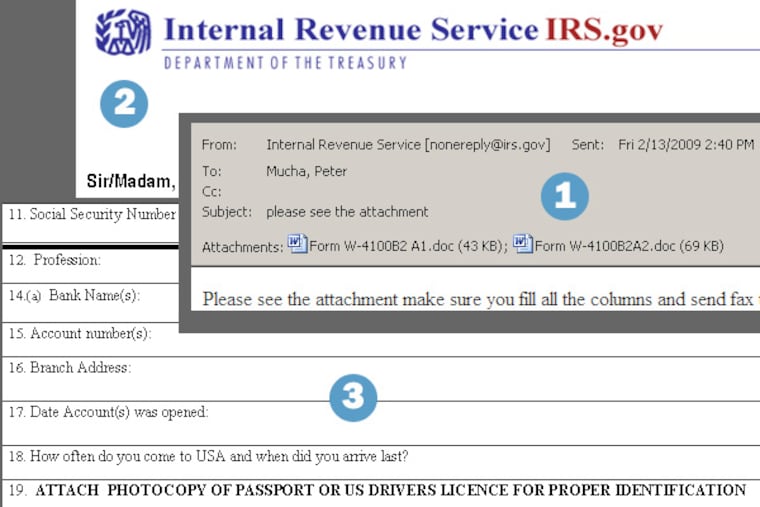
The phony email arrives, pretending to be from "Internal Revenue Service," with a subject line such as "please see the attachment."
The email I got last week had two attachments.
One looks like a letter on official IRS stationery, claiming, "Our records indicate that you are a non-resident alien."
The other is a copy of an actual IRS form.
The recipient is instructed to "make sure you fill all the columns" - including Social Security number and bank account information - "and send fax to" a phone number.
Oh, and "Attach photocopy of passport or US drivers licence for proper identification."
Behind this scam are identity thieves, not the IRS.
"To be honest with you, that's pretty clever," said IRS spokesman David Stewart. "They're using our very own forms on the attachments. ... We've always said don't reply but we never said don't fax anybody."
The IRS got wind of this phishing expedition about six weeks ago, he said, and has worked to shut it down.
But, as is often the case, the perpetrators keep changing where they email from, he said.
The IRS never emails requests for private information, he said.
"We're not going to ask for Social Security numbers, bank accounts, PINs and passwords. That's just not going to happen."
Anyone suspicious of an email supposedly from the IRS can alert the agency by forwarding it to phishing@irs.gov.
Read more from the IRS on identity theft and phishing schemes.