"I apologize, Mrs. Cassidy."
With the widow of Philadelphia Police Officer Chuck Cassidy on the witness stand, his admitted killer today stunned the crowded courtroom with a teary, impromptu apology that stopped the trial for five minutes until order was restored.
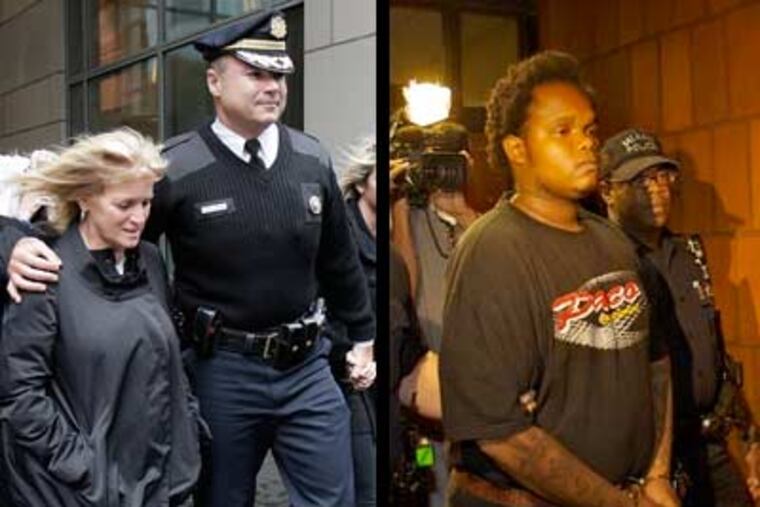
Judy Cassidy and her family immediately left the courtroom in tears, followed shortly by a distraught John "Jordan" Lewis, 23, who has pleaded guilty to killing the officer. With tears rolling down his cheeks, sheriff's deputies escorted him to an adjacent courtroom holding cell.
The emotional courtroom scene occurred near the end of Judy Cassidy's testimony for the prosecution. She was the prosecution's final witness - the jury will begin deliberations later tomorrow - and was supposed to give limited testimony as what is known as a "life in being" witness.
Basically, as a technical part of proving the prosecution's murder case, Cassidy was to testify that her husband was alive and healthy before Oct. 31, 2007, when he was shot by Lewis during the armed robbery of a North Philadelphia doughnut shop.
Instead, under questioning by Assistant District Attorney Jennifer Selber, Cassidy digressed into what was more akin to a "victim-impact statement" - testimony given during the sentencing hearing.
Defense attorney Bernard L. Siegel objected, but Common Pleas Court Judge Jeffrey P. Minehart refused to interrupt Cassidy's testimony by stopping to rule on the objection.
Cassidy testified for about 10 minutes, talking about her 26-year marriage to the veteran officer, their three children, family traditions and how Hallowe'en was her husband's favorite.
As she spoke, the heavyset, baby-faced Lewis removed his glasses, and his head sunk to the table. His shoulders moved as he rubbed his eyes with the backs of his hands.
Cassidy described a last cell-phone call to her husband, about 40 minutes before he was shot, and then the "sick feeling" she felt when she heard a newscast about an officer being "shot in the head at Broad and 66th."
"I knew that was Chuck's area," Cassidy said.
Lewis suddenly sat upright and called out his apology.
The courtroom dissolved, the families of victim and accused in tears and some of the large audience of police angry that Lewis had interrupted his victim's widow.
"Thank you, John," sobbed Lynn Dyches, Lewis' mother and a Philadelphia prisons correctional officer. "You did the right thing."
Lewis's outburst was a final surprise in a trial that began last Thursday with his unexpected guilty plea to a general charge of murder, six armed robberies and gun charges.
After about five minutes, the doors to the courtroom open and the crowd divided as Police Commissioner Charles H. Ramsey escorted Cassidy and her family to their seats.
When the trial resumed, Assistant District Attorney Edward Cameron announced the end of the prosecution case in a murder trial that could end with Lewis facing the death penalty.
Cameron was followed by defense attorney Michael Coard, who opened and closed his case with no witnesses and three words: "The defense rests."
Tomorrow morning, Coard and Cameron will make their closing arguments to the jury of 12 and four alternates, a panel picked over four days after affirming they are willing to consider imposing the death penalty if they find Lewis guilty of first-degree murder.
Minehart said he will then instruct the jurors in the relevant law, and the 12 main jurors will retire and begin considering whether Lewis is guilty of first- or second-degree murder.
A verdict of first-degree - a premeditated, malicious killing - will take the trial into a new phase, in which both sides will present evidence about whether Lewis should be put to death or sentenced to life in prison without chance of parole.
A verdict of second-degree murder - a killing during another felony crime - carries an automatic life prison term without parole.
The jurors heard from eyewitnesses to Lewis' six armed robberies during the fall of 2007.
The first was the Sept. 18, 2007, robbery of a Dunkin' Donuts at 6620 N. Broad St. in West Oak Lane in which Cassidy was among the police who responded to the employees' 911 call.
The last was Oct. 31, 2007, at the same Dunkin' Donuts. Cassidy, 54, a 25-year police veteran, stopped by during a routine patrol stop.
The jurors watched the security video of the killing, which shows Lewis in the midst of the holdup when he turns, spots Cassidy and shoots him once in the head.
Though Cassidy was not pronounced dead until 9:40 a.m. on Nov. 1, 2007, Philadelphia Assistant Medical Examiner Edwin Lieberman testified yesterday that Cassidy's brain ceased functioning the moment Lewis' hollow-point 9 mm bullet pierced his forehead.
"There was no brain function on his arrival" at the emergency room, Lieberman told the jury. "He was barely breathing and on a respirator."