Philadelphia group on the road to Port-Au-Prince
PORT AU PRINCE HAITI - Britt Parvus, a 33-year-old ophthalmology fellow at Wills Eye Institute was headed to the elevator with her boss, Carol Shields, Friday morning and decided to hint, none too subtly, about the need for donations to a small health clinic in Haiti.
PORT AU PRINCE HAITI - Britt Parvus, a 33-year-old ophthalmology fellow at Wills Eye Institute was headed to the elevator with her boss, Carol Shields, Friday morning and decided to hint, none too subtly, about the need for donations to a small health clinic in Haiti.
The two-year-old non-profit project called, straightforwardly, Haiti Clinic, normally provides basic first aid and primary care to the residents of Cite Soleil, one of the poorest neighborhoods in the city.
But after Tuesday's devastating earthquake, no one knew if the clinic, which operated out of a school building, had survived.
"My dad and some of my siblings are going down to bring supplies and check on the clinic," Parvus told Shields.
"Why aren't you going?"
Parvus, a thin woman with silky blond hair, was temporarily at a loss for words.
"Because, I didn't think I could get out of work."
"You absolutely should go!" Shields said.
At 6 p.m. that evening, Parvus was seated in row 9B on a USAirways flight to the Dominican Republic.
In her baggage, she carried four large boxes of medical supplies that Wills Eye had delivered to her apartment while she was packing.
Britt was met in the airport by her father, Dirk, sister, Candice, brothers Matt and Chad and Chad's partner, Tommy Davis, along with Luc Bouquet, a Haitian-born nurse practitioner.
Dirk, a family physician and director of a medical center in Vero Beach, Fla., has been building the Haiti Clinic using local health care workers, missionary connections and private donations. A group goes down every two months for a weekend and sees about 800 patients.
"We have no idea what we're going to find," Dirk said, leading the troop toward the two SUVs he'd rented. They rustled up some twine and valiantly tied a dozen enormous bags of supplies to the roofs.
After two hours sleep in a hotel, they drove in the dark towards the Haitian border.
*
Television reports had made the group nervous. And the rumors that flew like hot ashes from the news pyre had them worried that by making this trip, they would definitely be setting themselves up for four days of misery, and possibly risking their lives.
They heard that the roads are impassable and it would take 18 hours to drive from Santo Domingo to Haiti. They heard that medical supplies would be confiscated at the border. They had visions of rotting bodies strewn on the streets and lawless rioters coming out shooting at night.
But the 6½-hour drive from the hotel to Port au Prince was relatively quick and uneventful. The border crossing was clogged with Dominicans and Haitians passing in both directions on foot, bicycle, motorbike, tap-taps, the deliriously bright-painted converted trucks that pack a dozen passengers onto hard bench seats.
About 80 percent of Haiti is Catholic, and the depth of their religious belief is splashed on every tap-tap.
"Dieu est le Source d'Espoir" God is the source of hope. "Dieu me protégé." God protects me.
A noticeable, but hardly overwhelming, convoy of mini-vans containing aide workers from all over the world also plied their way toward the Haitian capital. The International Faith Mission, the Watchtower, the Salvation Army.
Crossing the border, you are lurched into awareness of the spectacular difference in the two countries' economies, politics and luck. Smooth paved roads gave way to dust and gravel. The twine holding Haiti Clinic's supplies miraculously held fast as the SUVs thunked and shimmied over highways as rocky as the Appalachian trail.
Dirk Parvus sustained a riotous, running commentary on the third-world driving habits of the motley vehicles sharing the road. Relentlessly upbeat, he is prone to gee-whiz comments like, "How cool is that?" and "Look at that lake. Isn't that beautiful? Imagine if you put a resort on that!"
Parvus is an American citizen who lived many years in Johannesburg, South Africa, (his German-born mother was a translator during the Nuremburg trials, his father went to law school with Nelson Mandela). His motivation for getting involved in Haiti Clinic was stunningly simple. "It's my tithe. People need help."
He tells a complicated story of a drug warlord who owned property in the center of Cite Soleil, and how he was cared for by a pastor who wanted to start a center for orphans. Just before the drug lord died of AIDS in jail two years ago, he gave the land to the pastor who built a health clinic, an orphanage and a nutrition center.
Twenty-six miles outside the city limits, the Haiti Clinic emissaries ran into a traffic jam. Hundreds of people were crowded into a gas station, with a line four-blocks long of cars and trucks waiting to fill up. An ominous hand-scrawled sign over one of the gas tanks read "Jesus Revient Bientot Repentez-Vous." Jesus is coming. Repent.
For those who were caught in the earthquake's fist, throttled and smashed and tossed into the rubble, it must have seemed like the end of days. For tens of thousands it was.
The group headed for a hilltop where Luc Bouquet's friend had offered to shelter the group if needed, and also to guard the medical supplies from looters.
Bouquet, 56, had left Haiti when he was in his early 30s. Ten years ago, he'd bought an acre and a half in the middle-class neighborhood of Ilabois, planning to build a house and retire here.
As they climbed the road to the property, they looked for the harrowing scenes they'd seen on television and in newspapers. But the quake had played with the city in a perverse game of duck-duck-goose. This school was spared. That grocery store. But this three-story building had been tapped and was now kneeling in the dirt where its ground floor once stood.
This church had lost its roof. This restaurant's wall had splayed off like a dislocated shoulder. But men played dominoes on a table alongside the road. A child flew a kite in a tent city. And 50 yards further on was a school, where a crowd, many wearing face masks or bandanas covering their nose and mouth, had gathered to watch heavy equipment bite into the broken cinderblocks.
Parvus stopped to ask about it.
"Many, many, many children died," he was told. "Can't you smell it?"
*
Traveling in Haiti has always been an adventure. But with roads blocked by rubble cairns, bridges closed and clots of cars queueing up for scarce gas reserves, a 5-mile drive has become a half-day ordeal.
Along the main Route Nationale No. 1 today, traffic was diverted into a muddy river where trucks sunk up to their axles. Five men struggled to push one out, but the wheels only drove down deeper into the muck.
"I have never seen anything like this before," said Tommy.
"It's enough to break your heart," Luc said.
"At the same time, though, it's kind of lively."
"They have no choice," Luc said gently. "They have to get on with their lives."
The group had arrived at the road leading to the Cite Soleil.
"This is where the poorest of the poor live," Parvus said.
"Let's go in."
Normally, the entrance is guarded by police who escort the aid workers into the often dangerous neighborhood. None were there.
"Dad, we really don't feel good about this," said Chad.
A mini van stopped and a passenger rolled down his window.
"Where is the capital?" he asked.
"Where do you want to go?" Bouquet asked.
"The palace."
Like some massive car wreck on the Caribbean highway, the earthquake has drawn not only thousands of volunteers, but a fair share of gawkers.
"Straight ahead," Bouquet said curtly.
It is hard to know where to draw the line between reasonable caution and irrational fear. Although Bouquet understood Parvus' eagerness to check on his friends within the Cite Soleil, and the condition of the buildings where they hoped to hold a clinic on Sunday, he was loathe to take the risk.
"I have a wife and I have three kids, you know?" Bouquet said. Prisons had been destroyed, criminals had escaped, and four days after the disaster, not all the reports of lawlessness were exaggerated.
They compromised, dropping off Parvus's children at a nearby hotel. They drive under the sign to the Visa Lodge, the "o" dangling precipitously. This is where the Haiti Clinic visitors usually stay. But today, it has been overtaken by media from around the world.
"Get something to drink. We'll be back in an hour."
On the way back to Cite Soleil, Parvus and Bouqet passed a few national police dressed in neon yellow vests and baseball caps and carrying automatic rifles loosely by their sides and asked for an escort.
"We have a different assignment," the police said. So the volunteers continued alone.
The slums of Calcutta may be the only rival to Cite Soleil, where tens of thousands of the city's poor live in jammed-in tin-roofed shanties, each the size of a small bedroom, each housing a dozen or more people.
A massive open sewer filled with trash dissects the residential area. A road has been built blocking the sewage's path. "It was built by Americans," Parvus said.
"They call it the American road," said Bouquet.
"Imagine what will happen during the next hurricane."
After five minutes wriggling through the streets, they came upon the school where the clinic is held.
"It's ok!" Parvus cheered.
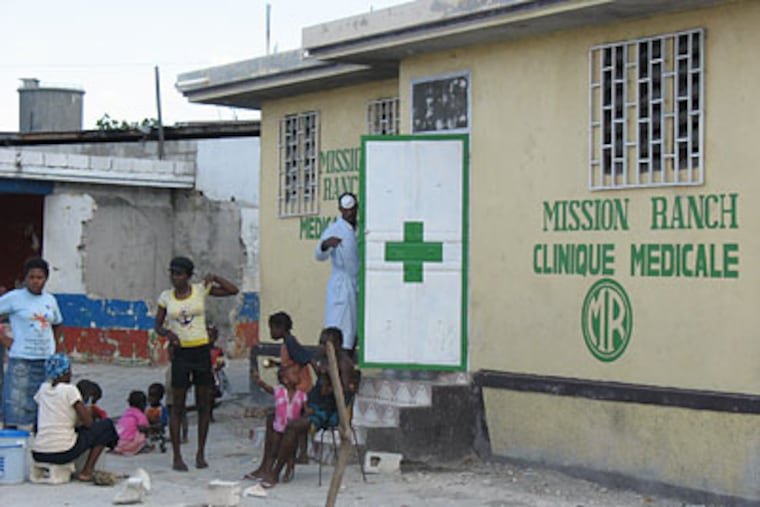
Outside the clinic, they ran into the Haitian counterparts who help treat patients and organize clinic sessions. They embraced and talked about the earthquake's toll then drove to Mission Clinic, the compound built on the druglord's old territory. It's now called Mission Ranch. The orphanage is uninhabitable, the nutrition center is in ruins, but the clinic survived.
"When the earthquake happened, I thought it was the end of the world," said Robinson Remedor, local director of the clinic. Within an hour, the clinic was swamped with more than 500 victims. Many had injuries too serious for the small primary care facility to handle, so they were referred to other rescue sites in the city.
Remedor's 80-year-old father was killed in the quake. His mother and six siblings survived.
"It was a catastrophe," Remedor said, "But the living must eat. We can't rest without doing something."
Despite the relentless onslaught of disasters, he says, he has not lost faith. "At the moment, we pray. The best thing to do is pray. We don't ask why us? It's the way of the world."
Returning to the hotel, Parvus tried to figure out how to provide at least three hours of patient care before he and his children had to head back to Santo Domingo to catch a flight back home.
"It would have to be just people with serious problems. People who needed bones set or wounds stitched."
Robinson and Bouquet shook their heads. Once word got out that a medical team had arrived, they would be overwhelmed with people with all kinds of problems – many not related to the earthquake.
"We thought there were people lying all over the place," Parvus said.
"But it's not the case," Bouquet said.
"Believe me, you don't see a lot of problems here, but they are in their homes."
In the end, they decided there wasn't enough time to do the clinic right.
"In any case, we really came to assess the situation," said Parvus. "We'll come back with doctors soon. I have 40 volunteers waiting to get on a plane."
As the men spoke, they were thronged by children. Barefoot. Snotty-nosed. Boys with broken radio parts for toys. Girls with eyes like green cat's eye marbles. Kids with naked butts and muddy toes.
"Let's go and get you those supplies," Parvus said, and they climbed back in the car to fetch the bags up on the hill before the sun went down.