‘What is going to happen to Haiti?’
PORT-AU-PRINCE, Haiti - The trip to Haiti Clinic in Cite Soleil these days is a journey through the rings of hell.
PORT-AU-PRINCE, Haiti - The trip to Haiti Clinic in Cite Soleil these days is a journey through the rings of hell.
In country now for five days, Luc Bouquet no longer comes across corpses out in the open, where they had lain, turgid and shiny as plastic dolls. Still, throughout the city, more buildings have fallen than survived, and the odor of the dead seeps out in acrid tendrils, carried on the breeze.
The route to the small non-profit facility in Cite Soleil, a crowded and desperately poor ghetto with a population estimated at 200,000, takes him past a school where, he was told, 300 students died watching a soccer game.
God knows how many people are still trapped in the Daihatsu car dealership, the Union Bank, the Dubois Shopping Center and the National Office for Aging.
On walls, scraps of cardboard and signs tied to overhead wires, people have written messages. "Many dead here." "Please Help."
"What is going to happen to Haiti?" Bouquet said.
His voice, which normally sounds deep as James Earl Jones', drops even lower into his chest. "They should just erase it and start over."
With its huddled tin-roofed shanties, Cite Soleil doesn't look as devastated as the area around the Grand Palace, but there is virtually nowhere to fall from a place so forsaken. That is why Haiti Clinic is located here, Bouquet says. It seems like the nexus of the greatest need.
But no good non-profit deed is ever so simple.
Various groups in the slum are in competition to serve their community, as well as secure paid positions from well-meaning American non-profits.
"We have to find a way to get them to work together," said Bouquet.
He arrived on Saturday with a group of doctors and several volunteers from the U.S. They came to assess the Haiti Clinic's needs after the earthquake.
When they left, Bouquet was told to expect more doctors and supplies to arrive within days. With unreliable communication, no car of his own and price-gouging for gas and water, meeting up with the new contingent and transporting the supplies would have been a challenge.
But they didn't come.
So he went to work at Hopital Saint Francois de Sales, where he knows the medical staff. Its morgue is also where 90 bodies, including that of the archbishop, were sent. After a grueling day Tuesday, he planned to return to the hospital today.
Then he received a cell phone call from Dirk Parvus, the medical director of Haiti Clinic. Parvus, based in South Florida, told Bouquet that a doctor and some missionaries from another organization were arriving to help out in Cite Soleil.
Roused from bed this morning by another earthquake, strong enough to make hearts pound and screams echo across the city's pulverized hills, Bouquet decided to give the clinic another try.
In its two years, it has moved from school rooms to sparsely-equipped clinics four times. However insufficient the care is that he and his friends can provide, it is care that these people would not otherwise receive.
"I just hope they have medicine," he said. He didn't want to waste another day looking at gravely injured patients and have nothing to offer them but Tylenol and gauze.
Bouquet is a man of 52, a deeply spiritual believer in the power of God, a husband, a father of three, a Haitian by birth, culture and heart, but an American by nationality and current permanent address.
"Everything is shifting," he says, speaking both literally and figuratively.
Long before the earthquake gave Port au Prince a merciless thrashing, Bouquet had felt a growing obligation to come back home to save some children as he had been saved.
"I don't know where to begin," he said. In this, he is among tens of thousands of well-intentioned volunteers and non-profit workers and church groups. Almost everyone you meet in Haiti seems to work for some good-works organization. The rescue operation, which has added legions of foreign volunteers to the mix, has made the pre-existing problem clearer than ever to Bouquet.
As promised, there were two doctors yesterday afternoon at Mission Ranch, a facility run by another faith-based group in America that shares space with the Haiti Clinic.
One was Larry Kaplan, a retired gastroenterologist from Boston. The other was Sem Victorin, a local general practitioner who works for a variety of missionary groups, including "Healing Haiti," a non-profit based in Minnesota.
But they had come without any medicines.
In exasperation, Bouquet looked at the 30 patients waiting to be seen. Without antibiotics and other supplies, they would not be able to do much more than clean wounds and refer the gravely ill to hospitals. But Bouquet could not bring himself to walk away, so he went to work.
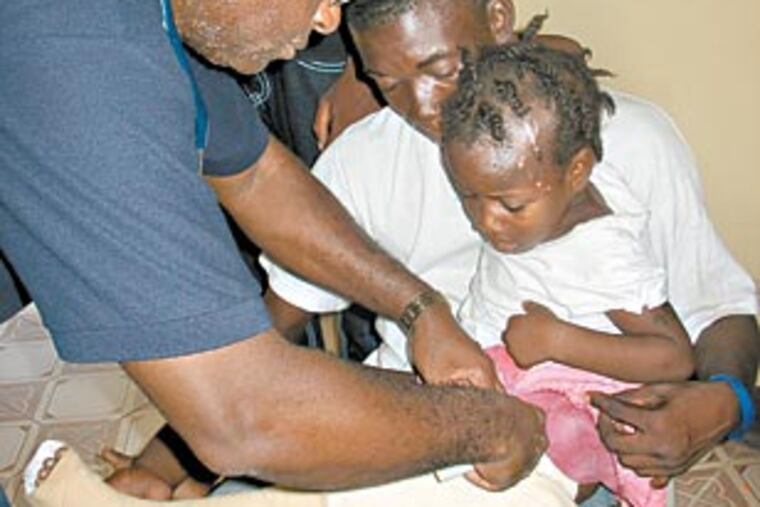
The stories and injuries were as awful as before, only infections had had a few more days to fester. One baby, whose mother had been killed in the earthquake, had a fractured hip that had been put in a cast, but the wrong kind.
The pain had been so awful, her father brought her to a makeshift clinic somewhere in the city. There, a health care worker had cut open the top half of the cast and told her father to just keep the child like that until the bones healed.
"Can you imagine?" Bouquet said. He splinted the girl's leg and hip and sent her father to Hopital Saint Francois. Watching the man and the child's weeping grandmother carry the girl away, he talked to himself.
"I don't know how they are going to pay for that. They have been paying all morning, going from place to place trying to get her help."
He gave the same instructions to another boy, whose foot resembled scrapple. The father said he just couldn't do it. He had no money for a taptap to the hospital. Discreetly, Bouquet slipped him cash to pay for the ride.
Yet another woman, lying in a wheelbarrow, had an infected hip and a broken leg. Dr. Kaplan examined her belly. "She has an acute abdomen," he said, either a ruptured spleen or a damaged liver. "She needs to go to a hospital immediately."
The family returned, reporting that the main road to the airport, the one leading to most major destinations in the city, was blocked off by police.
Bouquet and Victorin did manage to stitch up the gash in a 9-year-old boy's head. But it was the only real victory of the afternoon.
Cite Soleil has a reputation for violence. It had been hard to imagine in the bright afternoon where children danced and sang outside the clinic and grateful patients thanked the staff profusely.
But at 4 p.m., one of the missionaries, sitting on a chair outside the clinic, fell over. A punk had ridden past and hurled a rock at the man's head. He would need stitches.
Bouquet got into a truck his nephew had borrowed. Several members of the missionary group, including Dr. Kaplan, piled in.
"Are you coming back tomorrow?" Dr. Victorin asked.
"Not unless there are medicines," Bouquet said.
On the way out of the ghetto, another rock slammed into the driver's side door.