Philly superintendent: More charter oversight
The Philadelphia School District will increase oversight of its 67 charter schools, Superintendent Arlene Ackerman told City Council on Monday. Officials will now visit about 10 percent of the charters annually for "...random, unannounced visits to look at the records, to make sure everything's in place," she said.
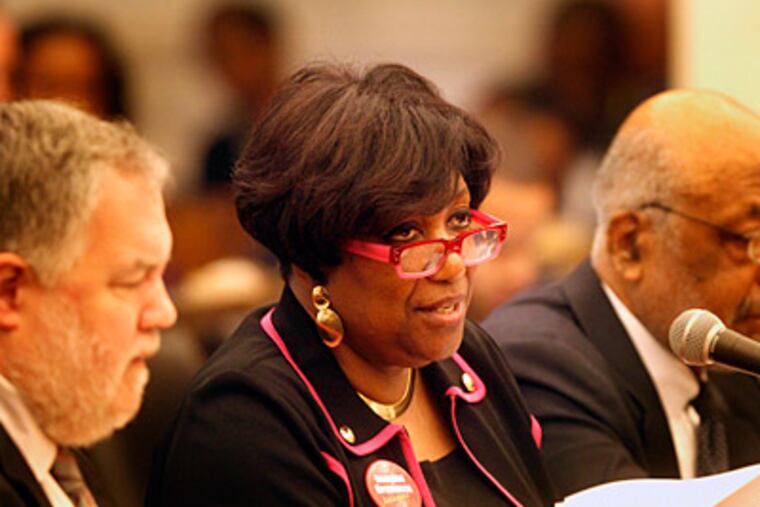
The Philadelphia School District will tighten control over its 67 charter schools, Superintendent Arlene Ackerman told City Council on Monday.
Previously, the district, which authorizes city charter schools, audited them only when their charters were up for renewal.
In addition to the renewal audits, Ackerman said, officials will now visit roughly 10 percent of charters annually - "make these random, unannounced visits to look at the records, to make sure everything's in place," the superintendent said.
Ackerman said she would not need to hire more workers to perform the work. Audits will be completed by outside firms, she said.
Ackerman and her top staff came to City Hall on Monday to testify before Council on the Philadelphia School District's $3.2 billion budget. District officials annually discuss the budget before Council, which collects real estate taxes on behalf of the school system.
Her charter school comments came in response to questions from Councilwoman Blondell Reynolds-Brown and Councilman Curtis Jones Jr.
Jones wanted to know what the district would do in response to a recent report from City Controller Alan Butkovitz, which detailed financial irregularities at several charter schools.
"I think there are lots of lessons to be learned here. We need to step up our monitoring, and not be intimidated or pushed back" in asking for information, Ackerman said.
Addressing Council, Ackerman summarized highlights of her superintendency - negotiating a groundbreaking contract with city teachers, enrolling 8,000 parents in free courses, introducing a weighted student funding formula to shift money to needy learners - but also its challenges.
Youth violence is one that sometimes seems overwhelming, she said. This school year in particular, the district has struggled with racial violence at South Philadelphia High and city students involved in flash mobs.
But Ackerman also cited staffing as a difficulty - "Philadelphia, like other high poverty districts, faces a leadership crisis. Finding highly effective, qualified teachers and principals to meet our needs is a major challenge," she said.
The superintendent said reform must be accelerated. Though the district has made progress on state tests for seven consecutive years, it will take until 2123 for all students to meet their goals if the current pace continues.
"Incremental growth is just not good enough," Ackerman said.
Michael Masch, the district's chief business officer, outlined a relatively rosy budget that contains $180 million for new initiatives. No layoffs are predicted, unlike many districts around the country.
The good budget news is thanks to the federal stimulus package, which is scheduled to dry up after the 2011-12 school year.
There's a 4.5 percent increase in spending over the current budget. It relies on $1.68 billion in state aid, a figure proposed by Gov. Rendell for the state's budget but not yet approved by the Legislature. As it was last year, education spending figures to be a contentious issue in Harrisburg.
Councilman Bill Green questioned the district's reliance on state funds.
"This year, you're not going to get what the governor's appropriated, in my view," said Green.
Masch said that it's common procedure to build budgets based on the proposed figures. Green wanted to know what the district would do if Harrisburg doesn't come up with that much.
The district's budget already includes a six percent cut in administrative spending, but an alternative version would cut an additional two percent - eight percent total - in administrative spending.
The trims would be "additional cuts in central office," Ackerman said. "It would not affect the schools."
Jones told Ackerman he was "cautiously optimistic" about the district's progress. In his district, which lies in West and Northwest Philadelphia, the three lowest-performing schools have been designated Renaissance schools - schools that will be radically restructured, run either by charter or outside managers or by Ackerman herself.
Jones cited increased parent involvement at these schools said he has been impressed by the providers that may take over the Renaissance schools.
"If the worst of them gets it, it's a step above what we have," Jones said.
Ackerman said the Renaissance process will continue for years to come.
"We're going to systematically eliminate the lowest-performing schools while pushing the other schools to move to vanguard status, top status," she said.
Councilman Bill Greenlee asked Ackerman about what the district was doing to stem violence.
The superintendent said prevention programs have been added. But, she said, it's clear that the schools that tend to be more violent tend to have fewer music and art programs, sports, and other after-school activities.
"In the long run, what we're trying to put in place are the kinds of things that keep young children interested in school," Ackerman said. "You have to do it by making school more interesting than the streets."
Councilwoman Marian Tasco wanted to know how it came to be that some schools have programs and others don't.
Over the years, a lack of planning led to some schools having more than others, Ackerman said. Now, there are "blatant disparities" - some schools have no libraries at all, have restrooms that are dirty and broken.
"Without a plan, who can articulate and argue for their schools and their community the loudest, that's where it happened," Ackerman said. "In many ways, councilwoman, it's shameful, the discrepancies."
Ackerman has long said she's serious about addressing issues of equity. Her strategic plan will help needier schools improve, she said.