Freed hikers talk of hunger strikes, isolation
NEW YORK - Adding the first details to what had been a sketchy picture of their Iranian detention, Americans Joshua Fattal and Shane Bauer spoke Sunday of being blindfolded whenever they left their 8-by-13-foot cell, fasting for days to force delivery of letters from their families, hearing the screams of beaten prisoners, and of the 781 days they spent "in a world of lies and false hope."
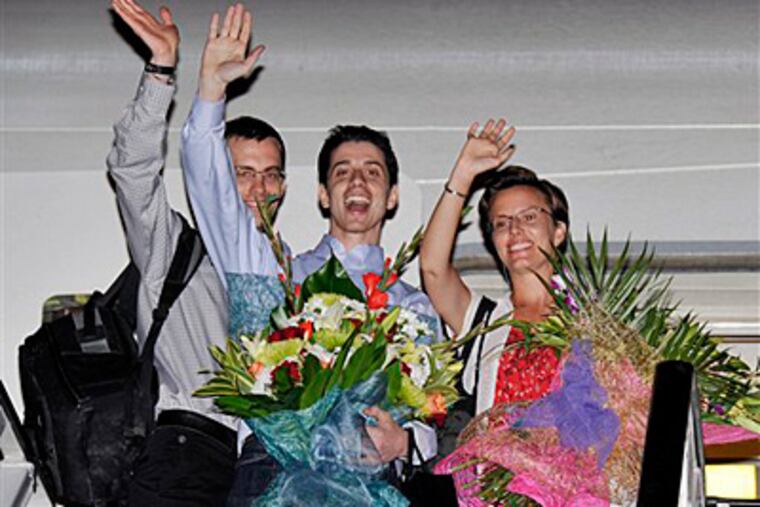
NEW YORK - Adding the first details to what had been a sketchy picture of their Iranian detention, Americans Joshua Fattal and Shane Bauer spoke Sunday of being blindfolded whenever they left their 8-by-13-foot cell, fasting for days to force delivery of letters from their families, hearing the screams of beaten prisoners, and of the 781 days they spent "in a world of lies and false hope."
Looking gaunt, with dark circles under his eyes, Fattal, 29, who was raised in Elkins Park, said their release from Evin Prison in Tehran Wednesday was a surprise. With no access to media, they were in the dark about the last week of back-channel diplomacy, and the $1 million "bail" for freedom deal, mediated by the Persian Gulf Sultanate of Oman, that won their freedom.
Instead of being led back to their cell that day, said Fattal, who addressed a packed news conference at a New York hotel, the guards mysteriously took them downstairs in the prison. "They fingerprinted us and gave us street clothes. They did not tell us where we were going."
The guards then took them to another part of the prison where they saw Dr. Salem Al Ismaily, special envoy of the Sultan of Oman. "The first thing Salem said to us was 'Let's go home.' "
Fattal, wearing a khaki shirt with epaulets, was flanked on the podium by Bauer, 29, and Sarah Shourd, 33. Iran's border guards arrested Shourd, along with Fattal and Bauer, on July 31, 2009. The three, who met as students at the University of California at Berkeley, say that they were hiking on a one-week vacation in a tourist region of northern Iraqi Kurdistan and that if they crossed Iran's unmarked border it was by accident.
Held for 410 days in solitary confinement, Shourd reportedly fell ill and was let go last September after bail of $500,000, also mediated by Oman, was paid. Fattal and Bauer remained locked away in Evin. They were mostly deprived of contact with their Iranian lawyer, and with the Swiss ambassador who represents U.S. interests in Iran since the U.S. severed diplomatic ties after the Iranian revolution of 1979.
After numerous delays, Fattal and Bauer were tried, convicted and sentenced last month to eight years in prison on charges of espionage that they have always denied. No public evidence was ever presented against them.
"Releasing us is a good gesture," said Fattal, "and no positive step should go unnoticed. We applaud the Iranian authorities for making the right decision regarding our case. But we want to be clear that they do not deserve undue credit for ending what they had no right and no justification to start in the first place. From the very start, the only reason we have been held hostage is because we are American."
He said hostages "is the most accurate term because, despite certain knowledge of our innocence, Iran has always tied our case to its political disputes with the U.S."
Bauer, of Minnesota, echoed that theme, but with a nod first to all the problems that the trio's trek had caused.
"We will always regret the grief and anxiety that our fateful hiking trip led to," he said, "above all for our families."
But then he asserted that their case was never really about crossing an unmarked border.
"We were held," he said, "because of our nationality. Indeed, there are many other cases of unauthorized entry to Iran in which people were simply fined or deported after a short time. We do not know if we crossed the border. We will probably never know. But even if we did enter Iran, that has never been the reason why Iranian authorities kept us in prison for so long.
"The only explanation for our prolonged detention," he said, "is the 32 years of mutual hostility between America and Iran. The irony is that Sarah, Josh and I oppose U.S. policies toward Iran which perpetuate this hostility. We were convicted of espionage because we are American. It's that simple. No evidence was ever presented against us. That is because there is no evidence and we are completely innocent. The two court sessions we attended were a total sham. They were made up of ridiculous lies that depicted us as being involved in an elaborate American-Israeli conspiracy to undermine Iran."
Bauer went on to say they he and his fellow prisoners could not forgive Iran while other innocent people and prisoners of conscience are held in its jails.
"It is the Iranian people who bear the brunt of this government's cruelty and disregard for human rights," he said. "There are people in Iran who are imprisoned for years for simply attending a protest, for writing a pro-democracy blog, or for worshipping an unpopular faith. . . . If the Iranian government wants to change its image in the world . . . it should release all political prisoners and prisoners of conscience immediately."
Whenever the hikers complained about their treatment in Evin Prison, their jailers cited bad conditions at the U.S. detention facility in Guantanamo Bay, and CIA prisons in other parts of the world.
"We do not believe that such human rights violations on the part of our government justify what has been done to us. Not for a moment," said Bauer. "However we do believe that these actions on the part of the U.S. provide an excuse for other governments, including the government of Iran, to act in kind."
Fattal thanked their families, first and foremost, "who have done more for us than we can ever repay." He thanked friends, at home and overseas, "who put their own lives on hold to fight for our freedom."
In an interview after the news conference, Fattal's mother, Laura, was radiant in a royal blue jacket over a red blouse.
Her family will spend the next day or two in an undisclosed location, she said, but they will be back in the Philadelphia area in the coming week. Plans are still being discussed, she said, for the proper way to thank local supporters.