Romney decisively wins Florida primary
TAMPA, Fla. - Mitt Romney took a big step toward securing the Republican presidential nomination with a decisive primary victory Tuesday in Florida, the largest and most diverse state to vote in the race so far.
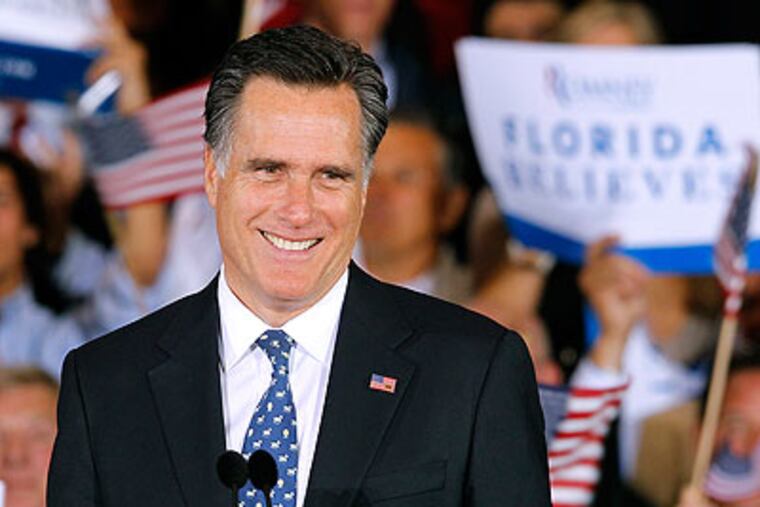
TAMPA, Fla. - Mitt Romney took a big step toward securing the Republican presidential nomination with a decisive primary victory Tuesday in Florida, the largest and most diverse state to vote in the race so far.
Newt Gingrich, the former House speaker who emerged as the voice of grassroots conservatives, finished a distant second but vowed to fight on to the GOP convention in August.
"I stand ready to lead this party and our nation," Romney told cheering supporters in a victory speech at the Tampa Convention Center, urging Republicans to keep focused on the common goal of defeating President Obama. He added: "A competitive primary does not divide us; it prepares us."
Exit polls showed that Romney won virtually every voter group, except those who described themselves as "very conservative," across age, income and education levels. He and Gingrich ran roughly even among tea-party supporters and evangelicals.
For Romney, it was a strong response to his crushing loss 10 days earlier to Gingrich in the South Carolina primary, with Florida proving to be the firewall his advisers had planned.
As the victor, Romney will get all 50 Florida delegates, the biggest cache at stake to this point in the Republican contest.
Former Pennsylvania Sen. Rick Santorum finished third, and Texas Rep. Ron Paul ran fourth. Both had left Florida before the polls opened so they could campaign in states with forthcoming contests, Santorum in Missouri and Paul in Nevada.
Gingrich addressed supporters in Orlando Tuesday night at the Rosen Hotel behind a sign that read, "46 states to go."
"We are going to contest every place, and we are going to win," he declared. Citing Abraham Lincoln's words at Gettysburg about a government "of the people, by the people, for the people," Gingrich said: "We are going to have people power defeat money power in the next six months."
Floridians voted after a week of nasty campaigning in which Romney, a former Massachusetts governor, and Gingrich traded harsh attacks in person and through millions of dollars' worth of television ads. A study by Kantar Media found that 92 percent of the TV ads broadcast from Jan. 23 through Monday were negative.
Romney worked to paint Gingrich as a Washington insider who had cashed in his influence for corporate clients, including mortgage giant Freddie Mac, after leaving office, and as an erratic leader and one given to "grandiose" ideas, such as a proposal to build a U.S. colony on the moon, which Romney ridiculed.
He delivered those attacks on the stump, in a pair of nationally televised debates, and via a roster of surrogates from the top ranks of the GOP, but most of all with a barrage of commercials.
Romney and his allies in a supportive super PAC spent at least $15.4 million on air time in Florida, compared with $3.4 million spent by Gingrich and his allies, according to trackers of media spending.
Gingrich, for his part, portrayed Romney as the captive of big financial interests on Wall Street and of the GOP establishment in Washington. He tapped into a network of support from Florida's tea-party groups with a populist war cry against elites and accused Romney, a former investment banker, of having profited from the housing crash that has led to massive foreclosures in the state.
Gingrich had come roaring into the state with the momentum after a 13-point victory in South Carolina Jan. 21. But in Florida, he faced a more diverse, much larger, and less conservative Republican electorate - as well as Romney's attacks on his tenure as speaker, which included a $300,000 fine for ethics violations, and his $1.6 million contract with Freddie Mac, a quasigovernment company that many conservatives blamed for helping trigger the housing crisis.
Florida, certain to be a swing state in the general election, was seen as a test of Romney's claim of electability, and he apparently aced it. The win showcased Romney's financial and organizational strength and demonstrated his ability to recover from a major setback.
Earlier, Romney won the New Hampshire primary and was narrowly edged in the Iowa caucuses by Santorum.
The former governor, who had been taking the classic front-runner's approach of focusing on the general-election opponent rather than getting in the mud with his rivals, retooled starting late in the South Carolina race, turning to a sharp critique of Gingrich's record. His advisers considered Florida their chance to go all out to stop Gingrich's surge.
"When attacked, you have to respond, and you can't let charges go unanswered," Romney told reporters earlier Tuesday. He was referring to Gingrich's earlier attacks in South Carolina and elsewhere on him for changing from a supporter of abortion rights to an opponent and other shifts.
In any case, Gingrich did not congratulate Romney during his remarks Tuesday night and did not telephone him either.
Sid Dinerstein, GOP chairman of Palm Beach County, said Tuesday evening that it was a mistake for Gingrich to continue in the race. "There's no road to victory that isn't bloody," he said.
"There is no way that anyone on the Republican side could catch Gov. Romney without having to raise so much money and do so much negativity as to essentially help Obama win in November," Dinerstein said. "It doesn't matter what side you were on before. We're all on the same side tonight."
Tami Donnally, chairwoman of Gingrich's campaign in Palm Beach County, said she was sticking with her candidate but dismissed predictions that a continuation of hostilities would hurt the GOP's chances in the general election.
"I always look at silver linings. My take on it is that, yes, it looked brutal," Donnally said. "But by November we'll have a well-vetted candidate with no leaf left unturned. A well-prepared candidate to go up against Obama." In that sense, she was on the same page as Romney.