Photo shows wreckage of Amelia Earhart’s plane?
The giant coconut crabs threatened to steal the show, since they may have carted off most of Amelia Earhart's bones.
The giant coconut crabs threatened to steal the show, since they may have carted off most of Amelia Earhart's bones.
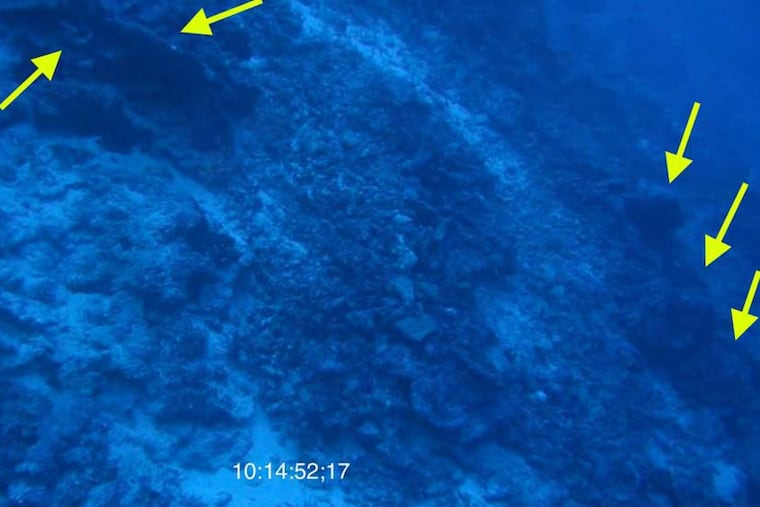
But at the very end of last night's Discovery Channel special - a chronicling of setbacks and false alarms during a $2.2 million mid-Pacific search in July for the famed aviator's plane - a photograph was shown of possible wreckage.
Supposedly the underwater image shows what could be a pulley, a fender and a wheel.
"Breaking News. Debris Field Found," now proclaims TIGHAR.org, home page of the Delaware-based group behind the expedition.
"A scattering of man-made objects" was found during a review of high-definition video footage brought back from July's trip to the remote Pacific island of Nikumaroro, where, TIGHAR's theory goes, Earhart spent her final days as a castaway.
The location, according to TIGHAR, fits a tantalizing photograph taken in 1937, months after Earhart's disappearance, showing what could be landing gear jutting from the water off the coral atoll's coast.
That photo sparked the interest of Secretary of State Hillary Rodham Clinton, who in March announced her enthusiasm for this summer's search.
But nobody's claiming this morning that the group found proof - or the "any idiot artifact," as expressed by TIGHAR founder Ric Gillespie.
"Maybe it's airplane debris, maybe it's not, but it's right where we reasoned airplane debris 'should' be, and that's promising," Gillespie said by email early this afternoon.
The video is even more intriguing, he said:
"What you see is a screen capture from the high-definition video. In the video you see the features from a changing perspective. That helps get a better impression of what the features look like. We'll post a clip that shows the whole pass past the objects. Might be a day or two."
Apparently another expedition will be needed to see if the sea will finally give up its secrets.
As the show summarized, searchers over 10 trips to the island, known as Gardiner Island in Earhart's day, have recovered all sorts of tantalizing clues, including a 1940 report of 13 human bones, a woman's shoe and an empty sextant box found on the rarely inhabited island; a zipper piece; a broken pocket knife; a shard of a cosmetics jar; a chunk of rouge, all consistent with Earhart and her belongings.
In 1937, a Florida girl reported picking up a long transmission after the disappearance in which Earhart identified herself and repeated something that sounded like "New York City."
A freighter called the Norwich City was abandoned on the beach at Nikumaroro in 1929.
Debris from that wreck may have misled the searchers while using underwater videocamera and sonar devices in July, but the since-noticed debris field is a distance from any freighter remnants, according to a Discovery Channel article.
As for the bones, they were taken away, examined by a physician and subsequently lost. He thought they were a man's, but forensic anthropologist Karen Burns was shown on camera saying the measurements were more consistent with a 5-foot-7 woman of European descent - a description that fits Earhart.
The mystery was, where were the other bones?
As a test, on a previous expedition, an animal carcass was left on the beach. Soon, as time-lapsed photography showed, giant coconut crabs began stripping it, swarming over it, and finally carrying bones away to their burrows.