Museum of the American Revolution is topped off
With drums tat-tatting and flags billowing, with two former governors and a major benefactor gazing skyward, a white-coated steel beam signed by hundreds of construction workers and history fans was raised Thursday by a massive crane and lowered into place atop the still-abuilding Museum of the American Revolution.
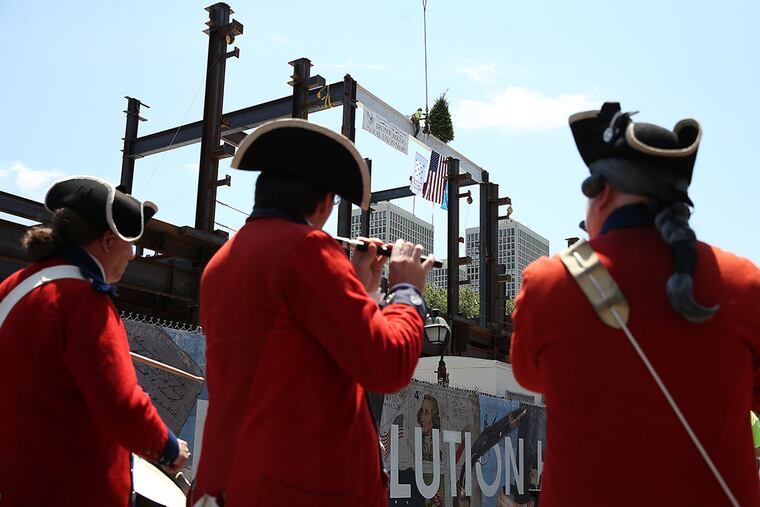
With drums tat-tatting and flags billowing, with two former governors and a major benefactor gazing skyward, a white-coated steel beam signed by hundreds of construction workers and history fans was raised Thursday by a massive crane and lowered into place atop the still-abuilding Museum of the American Revolution.
The celebration, attended by several hundred at the museum site at Third and Chestnut Streets, marked the "topping off" of the building's steel skeleton.
Construction of the $119 million redbrick museum designed by New York's Robert A.M. Stern Architects began last fall. Work will be completed by September 2016, and the museum is scheduled to open to the public in the spring of 2017.
"We are on schedule and fully funded," said Michael Quinn, the museum's president and chief executive. Looking at the construction beam covered with a multicolored spiderweb of signatures, Quinn urged his audience to sign then and there - "You'll never be able to sign again."
Former Gov. Ed Rendell, a longtime museum backer, hailed the construction and what it augurs for the epic tale that will unfold there.
"It's an important step in the telling of the story of Philadelphia and the shaping of this country," Rendell said. He linked the future museum, which will house George Washington's field tent and numerous artifacts assembled by the old Valley Forge Historical Society, with Independence Hall, Congress Hall, Fort Mifflin on the Delaware, and the entire sweep of the nation's founding.
"Too many Americans don't understand the significance of the revolution," Rendell said. "They don't understand how difficult a war it was."
As governor, Rendell enthusiastically followed the lead of his predecessor Tom Ridge, allocating many millions in redevelopment money for museum construction.
But it was Gov. Tom Corbett who released the money - $30 million.
"This is an investment," Corbett told onlookers. "There's been controversy about whether you should invest in projects like this. This isn't a giveaway. It's an investment in the future. . . . I was able to fulfill promises that were made . . . and fulfill the promise to the future so that they should learn from the past."
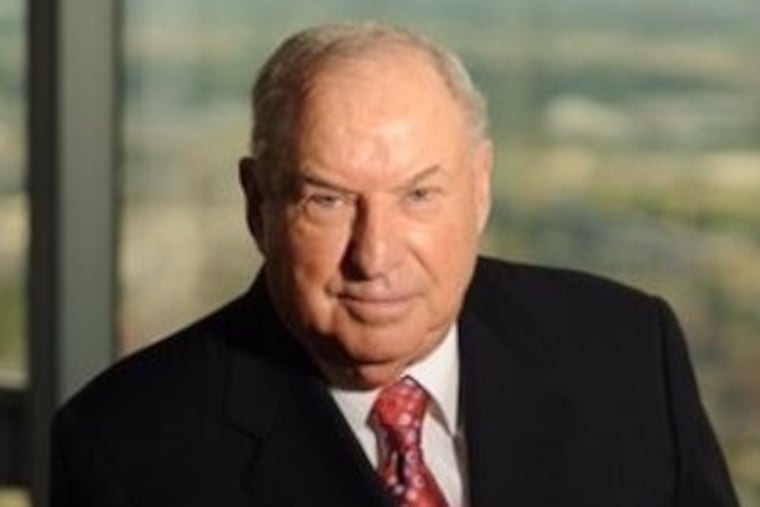
The largest private backer of the museum, H.F. "Gerry" Lenfest, owner and publisher of The Inquirer, told the crowd that Philadelphia is the "founding city" of America.
"This country could not have been founded without what happened in this city," he said.
After these brief remarks, as the sun washed the street, the signature-covered beam was hoisted aloft. It bore the flag of the museum, the flag of the country, and a replica of George Washington's blue silk standard. (The original resides in the museum's collection.)
Atop the beam, as it rose, was an evergreen tree, symbolic of the "human spirit," according to Scandinavian lore, said William Schwartz, cofounder of INTECH, which is building the museum. He said construction had been smooth and without injury.
Rendell, a museum board member, engineered the move of the museum to Third and Chestnut, site of the old visitor center for Independence National Historical Park. In 2010, the National Park Service agreed to swap the corner location for 78 acres owned by the museum and surrounded by Valley Forge National Historical Park.
Lenfest loved the city location. "We wouldn't be here without him," Rendell said.
215-854-5594
@SPSalisbury