Annette John-Hall: Lena Horne bloomed as she learned this: 'I'm me'
My mother, jazz aficionado that she is, never understood how "Stormy Weather" became Lena Horne's signature song, especially when everybody else sang it better than she did.
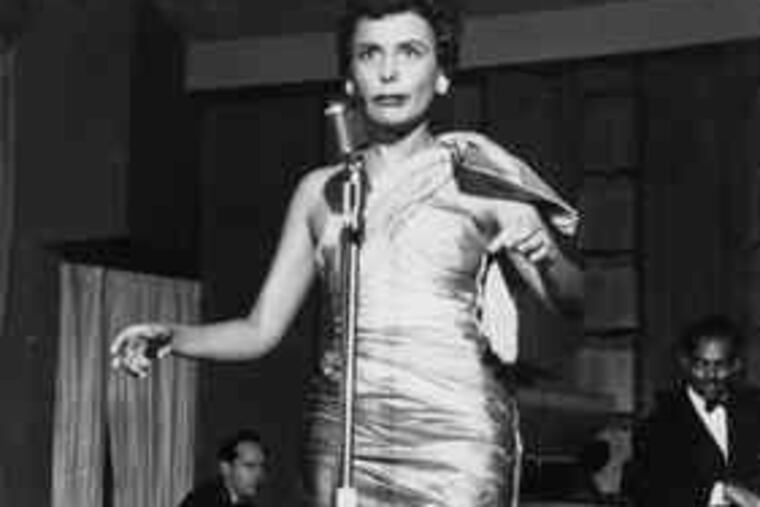
My mother, jazz aficionado that she is, never understood how "Stormy Weather" became Lena Horne's signature song, especially when everybody else sang it better than she did.
After all, Horne, who died Sunday at 92, couldn't swing or improvise like Ella Fitzgerald and Sarah Vaughan. She wasn't much of a stylist, like Nancy Wilson and Dinah Washington.
But her breathtaking beauty was indisputable, and as she got older, her voice grew into it. The more honest she became with herself, the more resonant her voice.
Looking back, I understood how Horne negotiated in a nonnegotiable era, and I realized that she really trailblazed fearlessly during a career of an astounding 60 years.
Don't get me wrong. Horne could sing. She sang every note just right, her pitch perfect and polite, and she looked damn good doing it. In fact, you couldn't take your eyes off her.
But early on, she couldn't compare to the jazz singers of her era, whose voices conveyed pain and joy, love and sorrow.
It wasn't that Horne didn't experience her share. Her looks were her blessing and her curse. Light skin helped her get a foot in the door, but it wasn't light enough to land her too many featured roles in Hollywood when she moved into acting. You had to be white to get those.
And while she wasn't typecast as a maid, Hollywood tried to make her look more exotic - but not too dark - even having Max Factor concoct a special makeup for her.
Horne knew all eyes were on her always. At the famed Cotton Club in Harlem, where she got her start as a dancer and singer, white people loved her as an entertainer, but later didn't allow her to flourish on the screen.
Black people understood that someone of her hue could open doors for them - but at the same time, they often resented her for the privilege it brought her.
And they didn't rush out to buy her records either. Like my mom, they preferred their singers with a shot of Johnnie Walker, not with a spot of Earl Grey.
It was only after Horne realized her own truth and chose to live it outright, that she reached her fullest potential as an artist - almost 50 years after she started.
"My identity is clear to me now," she said in an interview. "I am a black woman. I'm free.. . . I don't have to be a first to anybody. I don't have to be an imitation of a white woman that Hollywood sort of hoped I'd become. I'm me, and I'm not like nobody else."
We certainly understood it in 1981, when Horne opened her one-woman show, The Lady and Her Music, on Broadway. We'd never seen her this way - gritty, sultry, confident, honest, free.
It was as if she grew emotionally right before our eyes. Well into her 60s, she never looked more beautiful.
And boy did she belt out "Stormy Weather." She put fire in the torch ballad. Sang it like a signature. And it was.
The show ran a record 333 performances and earned the star a special Tony award.
Soon afterward, Horne, clearly flirting and enjoying herself, described herself as "rich, juicy, ripe plum again," to Ed Bradley, her 42-year-old interviewer on 60 Minutes.
Bradley asks her about her connection to the song "Believe in Yourself," taken from The Wiz, and the finale of her Broadway show.
"I believe in my real self now," Horne replies.
"It took awhile to find that," Bradley says.
"Yes," Horne agrees, wiping a tear. Then, flashing that spectacular smile: "Well, some people are late bloomers."