Flower pots growing greener
From feathers and manure, options take root.
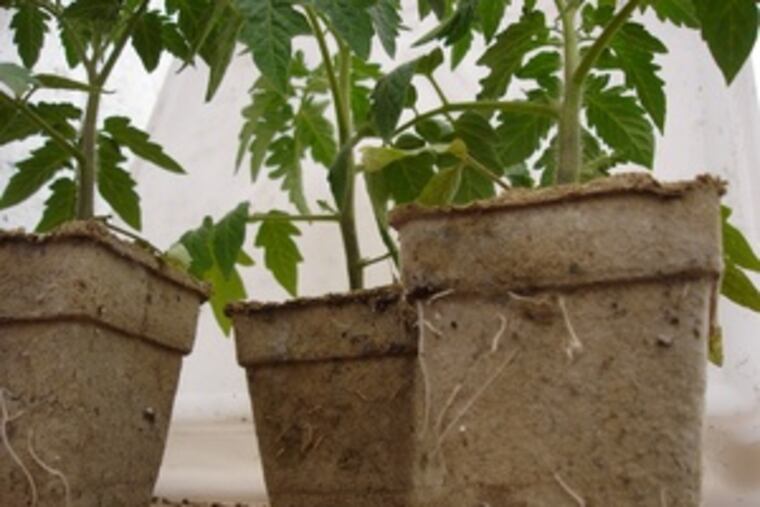
Gardeners are famous for recycling. They convert kitchen scraps to compost, stake tomatoes with old pantyhose, and hang unwanted CDs on sticks to spook birds in the berry patch.
But there's one thing every gardener buys that routinely gets tossed in the trash and buried in a landfill: the plastic flower pots used to grow seedlings.
They're everywhere, especially at this time of year. They don't decompose, and they're not usually made of the plastic recycled in these parts. What's a conscientious gardener to do?
The answer may lie in some surprising places: in chicken feathers and cow manure and, to a lesser extent, corn, soybeans and rice. Scientists and farmers are investigating whether these substances can be molded into biodegradable pots to replace the plastic variety, which constitutes a $500 million industry in North America.
"Something like that would be very helpful, more natural," says Merion gardener Diane Actman. "I'd buy it even if it added to the cost of the plant."
Plastic flower pots were introduced in the 1950s as a way to increase market share of petroleum products. Oil was cheap and plentiful then, and worries over the "sustainability" of the planet virtually nonexistent.
Now, the pressure to "go green" is mounting on all sides.
And consider that the U.S. poultry industry generates 5 billion pounds a year of chicken feathers. Most is converted to animal feed that provides little nutritional value and makes no profit for producers. The rest is landfilled, which costs money.
Add concerns over mad cow disease and avian flu, says Marc Teffeau, "and it's conceivable in the future that the Food and Drug Administration might ban the feeding of animal byproducts back into the production cycle."
Teffeau is research director and lobbyist for the American Nursery and Landscape Association's horticulture research institute in Washington. His group has contributed $100,000 to the U.S. Department of Agriculture's efforts to, as Teffeau says, "put a chicken in every flower pot."
"Plastic flower pots are just a lousy design," says Walter Schmidt, the USDA research chemist whose scientific curiosity brought forth a feather-pot prototype now being tested by plant nurseries.
The process began a few years ago, as Schmidt was comparing the chemical properties of collagen and keratin, which is also the protein feathers are made of. "I just decided, 'Oh, let's try feathers,' " he recalled in an interview.
The inquisitive Schmidt ground some up, turned them into paper, then filter paper, noted their absorbency, and had a brainstorm: "My wife's a gardener. I could make a flower pot out of this."
He knew that the same qualities that make feathers such great bird gear - strength, durability, light weight - make them perfect for growing containers. "You never see a Canada goose fall from the sky due to feather failure," Schmidt says.
He soon found that roots will grow right through a feather pot. Then you can plant the small pot in the ground, replant it in a larger pot, or toss it into the compost pile. It'll break down and turn to fertilizer.
"It's like a petroleum-free plastic. That's, like, really neat," says Schmidt, who hopes to have competitively priced feather pots on the market in two years.
Matt Freund's CowPot - made of genuine Yankee cow manure - is already available, a set of 15 small ones selling for $11.95 at Gardener's Supply Co. of Burlington, Vt. (www.gardeners.com). They're also sold at Agway and True Value stores.
"I'm just a damn genius," jokes Freund, who works the family's 600-acre dairy farm in East Canaan, Conn., with his wife and brother.
All are conservation-minded, and for the last decade have burned manure-derived methane gas in a furnace and used it to heat the house and offices, as well as water for the dairy.
They use the liquid parts of the "biomass," a fancy term for manure, and the fibers to make pots (see www.cowpots.com for details). Like Schmidt, Freund began at the beginning, glomming fibers together with Elmer's Glue and drying makeshift pots in his wife's toaster oven.
"Oh, she loved that," he says.
Freund is working on bringing the price down; it's now about four times the cost of plastic. But as word gets out, he believes his "poo pots" will sell themselves, even at the higher price.
"They're an organic alternative that really makes sense, helps more than one industry, and can do what the plastic pots do," he says.
Since January, Gardener's Supply has sold more than 10,000 CowPots, triple the projected sales, according to assistant buyer Will Pearson. "It's just a beautiful idea," he says.
Freund says his pots last 10 to 12 weeks, which limits their use for plants such as azaleas that are nursery-grown for two to three years, but makes them suitable for shorter-term plants like annuals.
Gardener's Supply also sells paper pots, which have a loyal following but aren't too strong. Peat pots have been around for a while, but peat supplies are finite. And pots being developed from corn, soybeans and rice have other issues.
For now, plastic pots - millions and millions of them - rule the roost, and that's not likely to change anytime soon, says Bill McNaughton, president of McNaughton's Nurseries in Cherry Hill.
Plastic is still cheaper, it does the job, and nurseries and pot manufacturers do some recycling. But encouraging consumers to return pots after planting is not something many attempt.
"You don't really want to reuse those pots," McNaughton says. "They could be contaminated, and you'd have to wash them and that would be very costly."
Some reuse is encouraged, on a small scale, by places like the Schuylkill Center for Environmental Education in Upper Roxborough. More than 500 pots were returned after the center's native-plant sale last spring, says Fran Lawn, director of land restoration.
They'll be filled with new plants for this year's sale on April 28 and 29.
"Gardeners are generally very thrifty in the sense that they reuse a lot of things, but when it comes to plastic pots, we thought, 'Wow, what a waste,' " Lawn says. "I feel the synergy building for this."
Actman, the Merion gardener, feels it, too. She made a few purchases at the Schuylkill Center's 2006 sale and took back several pots. The rest she used to start seeds for flowers, herbs and vegetables.
"I used to work in the plastics industry, and I know how important recycling is," she says. "For garden things? Why not?"
Schmidt, the research chemist with a fondness for chicken feathers, has another environmental "why not?" swirling around in his brain, one that once again the poultry industry might be able to solve.
His next project? Making biodiesel fuel from chicken fat.