Shooter is called a textbook case
As details of Cho Seung-Hui's life come out, it is becoming increasingly clear that Cho was a textbook case of a school shooter: a painfully awkward, picked-on young man who lashed out with methodical fury at a world he believed was out to get him.
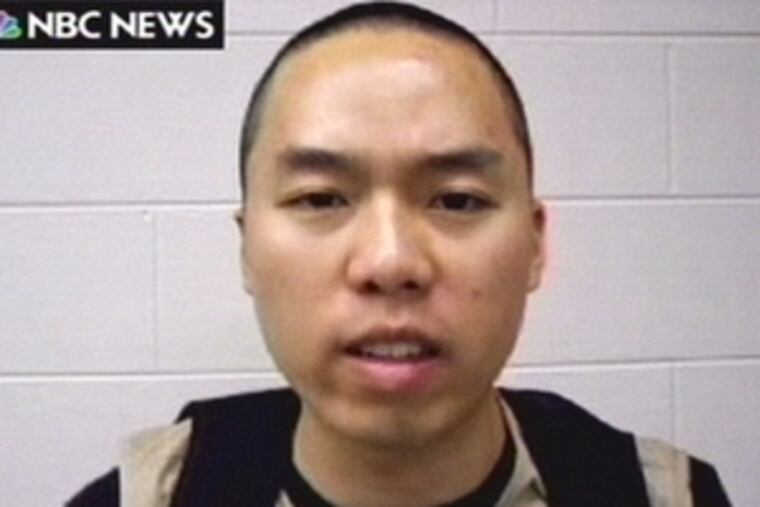
BLACKSBURG, Va. - In high school, Cho Seung-Hui almost never opened his mouth. When he finally did one day, his classmates laughed, pointed at him, and said, "Go back to China."
As such details of Cho's life come out, and experts pore over his twisted writings and his videotaped rant, it is becoming increasingly clear that Cho was a textbook case of a school shooter: a painfully awkward, picked-on young man who lashed out with methodical fury at a world he believed was out to get him.
"In virtually every regard, Cho is prototypical of mass killers that I've studied in the past 25 years," said James Alan Fox, a professor of criminal justice at Northeastern University and the coauthor of 16 books on crime. "That doesn't mean, however, that one could have predicted his rampage."
When criminologists and psychologists look at mass murders, Cho fits the themes they see repeatedly: a friendless figure, someone who has been bullied, someone who blames others and is bent on revenge, a careful planner, a male - someone who sent warning signs with his strange behavior long in advance.
Cho, 23, who killed 32 people on the Virginia Tech campus and committed suicide Monday, cast himself in a video diatribe as a persecuted figure like Jesus Christ. Cho, who immigrated with his family to the United States in 1992 and whose parents work at a dry cleaner in a Washington suburb, also ranted against rich "brats" with Mercedeses, gold necklaces, cognac and trust funds.
Classmates in Virginia, where Cho grew up, said he was teased and picked on, apparently because of shyness and his strange, mumbly way of speaking.
Once, in English class at Westfield High School in Chantilly, when the teacher had the students read aloud, Cho looked down when it was his turn, said Chris Davids, a Virginia Tech senior and high school classmate. After the teacher threatened him with an F for participation, Cho began reading in a strange, deep voice that sounded "like he had something in his mouth," Davids said.
"The whole class started laughing and pointing and saying, 'Go back to China,' " Davids said.
Stephanie Roberts, 22, a classmate of Cho's at Westfield, said she never saw anyone picking on Cho in high school. But she said friends of hers who went to middle school with him told her they recalled his having been bullied there.
"There were just some people who were really mean to him, and they would push him down and laugh at him," Roberts said. "He didn't speak English really well, and they would really make fun of him."
Regan Wilder, 21, who attended Virginia Tech, high school and middle school with Cho, said that Cho probably had been picked on in middle school but that many other children had been as well. And it did not seem as if English was the problem for him, she said. If he did not speak English well, she said, he could have reached out to other Korean students for friendship, but he did not, she said.
Among the victims of the Virginia Tech massacre were two other Westfield High graduates, Reema Samaha and Erin Peterson. Both graduated from the high school last year. Police said it was unclear whether Cho had singled them out.
Another expert who has worked with mentally disturbed young criminals suggested that Cho's actions probably had genetic causes.
"This is very different" from someone who was bullied to the breaking point; Cho was clearly psychotic and delusional, said Louis Kraus, chief of child and adolescent psychiatry at Chicago's Rush University Medical Center.
"This type of mental illness that this poor man had was not something that was likely precipitated by teasing or bullying," he said.
More likely, he said, is that Cho had a biological psychiatric disorder that may have worsened in recent years because of the pressures of college life and his leaving the support of his family.
An uncle of Cho's in South Korea said that Cho had been a worry to his family because he did not speak much as a child and that there had been concerns he might be mute.
But there were no early indications he had serious problems, said the uncle, who asked to be identified only by his family name, Kim.
Cho "didn't talk much when he was young. He was very quiet, but he didn't display any peculiarities to suggest he may have problems," Kim said in a telephone interview. "We were concerned about him being too quiet and encouraged him to talk more."
After Cho's family left to seek a better life in the United States, Kim said, the family never visited its homeland, and Kim said he did not recognize his nephew when his picture appeared on television as the shooter.
"I am devastated," Kim said between heavy sighs. "I don't know what I can tell the victims' families and the U.S. citizens. I sincerely apologize . . . as a family member."
In South Korea, Cho's parents ran a small bookstore in Seoul, Kim said. The family lived in a two-room apartment no larger than 430 square feet.
"They had trouble making ends meet in Korea," Kim said. "The bookstore they had didn't turn much profit."
He said his sister - Cho's mother - occasionally called around holidays but never mentioned having any problems with her son.
"She said the children were studying well. She didn't seem worried about her children at all," Kim said. "She just talked about how hard she had to work to make a living, to support the children."
He said he had been unable to reach Cho's mother since Monday's killings.
EndText