Fragile: Handle with caring
Center helps medically frail children get out into the world.
Frankie Lockwood's world was very small.
Gerald Szucs' was practically limitless.
At 23 months, Frankie was healthy. Then, on Oct. 9, 1997, she stopped breathing. She was diagnosed with a rare birth defect of the mitochondria and given little hope of survival. An experimental treatment saved her life, but she spent six weeks in the hospital and the next few years at home, tethered to medical machines.
"At first, the only thing she could do was blink," her mother, Conny, recalls. Nine years later, Frankie's life is still circumscribed by her body's defects.
At 68, Szucs is a former Catholic seminarian who holds a doctorate in public administration. He served as chief assistant to the U.S. secretary of health, education and welfare, then, in his 40s, started a Philadelphia-based home-health-care company, which grew into a $10 million business.
The vulnerable child and the powerful man met because of love. Their relationship led to the founding of a specialized day-care center in Philadelphia that has enriched both their lives, and could become a prototype for others as medical advances help more and more frail children survive.
The center, Frankie's World, will celebrate its first anniversary today.
"Frankie was a child who was given up as a hopeless case," says Szucs, who is hopeless himself in the company of the peach-cheeked girl when she hugs him like a teddy bear. Watching her learn, he says, "you can see the potential of a human being."
Szucs (pronounced SEECH) started dating Frankie's aunt, Marianne Buczek, five years ago. During their courtship, Szucs learned the silent side effects of having a broken child. For the parents, unrelenting worry and unstable work lives. For the baby, isolation and a friendless childhood.
Being the kind of mensch who once built a heated shelter for the stray cats in the alley behind his house in Fairmount and who volunteers to do hospice work for members of his church, Szucs felt obliged to do more than offer the Lockwoods his sympathy and prayers.
Therapeutic paradise
In 2005, he paid $900,000 for a 12,600-square-foot defunct clothing factory near the Richard Allen Homes in North Philadelphia. (Buczek, now his fiancee, is in real estate and helped find the property.) Szucs invested $700,000 in renovations and turned it into a therapeutic paradise for children like Frankie.
At today's blow-out celebration with face-painting, clowns and a catered buffet, Frankie, now 11, will be a guest of honor.
"I think she wouldn't have been stuck in a wheelchair for three years if she'd been able to go to a place like this," says Conny. "Kids do better with kids."
Mainstream schools have been out of the question. "Imagine how many times a day you clear your throat," Frankie's father, Paul, explains. "When you have a hole in your throat and a tube sticking out of it, you need a nurse to clear it for you."
Breathing on her own
A year ago, Frankie grew strong enough to breathe on her own. Though she can speak only about 30 words, she can read chapter books, solve sophisticated math problems, and - as if further proof of her intelligence were needed - has a crush on Johnny Depp.
"Go get Johnny," Conny says, and Frankie lowers herself from a chair, crawls into her bedroom, and returns clutching a pillow bearing Depp's image as Capt. Jack Sparrow.
The family has transformed their small Queen Village apartment to suit her needs.
"We have the means and time to do it. A lot of families can't," says Paul. "They need a place like Frankie's World."
Szucs relied heavily on the Lockwoods' experience in designing and equipping his center, and invited the couple to sit on the board of directors, which meets monthly in their apartment.
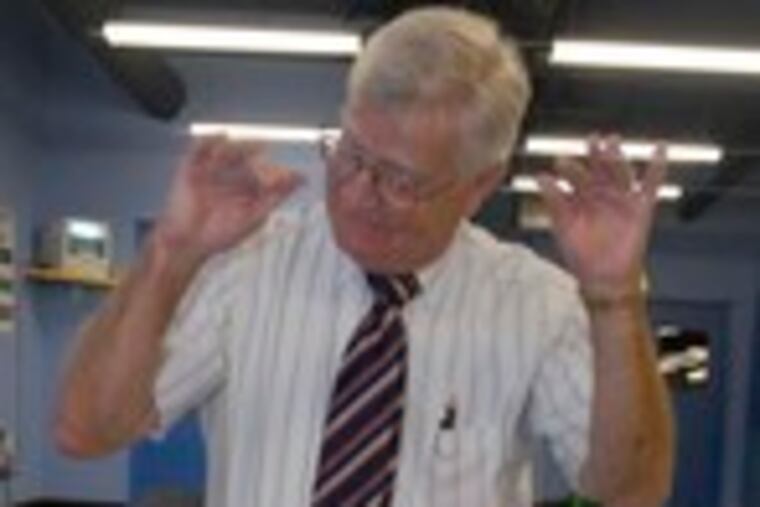
White-haired and bifocaled, he crouched on the puzzle mat in Frankie's World earlier this month to join a circle-time rendition of "The Itsy Bitsy Spider." The primary participants were Vincent Gay and his buddy Rymir Chapman, 2-year-old boys who hadn't yet mastered the vocals, but were into the music.
Before coming to the center, Vincent had never felt grass between his toes, or the sweet, icy shock of ice cream, or the scary thrill of a swing. Born prematurely, weighing less than a carton of eggs, he spent his first year in hospitals. After multiple surgeries, he had seen so many large hands come at him with needles and masks that he hates anything near his face - including food.
With help, his parents cared for him at home in Southwest Philadelphia. But the little boy with the gap-toothed grin, wire-rim glasses, and tiny sprinter's legs was pushing beyond the boundaries of his house. This past spring, his mother, Sabrina Jones, a financial-aid adviser, started looking at day-care centers. "As soon as they found out all his medical needs, they got scared," she says. "It's a lot of responsibility."
Then she heard about Frankie's World from a caseworker. His medical insurance agreed to cover the costs, and at the end of June, Vincent joined six other children enrolled in the center.
After circle time ends, Rymir, wearing a sport shirt open at the collar to accommodate the tube in his throat, mounts a tricycle, poised for what most 2-year-old boys would consider inaction. He clutches the wheel, rapturous.
Like Vincent, Rymir was a preemie and has multiple developmental delays, but driven by the natural competition among peers, he's pushing himself, says Heather Palasky, the center's director. On a recent outing, the boys had their first encounter with a lawn. Once Rymir realized the grass wouldn't hurt him, he flumped to the ground and rolled around like a puppy.
Licensed by the state to care for medically fragile children from infancy to 8 years old, Szucs's facility is one of only two in the city and eight in the state.
More are coming, says Deborah Boroughs, who runs a state program for children at home on ventilators. "They've been popping up over the past two years," she says, driven by dual trends - a nursing shortage and increased survival rates for extremely premature infants.
Szucs himself was responding to dual intentions - to do well and do good. "Jerry is a businessman who has a heart," says Walter Tsou, former Philadelphia health commissioner. "There's a huge need for this kind of program."
Although Szucs started Frankie's World as a business, at the first board meeting all involved agreed to invest all the profits - if they ever make any - back into the center.
"It just seemed," says Szucs, "like the right thing to do."