Luxury hotel - or hospital?
Penn's deluxe private rooms cost hundreds more.
What happens when the Ritz-Carlton meets
Scrubs
?
Patients willing to spend a few hundred extra dollars a day are finding out at the Pavilion, a 10-bed unit at Hospital of the University of Pennsylvania. Like similar enclaves at prestigious hospitals around the country, it marries the amenities of a five-star hotel with the medical care of a leading teaching hospital.
Hungry? A private chef can whip up oven-roasted salmon with prosciutto and melon relish or some braised short ribs with piperade sauce for you or your family.
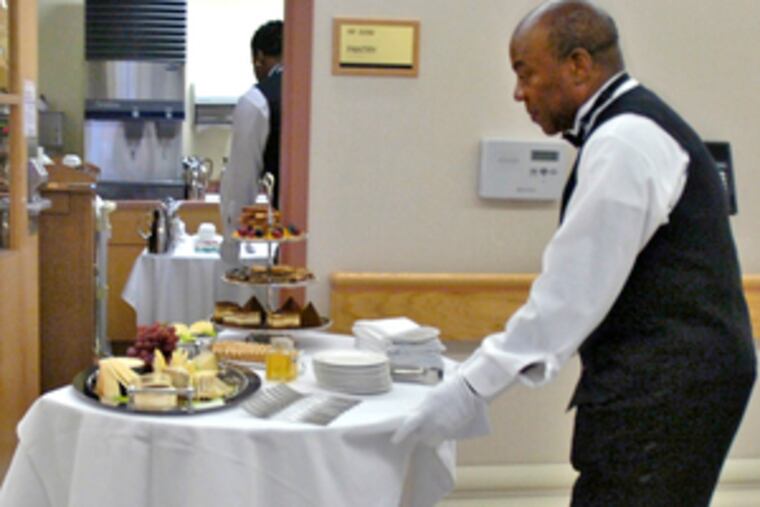
At 3 p.m., a friendly, black-vested man wearing white gloves arrives in the hall outside your tastefully appointed private room guiding a white-swathed table loaded with silver and picture-book sweets. It's time for high tea.
Pavilion patients get name-brand toothpaste, bottled water, extra-soft socks, and, perhaps most important, quiet behind the unit's imposing cherry doors. A concierge can help your family shop, order flowers, make airline reservations, whatever. The paintings on the walls belong to the Philadelphia Museum of Art. Like one? There's a number you can call to ask about the price. As a parting gift, you get a box of four fine chocolates decorated with the Penn seal.
Then there's the bill - an extra $350 to $450 a day, depending on your room's size.
At a time when much of the political world is focused on helping people afford medical care at all, big-name hospitals are finding that some patients will pay extra for privacy, peace and perks. At the Methodist Hospital in Houston, some pay a whopping $1,339 extra a day for a large suite in the Sue Fondren Trammell Pavilion. Because people with that kind of money are more likely than the rest of us to make donations, hospitals have an incentive to keep them cozy.
"Increasingly, American hospitals rely on philanthropy," said Ralph Muller, chief executive officer of the University of Pennsylvania Health System. Penn ranks second in the country for federal research money, he said, but diversion of government spending to Iraq has made hospitals scramble for other revenue sources.
Penn's Pavilion, which opened in January 2006, already has attracted more than $500,000 in gifts, which hospital officials say are used for everybody. People have paid to name rooms and the concierge desk. The naming rights for the pavilion itself are still available.
Deluxe units like this are largely the province of big, well-known hospitals. The VIP areas themselves tend to be small. Although some area hospitals have started offering upgraded food, massages or errand services, none in this region other than Penn offers this kind of luxury.
There are no numbers to support it, but some in the field say the upscale trend is growing as status-conscious baby boomers enter their hospital years. Unquestionably, they say, more hospitals are emphasizing hospitality to bolster patient satisfaction.
No one thinks a patient is going to come to a hospital only because it has fancy quarters. "That's not what's going to draw people," said Trish Archer, nurse manager of the Rollins Pavilion at Emory University Hospital in Atlanta. "It's the physicians that draw people."
But Penn decided to open the Pavilion because it learned that, despite its "world-class physicians," some patients were picking its national competitors - places like Johns Hopkins and Harvard-affiliate Brigham and Women's Hospital - because they had luxury units. "If we're losing patients because they can get a nicer room someplace else, that's of concern to us," said Larry Kaiser, one of the unit's medical directors and chair of surgery for the hospital.
Hospitals like Penn - which has an older building and few private rooms - also are facing competition from new facilities where everyone gets a room to himself.
In an unusual twist on that problem, UCLA Medical Center will open a new hospital next year designed by I.M. Pei where everybody will get a private room, sleeping space for guests, flat-screen TV, wireless access, and room-service-style food.
Its current building, dating from the '50s, has a special unit like the Pavilion. Now Lea Ann Cook, director of patient and guest services, is grappling with the big question: "In a building where every room is quite nice and we're focusing on service systematically, what is it that people really want and are willing to pay for?"
Penn leaders say medical care is the same throughout the 695-bed hospital, and the Pavilion is available to anybody with the extra cash. "We're not providing two levels of care, and we're very particular about that," said David Kennedy, the unit's other medical director and the hospital's vice dean for clinical affairs.
The unit can handle very sick medical and surgical patients, but not those requiring the attention of an intensive-care unit. Other parts of the hospital group patients with similar medical problems. Nurses at the Pavilion must have broader skills to handle the more varied patient mix.
Cheryl Boberick, the Pavilion's nurse manager, said each nurse has four to five patients, the same as in the rest of the hospital. But the 10-bed unit always has as least two nurses, no matter how many patients are there. Muller said it averages six or seven patients a day.
While some hospitals with luxury units also insist everybody gets the same medical care, others openly provide their first-class patrons with more nursing. The nurse-to-patient ratio at Methodist's unit, where prices start at an extra $350 a day, is 1 to 4. It's 1 to 5 or 6 in the rest of the hospital, said Alice Baker, patient liaison. Emory's Rollins Pavilion - $275 a day - assigns one nurse to three patients. Nurses elsewhere care for four to six patients.
The Pavilion's staff, including Kaiser and Kennedy, have received Ritz-Carlton training, an approach to customer service the hospital is spreading throughout the workforce. It emphasizes a "warm welcome and a fond farewell," said Kelly Brennen Abramson, administrative director for patient facilitated services and international programs. It also asks employees to lose the "it's-not-my-job" attitude and attend to any patient problem.
Sol Hirsch of Jackson, N.J., whose wife, Marjorie, was a patient at the Pavilion recently, was impressed with the service. "If I'd been staying in a five-star hotel, I couldn't get better service . . .," he said. "I wanted ice; it didn't take two seconds. Everybody's exceptional here."
Much staff effort is aimed at patients' families. Family members can wait in the patient's room during surgery. The suites are big enough for someone to sleep over. Impressive as the food is, many patients can't stomach a fancy meal. Their families can, for an extra fee. High tea is on the house - for everybody.
Marjorie Hirsch, who had come in for heart failure, and who was clearly feeling weak, said she shared some of her food with her husband and was relieved that he and her children were being treated well. "I feel like they take care of not only me, but my family," she said.
It's not perfect. Despite the more than 100 channels on the television in his wife's room, Bob Walsh said one recent afternoon that he planned to forgo the evening's gourmet meal and go to a sports bar. It was the only way he could watch the Phillies.