A testament to tradition
Rural synagogue comes to life just once a year.
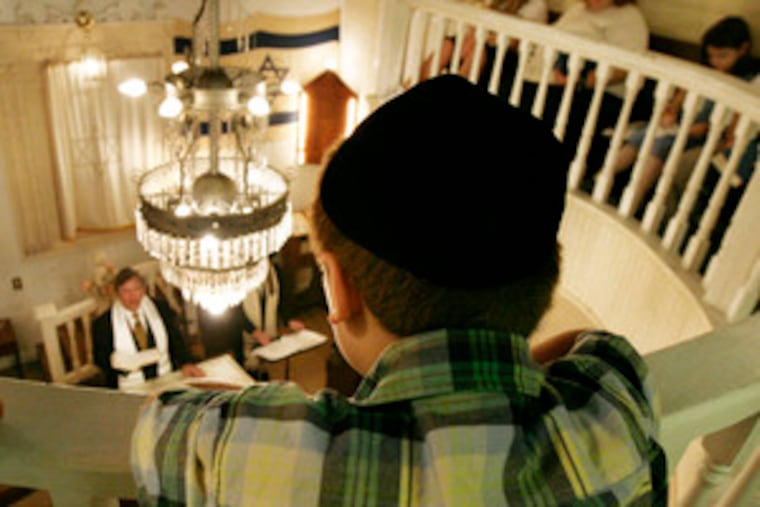
ROSENHAYN, N.J. - At his age, Morris Ostroff knows as well as anyone that there are some things to which you can never return, like to the way it felt when you were a child, or to when your children were little, or even, simply, to a time when your father was alive and sitting beside you in synagogue.
But then, living as he still does two doors down from that tiny old synagogue on a field fronting Garton Road, he knows that sometimes, return is possible, even if it's just one night a year.
That night was Friday, when this old Orthodox synagogue, founded by Jews from Russia who became farmers in South Jersey in the late 19th century, opened its doors for its only service of the year, Shabbat Shuvah, the Sabbath of Return, which falls between Rosh Hashanah and Yom Kippur.
And so it was with great care that Ostroff, 84, presided over this deeply felt ritual of return at Beth Israel, a synagogue no bigger than a two-car garage.
"That's why the Lord sent me here, to take care of that synagogue," Ostroff, a butcher by trade, said as he switched on the circuit breakers before the service, turning on the lamp above the Torah-less ark, his white baseball cap not yet traded in for a yarmulke.
"Who else should take care of it? I'm the only Jew on this road," he explained.
Not on Friday, though. About three dozen came, most from a Reform synagogue in nearby Carmel, complete with a guitar-playing female cantor, a far cry from the days when the women and children were sent to an upstairs balcony behind a curtain.
But there were also a handful of descendants of some of the original nine families - the Ostroffs, the Feinsteins, the Marcuses and the Rudolphs - who came to pray on Garton Road as their ancestors did. One arrived from Las Vegas.
"I remember my grandma and grandpop, how they used to sit in the corner and cry, as they confessed to God," Ostroff said. "There were 22 Ostroffs. We dominated one side."
Not hard to do in this shoe box of a synagogue, this Little Shul on the Prairie, with its still-impressive metal chandelier and blue-painted ceiling.
Despite its blue Star of David on the outside, it's not an easy place to find: Two nearby bridges are out from a nor'easter in April, and the congregants have all moved on in some way.
For decades, the shrinking membership meant that the synagogue would hold services only during the High Holidays, but by 1985 there weren't enough Ostroffs alive even to keep that going.
But on Friday, once back, the congregation seemed to find meaning in the idea that there was still something waiting for them, something imprinted on them as children, a place that couldn't possibly seem smaller as an adult, because, as one congregant put it, it's a place that couldn't possibly be any smaller.
Last week, Ostroff did what he has done just once a year for the last two decades to prepare for this night: a little vacuuming, a little dusting, running lines to get electricity.
The service was conducted by Rabbi Bradley Bleefeld - who, when his boisterous grandson escaped to the outside with a group of boys, remembered the restless days of his own youth - and Cantor Marlene Taenzer, both of Temple Beth Hillel of Carmel.
Ostroff sat alone in the front pew on the left. His wife, Helyn, 79, sat across the aisle on the right. They would have sat together, perhaps, if those front pews were any bigger. Neither one cried like their grandparents did. This night was too joyful for them, to see the pews filled, the candles lit, the prayer books opened.
The tears were left to Paul Marcus, 43, whose grandparents were founding members.
Still mourning the death of his mother in February, he had flown in from Las Vegas, fearing that this year would be the last year any service was held at all. That seemed like too much to lose, all at once.
"I'm sitting here crying," he said. "It's like losing a little part of my life.
"I remember coming here as a child. They complained I had mud in my shoes. It was so packed in here. To come back to where you're from is mind-blowing."
The land is deeded to the synagogue, but it appears that Morris Ostroff will be the last caretaker on this site. There are already plans in the works for the Jewish Federation of Cumberland County to move the synagogue to Alliance, a Salem County town that was the first Jewish agricultural community in South Jersey, along with several other synagogues, to form a museum of sorts.
Helyn Ostroff calls this the "Stonehenge of synagogues" and is not a big fan of that idea. Morris Ostroff is more practical. He knows the synagogue's days on Garton Road will probably not extend beyond his own.
But he has done what was asked of him. The Ostroffs have paid for new siding, new windows and other maintenance. And they keep the momentum going for each Shabbat Shuvah. On Friday, Helyn Ostroff cooked supper for anyone who stopped by. And as Morris sat in the front row, glancing again and again behind him at the packed pews, noisy children happily upstairs, clapping along with "Oseh Shalom," he shared his memories of the days when constables took you away for stealing a chicken, when a train brought in fancy theater-types from New York and Philly who viewed these farms as little country getaways, of the days when the synagogue was even smaller than it is now. "It was built in two sections," he noted.
On this day, when the High Holidays' notion of spiritual return became a literal returning, the concept of going backward to a place became a way to move forward.
"It exuberates me," Morris said. "What am I here for on this earth? Somebody told me to take care of the synagogue."