Area bakers can no longer eat flour costs
Amid the wheat crunch, the rising price of bread.
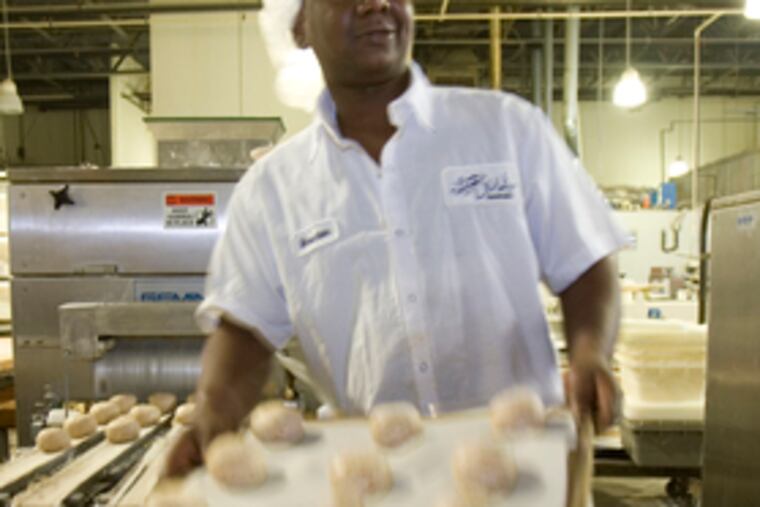
Anxiety, frustration and prices are on the rise in the kitchens that produce some of the Philadelphia region's most well-known breads and sweets.
Hear it from the bakers themselves:
"Catastrophic," said one.
"Oh my God," said another.
"Through the roof," said a third.
A local flour salesman - the bearer of bad baking news these days - summed it up this way: "They're in sticker shock."
Bread-makers are buckling under the heat of rocketing wheat prices. Their response: Raising their prices.
Drought, the weak dollar and rising crude-oil prices have caused wheat prices to nearly double over the last year, reaching about $9 a bushel in September. Prices have since settled - $7.66 on the Chicago Board of Trade yesterday - but are still much higher than the $5.45 this time last year.
That means flour is more expensive - and consumers are paying the price as the holidays approach. Bread prices have increased about 12 percent this year, according to Janney Montgomery Scott L.L.C. analyst Mitch Pinheiro.
The wheat crunch is part of an overall rise in the cost of food commodities, which are competing with gasoline, which can siphon more daily cash from consumers.
The government reported yesterday that food costs so far this year have risen at a rate more than double all of last year. Barley prices are up, too, which means consumers will dig deeper before they reach for a cold beer.
Local bakers said they resisted price increases through the summer, hoping that the wheat market would cool and prices would return to normal. But wheat-price declines are not in the near-term forecast.
Prices to fall in 2008
The U.S. Department of Agriculture expects grain prices to fall next year after farmers, enticed by the high demand and price for wheat, plant more crops.
"I can't ride this one out any longer," said Louis Sarcone Jr., of Sarcone's Bakery in South Philadelphia's Italian Market. He referred to the surging cost of flour with an unfettered, "Oh my God - it's doubled."
Sarcone raised prices Tuesday for the first time in five years after months of what he called "sucking it up."
"My most expensive loaf of seeded Italian bread, which is my most famous, is $1.55 a loaf," Sarcone said. "Last week, it was $1.35 a loaf."
LeBus Bakery owner David Braverman this week called the spike in flour costs "catastrophic."
"I was paying about 15 or 16 cents a pound in April," Braverman said. "I'm now paying 24 cents a pound."
LeBus buys 150,000 pounds of flour a week.
LeBus has raised its prices twice this year by a total of 12 percent and recently informed its more than 400 customers, who include many of the region's most well-known restaurants, that it would no longer accept bread-order cancellations without at least 24 hours notice.
Lots of adjustments
"We made a lot of adjustments," said Braverman, whose customers range from the swanky Four Seasons Hotel to the unassuming Down Home Diner at Reading Terminal Market. "We're simply being very, very careful."
Price increases also have recently taken hold at Philadelphia-based Tasty Baking Co., which produces the city's famous TastyKake dessert snacks, and Amoroso's Baking Co., nationally known for its hoagie and steak rolls.
"If they don't raise their prices, they're not going to be here a year from now," said flour salesman Robert Portley, of Reading-based Lentz Milling Co.
His bakery customers "are in sticker shock seeing their prices go up," said Portley, who sells to Sarcone's and others in Southeastern Pennsylvania.
The price surge has been caused, in part, by increased global demand and bad weather.
There was a second year of drought in Australia, which is one of the world's largest wheat producers, Pinheiro said. Bad weather also affected wheat crops in North America and Europe.
Rising crude-oil costs also are to blame, in that the increased demand for ethanol-based fuels has prodded farmers to plant more corn instead of wheat, he said.
"Instead of planting a second crop of wheat, you're planting a second crop of corn," Pinheiro said.
The declining value of the dollar is also a culprit. U.S. agricultural products have become more attractive to foreign countries because, simply, they are cheaper.
"We're on sale," Pinheiro said. "Our commodity market is having a 25-percent-off sale all year. There's a lot more demand for our exports."
Supply and demand aside, the meteoric rise of grain prices and even dairy prices remain nonetheless confounding to Sarcone. He said that on a gut level, it seemed that wheat should be largely immune from cost spikes - and yet, it is not. Neither is milk.
How, he wondered, can a gallon of gasoline, which requires drilling, transport and refining, cost less than a gallon of milk?
"Does that make sense, when milk just comes from a stinking cow?" he said.
"Think about that. Does that make sense?"