Camden low-income tenants to own homes for $1
There could be gold behind 91 green doors in Camden. As part of a deal to build low-income apartments in the early 1990s, a developer agreed that in 15 years he would sell each unit to tenants for the mind-boggling price of $1.
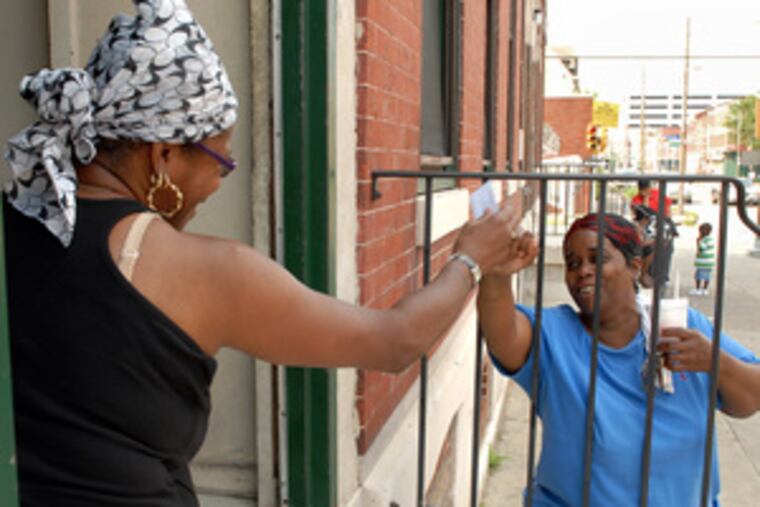
There could be gold behind 91 green doors in Camden.
As part of a deal to build low-income apartments in the early 1990s, a developer agreed that in 15 years he would sell each unit to tenants for the mind-boggling price of $1.
"Everybody did not believe that this development would exist for 15 years," said Israel Roizman, the builder and owner. "Because it's Camden. What can I tell you?"
Yet the Camden Townhouses, with their trademark forest green doors visible throughout Broadway and the surrounding area, have survived. And Roizman says he will keep his word and sell next year.
What that $1 sale really means for the units' low-income residents will be known tonight, when Camden City Council is expected to approve a $215 million plan to dramatically upgrade the largely blighted community, Lanning Square, where some of the homes are located. The rest are just a few blocks away, in Bergen Square.
"I'm sitting on a gold mine, huh?" asked tenant Carolyn Bethea, 49.
Maybe. Upon passage, the five blocks between Cooper University Hospital in downtown Camden and the Camden Townhouses would be almost entirely demolished and redeveloped.
A methadone clinic where drug dealers and prostitutes linger outside will be removed, making way for a medical school, student housing and higher-end stores.
The Camden Townhouses may have problems now - doors don't close properly, there aren't fire exits, residents complain about heating issues. But owning a piece of real estate in this part of town, particularly for $1, could be an American dream come true.
"I'll believe it when I see it," said long-time resident Darcell Gilmore, 38, a bartender.
Camden Townhouse renters qualify for federal Section 8 housing assistance based on their incomes. Few, if any, have ever been homeowners; some don't think they can be homeowners.
"The people who will be affected by it have still yet to believe," said the Rev. Al Stewart, of the Camden Community Temple Church, who has been trying to prepare residents for the $1 deal.
"They've been hoodwinked, they've been misled about a lot of things," Stewart said. "It's hard for them to believe what we're talking about is actually going to happen."
But it's likely to be complicated. Renters don't pay property taxes, homeowners' insurance, sewer fees or plumbers to fix toilets.
"You go and tell the people they have to [pay] the rent, water and sewer, taxes and insurance, they wouldn't know what hit them," Roizman said.
Because the deal was signed by the state Housing and Mortgage Finance Agency and the Camden Redevelopment Agency, Stewart says the government should assist residents educationally and financially to make sure they get their $1 homes.
Yet the residents haven't been told officially that the dollar deal even exists.
It's been so hush-hush that original tenants say they only recently learned that a 1992 agreement filed in City Hall contains this sentence: " . . . after a term of fifteen (15) years from the end of the Construction Period . . . the project unit rentals will be initially offered for sale for the sum of One Dollar (US $1.00) to the existing Low-Income Tenants.. . ."
A newspaper report two years ago revealed details of the agreement, but at the time Roizman would not say when he planned to sell. Now, he promised, he will sell next year, the 15th anniversary of the end of construction.
First, there are issues to work through, he said.
"I cannot go and just give each one a key. There has to be a transfer through the legal system," he said.
The state holds the second mortgage on the property, Roizman said, and it needs to approve the transfer. He also said he has investors who must sign off on the deal.
Roizman said he had one recent meeting with the state Housing and Mortgage Finance Agency (HMFA), and more meetings were planned.
A spokesman for the agency, Chris Donnelly, said he was not aware of any recent meeting with Roizman. The HMFA will assist in the process once Roizman details how he will turn the properties over, Donnelly said.
The Camden Redevelopment Agency, which signed paperwork in 1992 making it responsible for transferring the property to the tenants and setting up a homeowners' association, was unable to address the archived details of the arrangement yesterday.
Today, Broadway, which has many of the green-door homes, is marked by vacant storefronts, glass on the sidewalk and people who prey on clientele coming from the methadone clinic.
But inside the Camden Townhouses apartments, it's a different story.
Gilmore, the bartender, invites a reporter into her immaculate home on the Lanning Square side of Broadway, only to find that her son has left dishes in the sink.
She shouts for him to clean up, and he hustles from a back room to comply. In the living room, the maroon carpet is spotless, the coffee table's blue and orange candles are perfectly placed and the couches are a blinding white.
Gilmore rents, but she already lives like she owns.
A few doors down, Bethea, an original tenant, shows off the four-bedroom apartment where she raised five children after her husband died.
The walls are painted an earth brown that matches the leather-and-suede couches. Outside, a gutter hangs off the building and she has to pay someone $25 every few weeks to clear needles from the vacant lot next door.
Gilmore only pays $260 a month for her four-bedroom apartment. Another neighbor, Iona Evans, pays just $55.
For some, paying $1 for a house and then ponying up for transfer fees, taxes and maintenance costs could make owning unattractive.
"[There's] more with it than meets the eye," Evans said. "I know it."
The tenants pay on a sliding scale based on income. Each month, Roizman gets $63,000 from the federal government to supplement the rent on the units, according to the federal Department of Housing and Urban Development. That's $756,000 a year.
He also has a tax-exemption from the city that expires in January, according to tax records.
Stewart said if and when the residents get their homes, it won't be because of a lucky development deal.
"It's not really luck. I'd like to think it's answered prayer," Stewart said.
"It's a miracle on Broadway."