From Wall Street to Broad Street, jitters abound
If you needed a primer on consumer confidence, you could have found one at a South Broad Street bank branch yesterday morning:
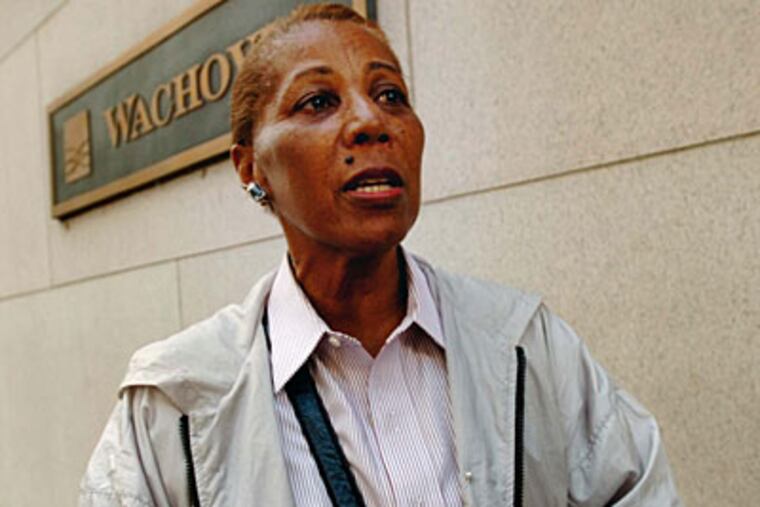
If you needed a primer on consumer confidence, you could have found one at a South Broad Street bank branch yesterday morning:
Hazel Gilstrop was taking her savings out of Wachovia and transferring it to Bank of America.
Not because a large chunk of Wachovia, the nation's fourth-largest bank, was being swallowed by Citigroup, the Center City woman said. It was because she had heard on the news that Bank of America wasn't being hit as hard by the financial crisis.
"I'm just an average person with little retirement savings. It's a mess for me," the 67-year-old said.
That description - "a mess" - was something everyone could agree on yesterday, as the House of Representatives voted down a $700 billion bailout plan that was supposed to stabilize the nation's faltering economy.
Around the region, people were supportive or dismissive of the rescue proposal, its failure leaving them skeptical or confident about the economy's ability to function more or less as it usually does.
"Things aren't as bad as people make them out to be," Ralph Rehn of Cherry Hill said.
He should know. He was a teenager during the Depression.
"I have some investments which are going down," Rehn, 91, said as he headed into the Genuardi's supermarket on Kings Highway. "They'll be back up again, but not in my lifetime."
All day yesterday, people asked themselves the biggest question of all: How is this going to affect me? And the answer wasn't always comforting.
"I will be graduating soon and it seems like it won't be to easy to find a job," Temple University junior Aaron Santos, 24, said outside the Wachovia branch at 1500 Market St. in Center City yesterday.
Shawn Ellis of Willingboro was walking out of the Genuardi's in Cherry Hill yesterday when he stopped to consider the impact of the crisis.
"A normal person can't survive with the cost of living," the 37-year-old high school teacher said.
Nine in 10 consumers believe the economy already is in recession, and in the last full week of this month the percentage who see more bad times ahead grew to 79 percent, up from 57 percent earlier in September, according to the Reuters/University of Michigan Surveys of Consumers.
"Lost confidence cannot be easily regained," Richard Curtin, who directs the surveys, said in a statement. "Confidence can be only restored slowly through experience."
He expects that over the holiday shopping season retail sales will post their lowest growth in decades.
"It's obvious that people are uncertain," said Christopher Coyne, an associate professor of finance at St. Joseph's University. "The system we have is based on faith and trust, and when that faith and trust is damaged, this kind of stuff is what happens."
Restoring trust requires providing an environment in which people know they can do pretty much what they had been doing - cashing checks, paying bills, getting a loan when they need one.
The government seemed poised to offer some psychic support yesterday, until the House defeated the rescue plan. Stocks fell before the 228-205 vote, and plummeted afterward.
"The market's telling you everything," said Alan Murphy, 55, of Bridgewater, a municipal bond underwriter. He was heading to a meeting with Philadelphia city officials when he got word of the vote. "Everyone was hoping it would pass. All the credit markets are locked up right now."
Yesterday the FDIC announced that Citigroup would acquire the banking operations of Wachovia, although the Charlotte, N.C., firm will keep its big brokerage business. That purchase comes days after the government seized Washington Mutual Inc. in the largest bank failure in U.S. history.
On Jewelers Row in Philadelphia, yesterday's overcast sky seemed to reflect the mood in shops where customers and confidence were sparse.
Stanley Schwartz, 72, and his son Robert, 42, were closing their store, Harry Merrill & Son, for the day while keeping a wary eye on a laptop that displayed news of the stock market.
"God help us," said Stanley Schwartz, who said that over 55 years three generations of his family had operated the store.
At Feiner's Ltd., Kevin Feiner, 52, said the problem with jewelry is that it's a luxury and thus an easy purchase for people to forgo in hard times.
"The only good thing," he said, "is we don't have to feed or freeze our product."