E-Z theft: Cheats get pass
Most tollgates open in the electronic lanes even when a driver has not paid. Authorities say it's a trade-off of speed vs. cost.
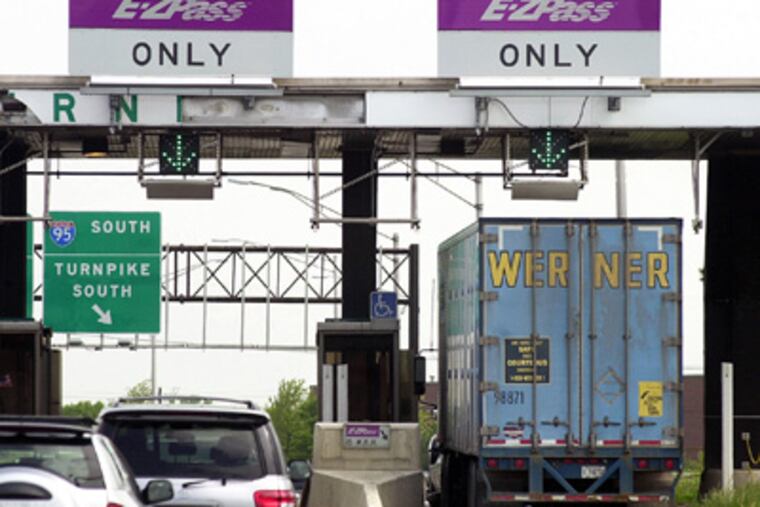
The advent of E-ZPass, the electronic magic wand that speeds commuters through tollbooths, also has given a free pass to scamps and scofflaws, not to mention the unaware and inattentive.
The Delaware River Port Authority has lost about $1 million since January 2007 in uncollected tolls, mostly to drivers using the E-ZPass lanes without an E-ZPass transponder or with a defective one.
The Pennsylvania Turnpike photographed 1.3 million vehicles not paying tolls last year. At an average fare of $3.20, that would amount to $4.2 million. About 25 percent of those - about $1 million worth - were written off as uncollectible.
The New Jersey Turnpike and Garden State Parkway lost about $6 million over the last four years to toll evaders. Delaware loses about $1 million a year to toll violators.
On the Atlantic City Expressway, cheaters in exact-change and E-ZPass lanes bilked the agency of nearly $2 million a year - about 3 percent of the annual $60 million in tolls collected on the highway.
But one local tolling agency uses an old-fashioned, low-tech way to beat deadbeats. The Burlington County Bridge Commission, which operates the Tacony-Palmyra and Burlington-Bristol toll bridges, had only 511 "unpaid transactions" out of 12.5 million crossings last year, a 0.004 percent cheater rate.
The reason? The toll-gates won't open if you don't pay.
"We don't have scofflaws," said Liz Verna, commission spokeswoman.
The downside to that, of course, is that it diminishes the main advantage of E-ZPass - a speedy trip through the toll booth.
In the Philadelphia region and around the nation, toll authorities are struggling to balance those competing imperatives: speed vs. money.
"We go to great lengths to keep things moving," said John Hanson, DRPA chief financial officer. If toll gates blocked nonpayers, "one person could completely back things up in a hurry."
"It's easier to deal with this set of problems," Hanson said.
On the four DRPA bridges (Ben Franklin, Walt Whitman, Betsy Ross and Commodore Barry), the toll arms go up whether or not the toll is paid.
On the Pennsylvania Turnpike, "we debated whether to have gates" when E-ZPass was installed in 2000, said turnpike spokesman William Capone. "It would certainly slow drivers down, and that sort of defeats the purpose."
The problem is severe enough that the E-ZPass Interagency Group, which represents the toll authorities in the 15 states using E-ZPass, recently created a task force to develop an interstate system for catching big-time scofflaws.
"A small percentage of users, probably less than half of 1 percent, are frequent violators, but if they're heavy users, they can run up big numbers," said James Crawford, executive director of the interagency group.
He said bordering states already were alerting one another to frequent offenders, and state police had begun trolling for violators with camera-equipped computers that read license plates.
E-ZPass has made it possible to replace human toll collectors with an electronic system that reads a signal from a transponder in a vehicle and automatically deducts the toll from a prepaid account or credit card.
When a driver goes through an automated toll plaza without an electronic transmitter or with one that malfunctions, a camera photographs the license plate and the car's owner is mailed a violation notice that typically demands the toll plus a $25 penalty.
Most drivers who get in a wrong lane or unintentionally skip the toll simply pay up. Some are wrongly billed. And then there are the repeat offenders who are the bane of the system.
Some try to thwart toll cameras by covering or altering their license plates. One driver caught on the New Jersey Turnpike had rigged a pulley system to cover his plate when he pulled a cord. A Florida motorcyclist wrapped his feet over his license plate to hide it from the cameras.
Last month, the Port Authority of New York and New Jersey said it was seeking $32,879 in unpaid tolls and fines from a Weehawken, N.J., woman who allegedly made 1,087 bridge and tunnel trips without paying.
Catherine Cappelluti, 38, blamed her ex-boyfriend for using her car during a six-year period when the tolls were accumulated.
Last month, the Atlantic City Expressway started taking its biggest violators to court.
First to get a summons from the state police could be a company that owes $14,000 - just for tolls, according to Kevin Rehmann, spokesman for the South Jersey Transportation Authority, which operates the expressway.
The DRPA says its biggest scofflaw is a company that owes about $18,000, and the next biggest owes $7,000.
The DRPA turns scofflaws over to the New Jersey Electronic Toll Collection Group, which handles E-ZPass accounts for New Jersey agencies. The group's customer-service center sends three notices to violators before turning the accounts over to a collection agency.
Criminal prosecutions are rare, though agencies say they increasingly are turning violators' names over to the police for prosecution as theft cases.
Last year, Delaware began prosecuting "habitual toll evaders" - those with more than $1,000 in violations - as felons.
And some states, such as California, have given toll authorities the power to prevent toll evaders from renewing their vehicle registrations. Neither New Jersey nor Pennsylvania has that power.
"We really have no teeth," said Capone, spokesman for the Pennsylvania Turnpike Commission. "We can't prevent you from renewing your registration or take your car. We don't have the ability to do that."
Nonetheless, Capone said, most violators on the turnpike pay up. Last year, the agency collected $11.6 million in tolls and fees from violators.