'Everybody's giving a piece . . . to survive'
When credit crisis threatens worst, car dealer's workers offer their best.
Scott Eckenhoff's guys weren't going down without a fight.
Not while there was still a chance to beat the odds.
And certainly not after seeing the boss break down in tears.
So much was at stake as the economy was souring: Eckenhoff faced losing his home if his Jenkintown car dealership went out of business. Four dozen employees would also be out of work - just as the U.S. auto industry was in a tailspin and the stock market had vaporized people's nest eggs.
Eckenhoff's business, a General Motors dealership that had been relatively healthy just months earlier, was suddenly a credit-squeezed enterprise holding on for dear life.
So two weeks ago, after praying with his family and pulling an all-nighter in front of his computer, Eckenhoff drew up a rescue plan. Half his employees, including a stepbrother, would have to be let go. It was awful.
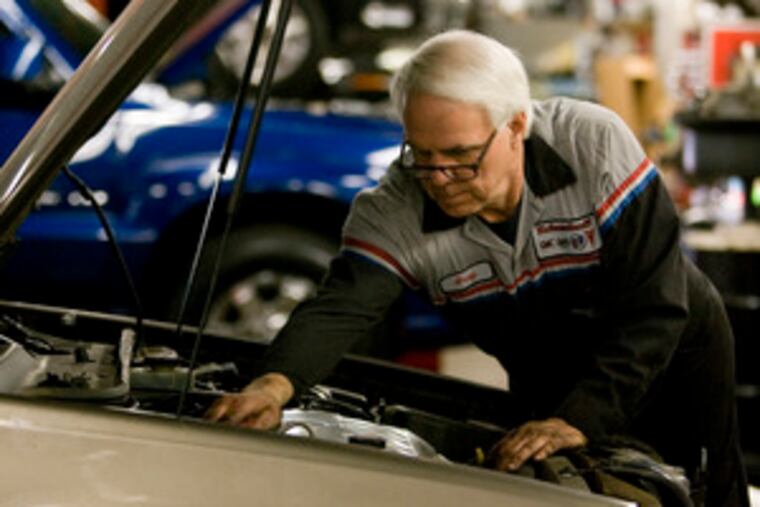
The day of the layoffs, though, something unexpected happened: The mechanics who had not been fired marched into Eckenhoff's office. "What can we do to help?" asked the men in grimy work gear.
With that, the lines that had long separated manager from minions, khaki-clad salesmen from grease-smeared mechanics, vanished. The survivors - the salesmen, associates and receptionists spared the ax - had become a single crew trying to save their ship.
Work one week at minimum wage to create a cash payroll reserve? Check. Even the owner and his top managers would clock $7.50 an hour. (The paltry pay stubs are due out this week.)
Stay late and on weekends? Check.
Dust off six-year-old sales leads? Done.
One mechanic - the veteran of the shop - even shared his paycheck with a pair of guys he knew would have trouble getting by during the low-wage week.
"Everybody's giving a piece of what they can to try to survive," said service manager Mike Lanzetta, 46, of Warminster. "None of us want to see this place go."
That means taking things "one day at a time," said Chuck Dampf, 49, a mechanic from Ivyland. "We're still here. That's step one."
Eckenhoff said his employees' grit and goodwill had been restorative and were improving the odds that his gamble would pay off.
"I've had days where I was in tears," said Eckenhoff, 47, who almost gave up two weeks ago but changed his mind after getting hugs from his 10-year-old daughter and courage from his wife, a breast-cancer survivor.
The cost-cutting already has added cash to his balance sheet. He also has eliminated most of his advertising budget and applied that to discounts on car prices in the hope of attracting customers, mostly via the Internet.
"It's just absolutely incredible," Eckenhoff said, "because it's something that nobody could forecast."
Indeed, despite the troubles that have hurt U.S. automakers for several years, Eckenhoff's tale is unique because it contains an element of extreme bad luck.
A few years ago Eckenhoff was at the top of his game. He sold enough Buicks off a six-acre lot in Cherry Hill to earn a case of trophies and a round of golf with Tiger Woods.
The grandson of a Center City Cadillac dealer, Eckenhoff had fallen in love with cars at 14 when his mother sent him there to work, first as a mechanic.
By the late 1990s Eckenhoff owned and operated his Buick dealership - among the largest on the East Coast - near the Cherry Hill Mall. But in 2004, as GM was trimming its Buick line, the company asked Eckenhoff to revive a defunct Jenkintown dealership.
Eckenhoff, an affable man, agreed. He took out two loans and signed a lease for Jenkintown. He eventually shut down the New Jersey business with the goal of selling the land, which he owned.
The cash would pay down the Jenkintown loans and strengthen his balance sheet. He figured it would be a snap to sell land so close to such a strong mall.
In May, the pressure rose when GMAC Financial Services, which helps Eckenhoff fill his lot with cars through a $9 million credit line, was being hurt by losses on its mortgage business. Tightening its lending, GMAC wanted Eckenhoff to pay down his bank loans.
But three deals to sell the Cherry Hill land fell through. Then, on Sept. 10, Eckenhoff and an electronics retailer agreed on a price. A deal was within reach.
On Sept. 15, the Lehman Bros. bankruptcy unleashed panic on the stock market, battering personal incomes and consumer sentiment.
Several days later, the president of the national retail chain visited Eckenhoff and pulled the plug on the Cherry Hill deal, saying the chain was reevaluating its expansion plans given the economy.
"When the last deal was done and we had an agreement on price, you can't believe the feeling in my throat when the stock market dropped 770 points and just hasn't come back since," Eckenhoff said.
Sales at the Jenkintown dealership, which Eckenhoff said had been equal to last year's, took a dive in the last month, making matters only worse. He had too much staff, not enough customers, and GMAC freezing his ability to bring in additional cars.
"There was a time," he said, "when I thought I was done."
That time came two weeks ago.
He told his wife and daughter, Erica, that he was closing down. Because his personal assets are tied to the GMAC credit line, their home would be in jeopardy.
Erica's face made him change his mind. Her hugs, too. The family prayed, and he drew up a reorganization plan that night. He e-mailed his managers at 3:30 the next morning.
Later that day he met directly with his sales staff - an unusual move - and cried. The staff decided it was time to fight.
"Now you go that extra yard," said Frank Raisman, who was not laid off. "You will make more calls. You will send more e-mails."
Two days later, after being spared layoffs, mechanic David Duff and his comrades walked into Eckenhoff's office.
"We said, 'We're willing to help,' " said Duff, 45, of Upper Moreland, who has worked there for 25 years. "He said, 'What do you suggest? I'm at my wits' end.' "
The guys accepted Eckenhoff's idea about going minimum wage for a week.
"Sometimes you've got to eat one, as they say in the business," said Greg Seaman, 60, of Warrington, who at 31 years is the shop veteran. He also donated a paycheck to two of his buddies.
The minimum-wage workweek has come and gone, and Eckenhoff is still searching for a lender to finance new inventory. His people are still selling cars, but not as many as a few months ago.
With word of the layoffs spreading through the community, rumors had the dealership closing, and people were calling last week to see if it was true, he said.
Eckenhoff said the restructuring had given him breathing room to line up financing in the months to come.
"If we're still here this time next year," said technician Dampf, "it worked."