Tough times hitting animal shelters, too
As the recession forces more and more Americans to downsize, leaving their homes and struggling to pay their bills, animal welfare groups report a dramatic rise in pets given up for adoption or abandoned on the street.
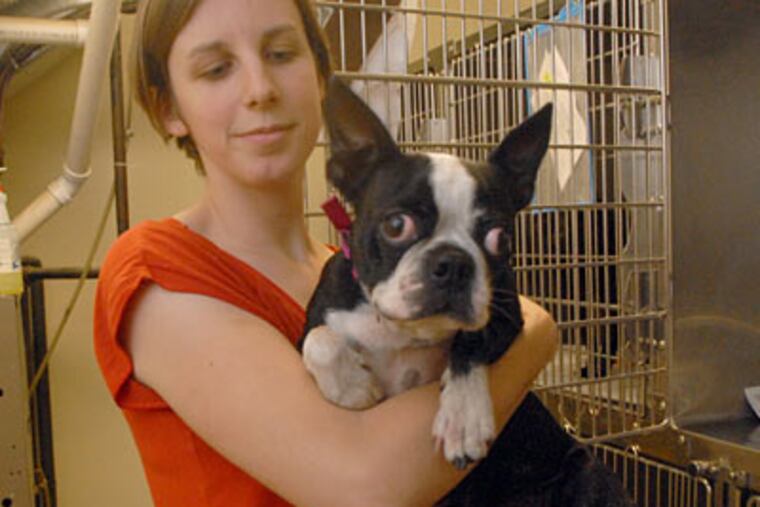
Samantha is cowering in the corner of a cage in the Philadelphia Animal Welfare Society (PAWS) shelter on Hunting Park Avenue.
"She's a little freaked out right now," says Natalie Smith, coordinator of community programs. "The noise in here is very stressful for some dogs."
The 5-year-old purebred bloodhound, with droopy jowls, soulful eyes, and a sleek caramel-brown coat, was dropped off the day before by her owner's friend.
"I couldn't bear to take her there," says Mary Stein. "It was horrible for me." Stein, 34, a veterinary technician who used to work at the shelter, had bought Samantha as a puppy. She raised the dog along with two adopted mutts in a house she shared in Kensington with two roommates.
With the economic downturn, however, one roommate moved to Texas for a better-paying job. And Stein, who most recently worked at Petco, had her hours cut back. No longer able to afford the house, she moved into a small apartment this fall.
"There just wasn't enough room for Samantha," Stein said, sobbing. "I have nowhere else to go. If I did, I never would have done this."
As the recession forces more and more Americans to downsize, leaving their homes and struggling to pay their bills, animal welfare groups report a dramatic rise in pets given up for adoption or abandoned on the street.
"We got a call from a young couple last Sunday," said Bill Smith, founder of Main Line Rescue. "They were on a payphone in a parking lot at a Burger King in West Chester. They said they were on their way to a [homeless] shelter themselves and needed us to take their dog and cat."
A passing social worker saw the couple and, realizing they were in trouble, stopped to ask if she could help, Smith said. "She drove them here." The dog, 10-year-old Chance, is a cross between a cocker and a springer spaniel. The cat, Charlie Brown, is 6 and has a deformed leg.
Two regional shelters recently received dogs after neighbors reported that the animals were kept in cars all day. In both cases, the owners were homeless and living in the cars with their pets.
When people come to a shelter to give up an animal, they are not required to explain their financial circumstances. So there is no firm data on how many animals have been left because of the recession, according to the Humane Society of the United States. Anecdotally, however, shelters across the country are reporting an increase not only in the numbers of pets coming in, but also in the emotional straits of their owners.
"It's a different kind of surrender," says Smith. "Usually, when people drop off animals, they're just not willing to take care of them anymore. But more and more, they would like nothing more than to keep them."
Some pet owners who are managing to stay in their homes give up their animals because they can no longer afford to feed them or treat their illnesses.
United Animal Nations, one of several groups that provide emergency funding for vital veterinary care, reports a 52 percent increase in applications this year.
"Last week, we took in a black lab with a broken leg," says Smith of Main Line Rescue. The owners had called an animal hospital in Trooper to find out how much it would cost to treat the dog. "When they found out, they took it to PACCA."
PACCA, the Philadelphia Animal Care and Control Association, is the nonprofit agency that runs the largest shelter in the city, taking in 30,000 animals a year. (PAWS is the group's "lifesaving" arm, which, since 2005, has promoted foster care and adoption to lower the euthanasia rate.)
Alerted to the dog's need, Main Line Rescue sent a volunteer to pick it up. "It was only five or six months old," Smith said. "It screamed all the way." The puppy's leg was treated, and when it recovers from surgery, it will be available for adoption.
"The situation is bad," says Stephen Zawistowski, executive vice president and science adviser for the American Society for the Prevention of Cruelty to Animals. "It's a sort of triple whammy."
Pet owners are under economic pressure, which increases demand at shelters, which are running out of room and money. Meanwhile, local governments are cutting back support for the shelters they run. And finally, private donations are dwindling.
"The last number I heard was that six million Americans are potentially looking at foreclosure. We expect 60 percent of these homeowners have a pet. That means 3 to 4 million pets are at risk."
Jon Snyder, of the Humane Society of the United States, says that in his 10 years with the organization, "we've not seen anything like this.
"Animal welfare agencies always struggle," Snyder says, but this year "few if any have the money they need to do what they need to do correctly."
At the shelter on Hunting Park Avenue, staff members regularly go home in tears, says John Pastor, shelter manager. "This place has plenty of 'Oh my God's,' " he says, passing a cage with a mother cat and her two-week-old kittens.
Then there is Boss, a magnificent Akita, big as a Great Dane, found by police two months ago wandering in North Philadelphia. And Azul, a 3-year-old, blue-eyed Australian shepherd mix. And Pepper, an effusively affectionate mutt who was adopted five months ago. Her owner returned her on Wednesday, saying she could no longer care for her.
Samantha was luckier than most. She was adopted on Saturday.
Her former owner, Mary Stein, says she's all too aware of what can happen to pets that don't find homes.
For two years, Stein says, she worked at that shelter on the 3:30-to-midnight shift, euthanizing animals that were either too ill or aggressive to be adopted. "Eventually, it got too hard for me."
Stein also spent 13 years at the Philadelphia Zoo, leading elephant and pony rides. With the stress of losing Samantha, she says, she's taking a break from working with animals, cleaning houses part time instead.
"I'm doing my best to take care of my other dogs," she says. The expenses are constant, but so is the love.
"Just like children."
Advice for Pet Owners
Start a savings account for emergency veterinary care. Even $5 per month can add up to a significant amount.
Spay and neuter all animals and practice good routine care, including necessary vaccinations, heartworm and flea prevention.
If, despite your best planning efforts, your veterinary bills are piling up, ask your veterinarian if you can work out a payment plan.
Contact your local shelter. Some shelters operate or know of local subsidized veterinary clinics or veterinary assistance programs.
Many organizations that provide help are restricting grants or refusing new applications because of the economic crisis. However, you can still try:
Adoption or volunteer sites:
EndText