With no insurance, broken arm becomes long ordeal
Richard Hershman couldn't find a doctor to fix his broken arm. When he finally did, his arm needed to be rebroken.
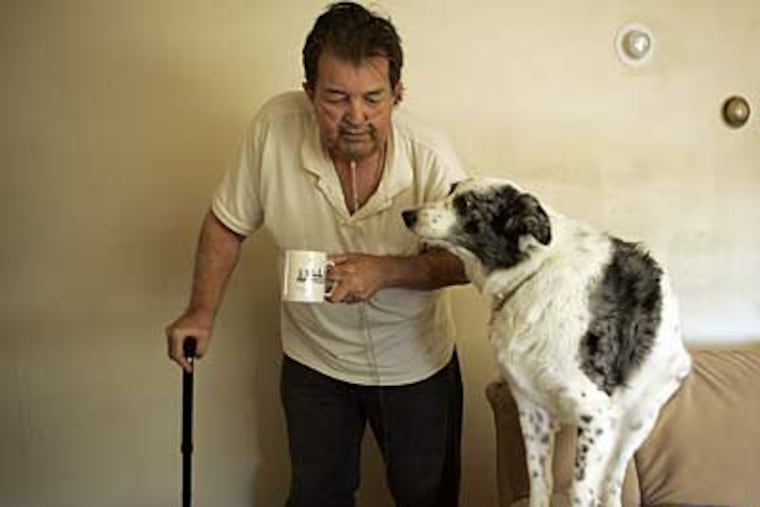
Richard Hershman, 62, has this advice for his daughter: "Everything I did in life, everything I do - you do the opposite, and you'll be fine."
That goes double for health insurance. He didn't have it earlier this year when he broke his arm, and suffered - literally - because of it.
Hershman had every opportunity in life - loving parents, middle-class upbringing in Overbrook, presidency of his elementary school. But his parents imposed no discipline, he said, no limits.
Soon he was into 1960s love and drugs. And more drugs. In 1974, at 27, he said, he saw his cousin, with whom he shared a bedroom like a brother, leap through a 10th-floor window on City Avenue. He said he was the one who persuaded the family to pull the plug on his brain-dead cousin, let his kidneys save somebody else's life.
That propelled him into even more drugs.
"I did everything I could not to feel anything," Hershman said, "because I was so torn up inside."
For many years, he did have health insurance through the fund-raising company he worked for. Hershman solicited over the phone, raising money for the firefighters fund, or the state police auxiliary. But the owner dropped Hershman from the plan, he said, because his ailments were driving up costs for everyone.
A lifelong smoker, Hershman said he now can work only part-time at best, and has no money to buy private insurance. He takes methadone to ease the pain from his years of drug addiction. He suffers badly from emphysema, and is on oxygen 24 hours a day.
He lives in a small, messy apartment on Rhawn Street in Northeast Philadelphia. He's been divorced four times. His daughter, 24, helps when she can, he said, but she's living her own life, and who can blame her. A social worker with Jewish Family and Children's Services looks in on him.
Hershman has one friend in the world, his beautiful, devoted dog, Blue, an 8-year-old border collie.
On Jan. 17, Hershman was out in front of his apartment, giving Blue a short walk. He slipped on the ice. His bones are as brittle as twigs because of years on the steroid prednisone to treat his diseased lungs.
His arm snapped.
An ambulance took him to the emergency room at Nazareth Hospital, where, he said, "I was in and out like a car wash."
The ER staff X-rayed his arm, stabilized it in a splint, and told him to follow up with an orthopedic surgeon, because he was going to need surgery.
He called the Rothman Institute on Holme Avenue, across from Nazareth Hospital.
"The first question they asked me was, 'Do you have insurance?'
"I said no."
"OK, bring $600. That's for your initial consultation."
"Ma'am," he says he told the woman on the phone, "I have emphysema and am borderline impoverished. I don't have $600."
She said, " 'Well, you can't come here,' " he recalled.
In an e-mail, a Rothman spokesman said it was policy not to comment on individual cases. "Rothman Institute, as a private medical practice, works closely with self-paying patients in an effort to accommodate their needs, including offering structured payment plans for self-pay patients," the e-mail said.
Hershman said he called around, looking for doctors who would operate, elected officials who could help him, and got nowhere.
Hershman said it took six weeks "of me being in utter agony" before he was approved for medical assistance by the state Department of Public Welfare.
He was aided in this effort by the staff of the Pennsylvania Health Law Project, which helped speed along his application for medical assistance - state-provided health insurance for the poor - effective March 1.
Then he got an appointment at Temple University Hospital with Asif M. Ilyas, assistant professor in the Department of Orthopaedic Surgery.
Hershman says the doctor's first question was: "Why did you wait so long to get surgery?"
Hershman said he told the doctor he tried, but nobody would help.
Ilyas operated on March 2.
"He had difficulty finding a surgeon because he didn't have health insurance," the doctor confirmed.
"Typically, we get to this within the first one or two weeks," Ilyas said of breaks like Hershman's.
Because of the delay, the doctor said, "the fracture began to heal in an abnormal position. As a result, the procedure was more extensive and more complicated than had I been able to do this when it was a fresh injury."
"We had to re-break the bone, reset it, use bone grafts we don't normally use, and bone implants."
Hershman has nothing but praise for his doctor and is grateful for the surgery.
Because of the delay in surgery, the scar, rather than an inch or two, now runs all the way from his shoulder down his arm. "I look like Frankenstein," Hershman said.
Hershman says his arm is weaker than it used to be, and the doctor concedes the chances of a full recovery are smaller because of the delay.
Did the delay increase suffering?
"No doubt, no doubt," Ilyas said.
Emergency rooms in the United States are required to stabilize patients with life-threatening injuries.
But hospitals and doctors are not required to conduct tests, give chemotherapy, or do surgery on broken bones - "things that would hurt you slowly, or kill you slowly," the doctor said - if a patient doesn't have insurance or can't pay.
The surgeon said he was no health-policy expert. And changing the system would be complex.
But "there needs to be some basic coverage that everybody has, so nobody's put [out] in the cold," he said. "So you don't go home with an injury like this with no place to go."
What Went Wrong
Richard Hershman is sick and poor, partly, he said, because he abused drugs and did not lead a model life. When he slipped and broke his arm, he could not get surgery to repair it properly because he had no insurance.
So his bones set improperly, and six weeks later, when he finally had coverage, the surgeon had to re-break the bones, and reset them, because the arm had begun to heal improperly.
The case shows how uninsured people often experience delays in care because of their insurance status. EndText
The Next Installment
Mary Gannon worked a new job, as a medical assistant temp, without health insurance. When she felt a lump in her groin, she paid out of pocket for initial testing and to have the lump removed. When she couldn't afford a $3,000 PET scan to determine the severity of her cancer, she had to wait until she was determined eligible for charity care or approved for medical assistance. She waited eight weeks, an extremely stressful and potentially dangerous delay.EndText
.