Christmas trees: Due for downsizing?
Black Friday is the day Christmas tree growers look forward to all year. At last, it's time to make money.
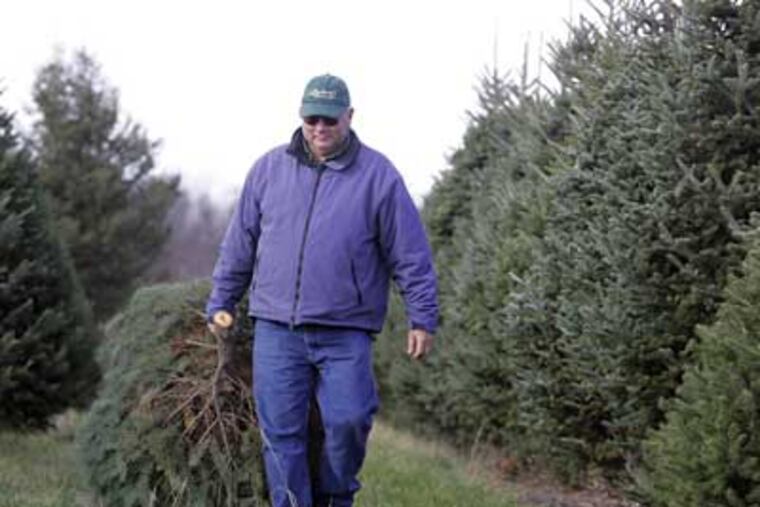
Black Friday is the day Christmas tree growers look forward to all year. At last, it's time to make money.
But American consumers aren't spending as they used to on cars or clothes or cappuccinos, leading us to wonder:
Will Christmas trees get the boot, too?
Interviews with growers, psychologists and consumers, with a loose reading of tea leaves tossed in, suggest the answer is a qualified no. It's more likely folks will buy smaller or fewer trees, cheaper or less nearly perfect trees, they say, than forgo this beloved holiday symbol entirely.
"The Christmas tree becomes the center of the family tradition, and for many families it is a holder of memories," says Donna Tonrey, psychology professor and director of La Salle University's marriage and family therapy program.
Frank Wiechecki, father of 2-year-old twins, is just beginning to invest in that memory bank. So while there will be fewer presents under the tree this year, there will be a tree - if a less expensive one.
"We always have a live tree - it's a tradition - but we'll probably be watching the expense much closer this year," says Wiechecki, a corporate recruiter in Center City who lives in Wilmington and usually spends $65 on the annual evergreen.
That's about as good as the news can get in Pennsylvania, which has 2,200 Christmas tree farms, more than any other state, and ranks fourth in the nation in number of trees cut (1.7 million) and sales (about $30 million) per year, according to the U.S. Department of Agriculture.
By comparison, New Jersey cuts 133,000 trees a year, ranking 18th.
Even before the economy went bad, growers were having a rough time of it.
Thanksgiving falls at the very end of November this year, eliminating a week of tree sales right off the bat. Unlike other retailers, growers say they won't sell earlier; their product is perishable, and customers are too focused on Turkey Day, anyway.
Plus, costs have skyrocketed: labor, transportation, pesticides and petroleum-based fertilizers, wire, even ribbon.
True, gasoline and diesel fuel are coming down, but they've been historically high for months. And the hike in fertilizer has been staggering; growers who paid $330 a ton just a few years ago now pay $1,200.
David Croshaw, who is selling about 2,000 choose-and-cut trees at his farm in Columbus, Burlington County, is one of the few area growers to raise prices this year.
It's only $4, from $38 to $42, and it's his first increase in four years. But he's clearly nervous about it.
"It's maybe not the best year to do it, but it's got to be," Croshaw says, calling the economic climate "very strange.
"Will people buy trees?" he asks. "It just boils down to what they want to do."
And so it has always been, suggests Malcolm Lars Crooks, who's growing 33,000 Christmas trees at Tuckamony Farm near New Hope.
When his father began selling Christmas trees in 1934, during the Depression, Crooks says, they cost 65 cents each. Sounds like a pittance, but if you were out of work, without unemployment insurance, Social Security or welfare to draw on, 65 cents could loom large.
Despite that, Crooks says, "I always heard that people in hard times maybe cut down the number and size of presents, that they may not have had much else, but they still bought trees."
Sales have ebbed and flowed in this country, depending on the fashion and the times, since the first European-style tree was displayed at the new Moravian Church settlement in Bethlehem, Pa., in 1747.
For countless families since then, the rituals surrounding the Christmas tree - picking it out, lugging it home, putting it up, decorating it and opening the gifts underneath it - have come to "symbolize the timeline of the family and the family's development," says Tonrey, the psychologist.
"From year to year," she adds, "the memories are cherished, which helps to enhance the positive feelings for the holiday."
Today, Americans buy between 25 million and 30 million cut trees a year, with increasing incursions from artificial trees, which the live-tree industry pointedly calls "fake."
"Now you've hit my hot button. They're our Number One competitor," says Phil Civello, president of the 312-member Pennsylvania Christmas Tree Growers Association and owner of Misty Run Tree Farm in Annville.
Industry research shows that from 2002 to last year, the number of U.S. households buying real trees went from 22 million to 31 million. Artificial went from 7 million households to 17 million, which does not reflect the number of households that already had an artificial tree. They can cost more, but last for years.
The zooming market for artificial trees gave birth this month in California to its own trade group, called the American Christmas Tree Association. Thomas Harman, an association director and CEO of Balsam Hill, an artificial-tree company in Redwood City, Calif., said the organization's goal is to "make sure the truth about Christmas trees is out there."
With so much at stake, the rhetoric surrounding "the truth" has grown markedly hostile.
The live-tree group's Web site (www.christmastree.org) now features an online game for kids called Attack of the Mutant Artificial Tree. The artificial-tree group's Web site (www.christmastreeassociation.org) warns that live trees can be dirty, buggy fire hazards, and a nuisance to deal with.
While the two groups hustle for customers, another trend is inching up: a growing number of people who are too busy, transient, mobile, elderly, indifferent or poor to bother with a Christmas tree of any kind.
Rick M. Bates, an associate horticulture professor at Pennsylvania State University who studies the Christmas tree industry, says the nation's changing demographics also reflect more people without any Christmas tradition, religious or secular.
"As we become more diverse, that will have an effect on the industry," he says.
For those who do have that Christmas spirit and insist on a live tree, there's good news on one front: Locally, this year's crop of balsams and blue spruces, Douglas and Fraser firs enjoyed good fall rain coupled with early cold weather and frost.
"This means they're well-hydrated and will hang onto their needles real well this season," Bates says.
Kathy Ott, a retired legal assistant from North Wales, is happy about that. "Christmas trees are very important, and people will sacrifice anything to have one, especially if you have children," she says.
Ott's family couldn't afford a nice tree when she was growing up in West Philly and West Oak Lane.
"My father used to nail branches to a bare tree, and believe it or not, it was beautiful when he got done with it," she says, cherishing the memory still.
How ironic, then, that she married a widower with a strong attachment to his artificial tree.
"It doesn't really matter that much to me," Ott says, "as long as we have the feeling of Christmas."
And as long as she's free to improvise. "I get fresh branches and put them on top of the highboy," she says with a smile.