A Rutgers 'incubator' for small businesses
BRIDGETON, N.J. - Combining old family recipes and years of catering know-how, Linda Twining and Kathy Herring were sure they had a pretty good formula for an organic chicken potpie.
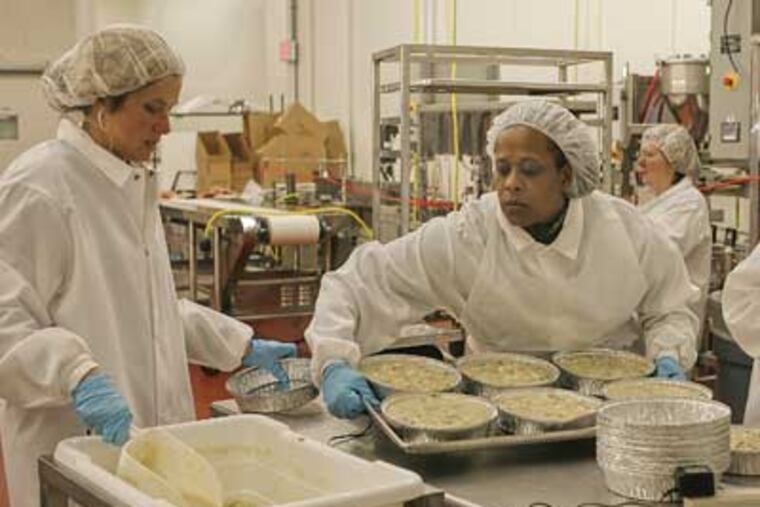
BRIDGETON, N.J. - Combining old family recipes and years of catering know-how, Linda Twining and Kathy Herring were sure they had a pretty good formula for an organic chicken potpie.
But the tens of thousands of dollars needed to meet government manufacturing standards threatened to end the Princeton entrepreneurs' dream of mass-marketing their homespun Twin Hens brand.
Then they found the Rutgers Food Innovation Center, a quietly emerging business incubator that opened in Bridgeton in October.
"It's like a dream come true to be able to walk into this kind of a facility and be able to have such a hands-on approach to what we are trying to accomplish," said Herring, 45.
"We started producing the product by renting a firehouse kitchen, but our needs got too big for that. The alternative was to either buy space at a large-production manufacturing plant or to come up with the money to build our own facility," she said.
Neither choice was appealing, the culinary school graduates said.
"At a large plant, we wouldn't have been able to be as hands-on," said Twining, 51.
Last year, at a wholesale show in New York, the chefs met representatives from the Food Innovation Center and made plans to produce their potpies there.
Rutgers University put its agricultural extension center off Route 49 because the area remains the hub of New Jersey's food-processing and agricultural industries. Cumberland County has produced not only prized tomatoes and tomato products but also corn, peppers, apples, and peaches. So rich is the soil that Welch's established itself as a grape-processing powerhouse in the county at the turn of the 20th century.
But the economy here has stagnated the last few decades as processing facilities moved away. Bridgeton's per-capita income of $10,917 a year is the second-lowest in New Jersey, where the statewide average is $27,006.
The establishment of the Food Innovation Center may help create a rapport between produce farmers and small entrepreneurs - and even well-established companies.
The "soup-to-nuts" approach to developing products and companies sets the center apart from 14 other business incubators in New Jersey and about 7,000 worldwide, said Margaret Brennan-Tonetta, director of economic development at Rutgers' New Jersey Agricultural Experiment Station.
Prospective businesses can choose from a menu of services, including public relations and marketing, business mentoring, product packaging and process development, and food production, she said.
"Someone can walk in here who may have an idea to produce perhaps a family recipe for tomato sauce, and we can help them develop a brand, market that brand, and then produce their product," Brennan-Tonetta said.
Established companies use the center to produce and market products, said its director, H. Louis Cooperhouse. The center has relationships with about 50 firms.
"I'm working with an Italian company right now that wants to break into the U.S. market but doesn't want to go with the expense of building a plant for production until they've kind of stuck their toe in the water and figured out whether they can make a go of it," Cooperhouse said.
The creators of Twin Hens potpies were up with the roosters on a recent morning for a daylong shift to produce about 100 pies at the center.
They had completed the food-safety and procedure courses that Rutgers requires before a company can buy kitchen time, which runs from $800 to $1,500 a day.
A U.S. Department of Agriculture inspector had arrived even before they did to ensure that the facility and the ingredients - which the center had trucked in a day earlier for Twin Hens - met safety standards.
Inside, Julie Elmer - the center's associate director of food technology, who helped Twining and Brennan adjust their recipe to yield 100 pies rather than a half-dozen - assisted as they made a batch of filling.
The center's food microbiologist, Donna Schaffner, had a detailed plan for every step in the potpie process. The flow chart ran more than 40 pages.
"It's when these processes aren't followed that companies can run into trouble," Schaffner said.
The women kept the crust flaky by popping the pies into the center's flash-freezers as soon as Herring ladled in the warm filling and Twining weighed each to guarantee consistency. The freezers quickly cooled the filling so the top crust - hand-punched with a hen design - could be laid on.
The entrees were then frozen and boxed. The completed order remained at the center for a couple of days until it was distributed to Whole Foods, Dean & DeLuca, and other regional markets. The 21/2-pound pies retail for about $28. A 9-ounce version, including a new Tex-Mex-style vegetable potpie, sells for about $11. The line also includes a beef recipe.
Science aside, Twin Hens' main goal is taste.
"We really want the end product to taste like it does when you make a potpie yourself at home," Herring said.