Aid for church in the (baseball) cards
David Smith just wants to do some good. That's why he rides the train from Berwyn to North Philadelphia every week to volunteer at St. Malachy Church and that's why, when he heard about the campaign to fix the pipe organ, he immediately thought of the tin box in his dresser drawer.
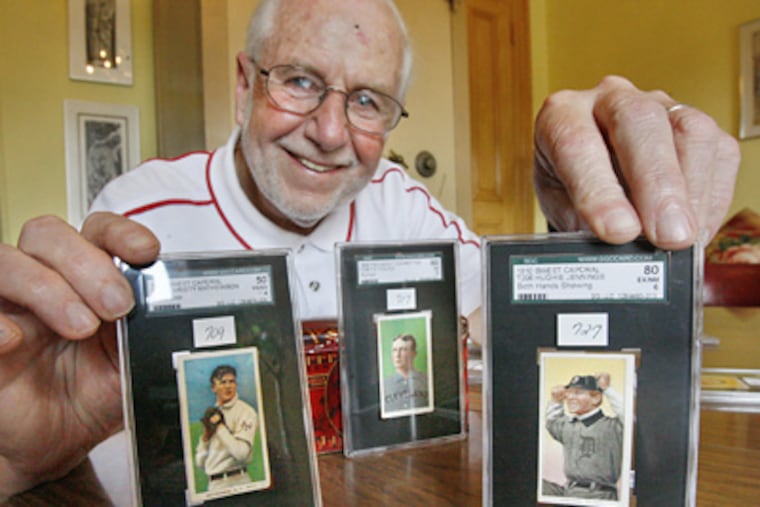
David Smith just wants to do some good. That's why he rides the train from Berwyn to North Philadelphia every week to volunteer at St. Malachy Church and that's why, when he heard about the campaign to fix the pipe organ, he immediately thought of the tin box in his dresser drawer.
Maybe his father's old tobacco cards, bearing the likenesses of baseball greats Cy Young and Walter Johnson and Tris Speaker among many others, could help.
"I thought maybe they'd be worth five bucks each or something," said Smith, a retired administrator who worked at Villanova and La Salle Universities.
His estimate was as modest as the man himself. Turns out the cards, which will be included in a live auction during All-Star Game festivities in St. Louis this month, could be worth $35,000 or more. The windfall will help a team of volunteers continue repairing the beautiful old organ, damaged by a 1997 roof collapse and careless workers. The estimated cost of the project is $350,000.
It is quite a tale, the nearly forgotten contents of an old tin box turning out to be treasure for baseball memorabilia collectors. But it is just the final twist in a remarkable story that began in the mid-19th century and includes the writer of "Take Me Out to the Ball Game," the baseball Hall of Fame, and the invisible ties that reach across generations of Philadelphia families.
Jack Norworth left the city, the organ business, and even the family name behind in his quest to find fame and fortune in the theater. He succeeded, too, becoming a vaudeville star and composer of more than 2,500 songs, including the classic "Shine On, Harvest Moon."
A century ago, as the legend has it, Norworth was riding a train in New York. He saw a sign for a baseball game and started writing down lyrics about a woman who loves the national pastime, knows all the players, and urges her beau: "Take me out to the ball game. Take me out with the crowd."
Yes, decades before Harry Kalas sang it during the seventh-inning stretch, "Take Me Out to the Ball Game" had a Philadelphia connection. That connection is what brought Tim Wiles to town. Wiles, who works for the baseball Hall of Fame, was researching a book on the history of Norworth's song (the music is by Albert Von Tilzer), and had an idea.
Wouldn't it be great to record the song as played on one of the magnificent organs created by Norworth's grandfather, Henry Knauff? The search for a Knauff organ led him to St. Malachy, a historic Catholic church at 11th and Jefferson. Wiles found the organ in a terrible state, many of its pipes destroyed by repairmen who stood on the instrument while working to fix the roof.
A committee led by engineer Gene Troxell was already trying to repair the organ. When Wiles brought to light the link between Knauff and his estranged grandson, an idea was hatched. With the Phillies winning the World Series last year, why not connect the fund-raising efforts to baseball?
It was decided to hold a concert in the church on April 5, opening day for the Phillies. Wiles read "Casey at the Bat." A barbershop quartet performed "Shine On, Harvest Moon" and "Take Me Out to the Ball Game." Then the song was performed on the organ, which fills a second-story loft opposite the church's ornate altar.
"The goal was to raise funds," said the Rev. Kevin Lawrence, the pastor at St. Malachy, "but also to celebrate baseball, the Phillies, and the organ itself."
Sister Cecile Ann Reiley organized the event, which included a silent auction of items donated by parishioners and friends of the church. That's where David Smith and his tin box came in.
Smith's home parish, St. Isaac Jogues, is a sister church to St. Malachy as part of an archdiocesan program that links suburban parishes to those in the inner city. Smith volunteered to help out at St. Malachy once. That was in 1993. He's been coming almost every week ever since.
"Some days I don't do much," Smith said. "Other times I'll work on the computer or handle billing for the school or get a mailing out."
He had never been to the church before, but was struck by a clock that looked exactly like one he had at home. On closer inspection, he saw the two clocks had the same brass plates with inscriptions.
"My grandfather, who I never knew, was the head of the St. Malachy's Young Men's Benevolent Association from 1894 to 1930," Smith said. "They gave him that clock."
When he heard about the baseball auction, Smith got out the red-and-gold tin box - it was made to hold Chichester's Diamond Brand "female pills," according to the black lettering - and took the smallish cards out. He was surprised to find so many - about 450 with color drawings of players on one side and ads for tobacco companies on the other.
When Smith brought the cards in, Lawrence thought it was a good idea to learn more about them. David Hunt of Exton-based Hunt Auctions was asked to assess the value of the cards.
"There is a pretty set market for cards like this," Hunt said. "This was unusual because of the quantity - usually someone will have 30 cards or something like that - but it is not that unusual for someone to have something of value like this and not know it."
Hunt's company offers free appraisals, and he recommends having old cards and artifacts checked out.
"You should know what you have," Hunt said. "Whether you sell them or not, that's up to you."
Smith said he was "taken back" by the value of the cards. Lawrence was, too. He knew what he had to do.
"Dave kindly gave them to the parish for the auction," Lawrence said. "But I can't take something of that value without someone being aware of it."
Smith declined to withdraw his donation, though. He'd been riding the train from Berwyn every week to be of service. He'd become part of the St. Malachy family, and he'd seen others donate time and expertise to try to repair the organ. He donated the cards in hopes they would help, so why would he take them back because it turned out they'd help more than expected?
The cards - which include about 70 Hall of Famers - can be viewed and bid upon online at huntauctions.com. They could bring in even more if some of the rarer ones, including a Ray Demmitt-Polar Bear tobacco card and a Cy Young in excellent condition, create a bidding war in St. Louis.
But the real beauty of the story is in the coincidences and connections. Smith's grandfather was at St. Malachy when Norworth dropped the Knauff name and left Philadelphia. And it's easy to picture Smith's father - a coffee merchant based at Front and Chestnut - humming that 1908 hit tune, "Take Me Out to the Ball Game," as he collected those cards from 1909 to 1911.
And there's a poetry to Norworth, who fled the family business, inadvertently helping to repair one of his grandfather's pipe organs. Sister Cecile captured it in a haiku she composed for the April 5 fund-raiser:
Baseball's Greatest Hit
Grandson bonds with grandfather
And rescues organ!
As for Smith, he has only one minor regret. After he donated the cards, his son recalled being shown cards for Joe Tinker, Johnny Evers, and Frank Chance - the Cubs' famous double-play connection - by his grandfather. Had he known of that intergenerational bond, Smith said, he would have set those cards aside.
"But now," Smith said with a can-you-imagine smile, "they're worth too much money. I can't even bid on them."