A close shave, but Sly's back
For 55 years, Sly's Barbershop sat on a corner of 29th and Dauphin Streets in Strawberry Mansion. Its barbers styled generations through conks, Afros, boxes, and fades. And they once catered to the likes of Billy Paul, Nat "King" Cole, and Muhammad Ali, whose signed portrait hangs on the back wall.
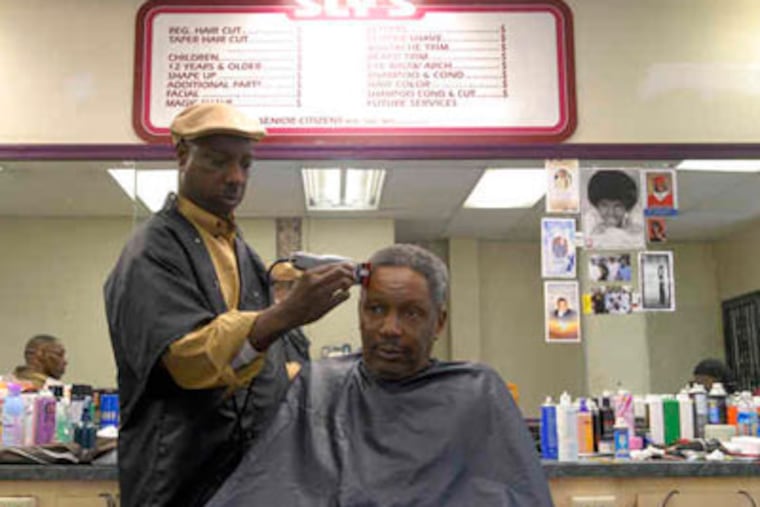
For 55 years, Sly's Barbershop sat on a corner of 29th and Dauphin Streets in Strawberry Mansion.
Its barbers styled generations through conks, Afros, boxes, and fades. And they once catered to the likes of Billy Paul, Nat "King" Cole, and Muhammad Ali, whose signed portrait hangs on the back wall.
But early one spring morning, as Derrick Ford, 52, approached the shop for his weekly haircut, he found it dark and empty. His longtime barber's car was nowhere in sight.
Ford called him and got the news.
In a wounded economy, the owner, Henry "Sly" Schley, 79, had fallen behind on the business' bills, and the barbershop was shuttered.
"It was painful," said Ford, a regular since he was 10. "That was a vibrant corner."
After seven months, two of Sly's veteran barbers decided it had to reopen.
Like many barbershops, Sly's was a haven. Men gathered there to debate politics, sports, and women; report community issues; share troubles and laughs; and gain counsel - all over the hum of the clippers.
The business also hired from its neighborhood.
"The neighborhood missed a spot like this," said new co-owner Ralph Jones, 52, in his mild South Carolina drawl. "All of the history makes it an institution.
"We decided we didn't want it to become another stop-and-go," he said, noting the community's abundance of take-out corner stores, "so we took it over."
Jones and his partner, Bo Wroten, brokered a lease with Schley, who prefers to remain quietly in the background. They reopened on Labor Day, Jones said, "to prove the point we are back."
Now their challenge is to regain old clients, and lure a generation of new ones.
One recent Monday morning, Jones, in a black smock and black jeff cap, sat in one of the shop's six chairs, his clippers waiting.
Wroten, 49, who earned his barber's license in prison, watched Jerry Springer, while hunched over an egg sandwich.
Around the shop, drywall awaited paint. New linoleum patched the floor. A few chairs were marked by rips.
Jones said he had found Sly's by chance.
Thirty summers ago, he came to Philadelphia to visit relatives and never left. On a friend's suggestion he attended beauty school, where he shaped a woman's Afro with such precision that the customer, Schley's daughter, told him where he could find a job.
He stayed at Sly's 20 years.
"For a while I didn't know where I was going," he said. "This is what I love to do.
"It's a good feeling when people come in here looking crazy and leave looking good."
Jones was there the day, in '82 or '83, when Ali came in, jabbing his fists.
"You ain't pretty no more," a regular shouted, sparking laughter.
"Watch this," Ali said.
Ali went to the back and, Jones swears, levitated off the floor.
"I don't know how he did it, but I seen it with my own eyes."
Floating Ali is one of many stories in Sly's volumes.
With R&B on the radio, Jones had his first customer of the day, a 13-year-old on school holiday. His next was a 10-year regular.
When Sly's closed, "I just didn't cut my hair," said Ronald Bridgett, 57, as Jones combed through his wavy, silver hair. "You're not supposed to close. This place has been around as long I am."
Schley comes in from time to time to tend to his remaining regulars, some topped with toupees.
He started doing hair, processes, in the early '50s in his mother's basement. Demand for the slick style was so great, business expanded to the upstairs bathroom. At his parents' urging, he opened Sly's in 1954.
Wroten, who grew up in the neighborhood, worked there the last nine years.
"This is the first job I've ever had," he said. "I was a crook. I didn't think I could get a job."
Wroten still styles his very first client, marking a career.
With breakfast over, he tended to a new face. He shaved a young man's head, then shaped his beard.
The two relished the Phillies' big win. Then they discussed the power of Michael Jackson, whose Afro-wearing image hangs from the mirror at Wroten's station.
"I used to be in the basement," Wroten said, breaking into a spin. "Me and my brothers, we tried to get us a Jackson 5."
Eventually, Wroten went to prison for armed robbery.
"I was just out of hand," he later explained.
Halfway through his 10-year sentence, he awoke in state prison in Huntingdon County with an urgent thought: "I've got to get out of here."
That day he signed up for the barber program.
"It gave me an avenue," he said.
When Sly's closed, he quickly found another job.
"That's the good thing about being a barber. You can work anywhere. You can plug your clippers up outside and start working."
But he and Jones missed the bond of Sly's.
Since its reopening, business is picking up "slowly, but surely," Wroten said.
The two barbers said they hoped to fulfill a larger purpose.
"Barbers are role models in this neighborhood," Jones said. "Guys come to us reaching out for help, for information. They look at us as mature men to talk to."
When business improves, they plan to hire.
As Jones finished Bridgett's hair, the conversation turned to the Jaycee Dugard kidnapping, then to the country's stance on gays in the military.
"You can be gay and don't act like it, though," Jones offered.
Wroten later wondered: "Suppose you report a guy and he's not gay."
Bridgett saw both points.
Standing, eyeing himself in the mirror, he said: "This is where you can actually have a conversation with men. You can talk about something, and disagree, in a barbershop."
Bridgett, who once lived across the street, drove from his Germantown home, past barbershop after barbershop to revisit Sly's.
He welcomes the old routine.
"You never forget your neighborhood," he said. "You feel at home when you come here. And if you have any worries or problems, you get them off in here."