Hometowns find ways to honor the newly fallen
When he wants to visit a memorial to the son he lost to a 2004 Baghdad roadside bomb, John H. Todd Jr. has no fewer than five destinations to choose from, mostly additions to public remembrances of other wars.
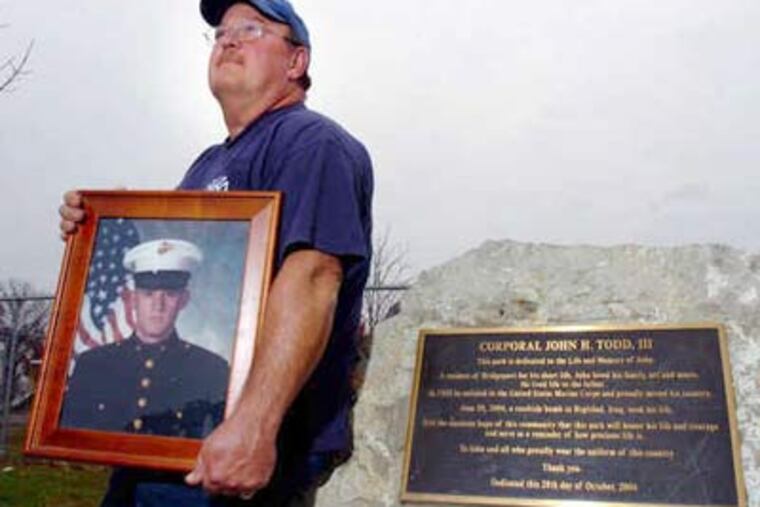
When he wants to visit a memorial to the son he lost to a 2004 Baghdad roadside bomb, John H. Todd Jr. has no fewer than five destinations to choose from, mostly additions to public remembrances of other wars.
In a downtown park in their home borough of Bridgeport, a plaque with Marine Cpl. John H. Todd III's name is affixed to the side of a monument to Korea and Vietnam war dead.
In Philadelphia, Todd's name is engraved with other new casualties in a corner of the Korean War Veterans' Memorial. A similar brick engraving in East Norriton is part of a commemoration of many wars.
And in Norristown, atop a county courthouse lawn dotted with engravings dating to a post-Civil War memorial, a banner showing Todd's name, hometown, and portrait hangs alongside a dozen others honoring Montgomery County casualties.
After more than eight years of war and 5,272 American troops lost, communities across Pennsylvania and New Jersey - states that have collectively lost more than 300 residents - have labored to come up with ways to honor them even before the conflicts end.
A mix of memorials has sprung up to honor the sacrifices. Some are improvised, like the plaques and engravings added to other wars' monuments. Others, like the banners, are impermanent.
Previous wars were commemorated in stone and metalwork years - or decades - after they ended. But the public monuments already engraved for the Iraq and Afghanistan war dead attest to a reduced willingness to wait.
"Most monuments aren't created until a war is completed and the story is written," said Celeste Zappala of Philadelphia, who became an antiwar activist after her son Sherwood Baker was killed in Baghdad in 2004, "but there's not an ending."
Despite the desire to pay immediate homage to the new casualties, lasting memorials dedicated solely to the two continuing wars remain isolated finds.
Among those in the region:
In Lumberton, Burlington County, a park was named after Army Reserve Spec. Bryan L. Freeman Jr., 31, who was shot in the head by a sniper in Baghdad in 2004.
Lower Providence in September dedicated a park marker to Staff Sgt. Marc J. Small, an Army Special Forces medic killed in Afghanistan in February.
At Joint Base McGuire-Dix-Lakehurst, a visitors center at the Route 68 gate to Fort Dix was named after Sgt. Terry W. Hemingway, 39, who was killed in an apparent car-bomb suicide attack in 2003. The gates of the fort also are named after four New Jersey soldiers who died in Iraq or Afghanistan.
To discuss Veterans Day, John H. Todd Jr. opted to visit the quiet hilltop park in Bridgeport dedicated to his son's sacrifice.
"It's more personal," Todd said yesterday. "It's nice to see this, but I'd rather have him back."
Where the current wars' casualties have been incorporated into existing monuments, an interest is often cited in showing kinder treatment to today's veterans than those of previous decades.
Korean War veterans, for example, still wince over the label of "the forgotten war."
So earlier this year, the Philadelphia Korean War Memorial's board agreed to carve the names of Todd and 61 other slain soldiers from the continuing wars into the stonework.
It had taken the Korean veterans 20 years of effort to get the memorial built at Penn's Landing in 2002.
"You don't want these young men and women to have to wait that long," said William J. Kelly, president of the Philadelphia Korean War Memorial.
Ruth Stonesifer of Kintnersville, Bucks County, is one reason scores of families are seeing immediate tributes. Her son, Army Ranger Pfc. Kris Stonesifer, was killed in 2001 in Pakistan in a helicopter accident. She has since become devoted to pressing for public recognition for Pennsylvania's casualties.
In 2007, Stonesifer had 140 banners, with color portraits, posted in Harrisburg showing each Pennsylvanian killed in the current conflicts. She has followed that up with similar banner projects outside the courthouses in Bucks, Montgomery, and Berks Counties.
"It was to bring the families together in Pennsylvania so that they knew that their loved one's sacrifice has not been forgotten," Stonesifer said. "It's very personal because you actually get to see a picture. It's not just a name that you pass by."
She allowed that the banners, in time, would likely be supplanted by more traditional markers.
"If there's something in stone, they will probably come down," Stonesifer said.
A memorial group in Berwyn has already grimly arranged to provide its permanent tribute to the current wars. Outside a SEPTA station, a steel arch and American flag soar above plaques that name the local casualties of World Wars I and II, Korea, and Vietnam.
When the memorial was finished, in 2005, the country was already amid war. So its builders left a refrigerator-sized slab of black granite alongside the other memorials. The obelisk remains gleaming and blank today, its community having so far been spared.
"I hope to God nobody ever has to have their name put on that," said Bill DeHaven, president of the Berwyn Veterans Memorial.