Health-care bill clears key Senate hurdle
Democrats, united at least for now, posted 60 votes to open debate on the $848 billion project.
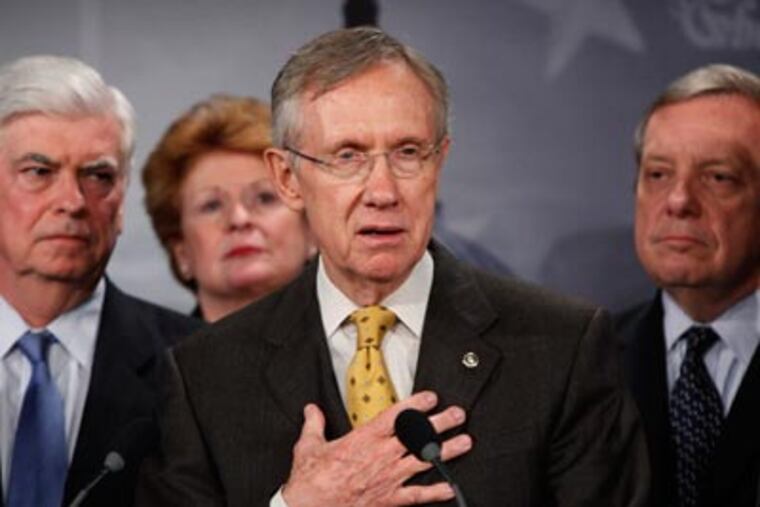
WASHINGTON - The Senate voted on party lines last night to overcome a Republican filibuster and bring to the floor a bill that would overhaul the nation's health-care system.
After days of indecision, the two final Democratic holdouts - Sens. Blanche Lincoln of Arkansas and Mary Landrieu of Louisiana - voted with the rest of the 60 members of their caucus to support a procedural motion to begin debate. Though strictly parliamentary, the vote marks a milestone in the quest for a health-care overhaul reignited by President Obama's election.
The 60-39 vote set up weeks of debate. Senate Majority Leader Harry Reid (D., Nev.) is aiming for final passage before Christmas.
All six Philadelphia-area senators voted in favor of the motion. George Voinovich (R., Ohio) was the only senator not to vote.
The House passed a $1 trillion health bill two weeks ago; the $848 billion Senate version represents the work of two committees and hundreds of hours of hearings and deliberations, against a backdrop of fervent Republican opposition. But even as Democrats heralded their expected victory yesterday, they conceded that the vote represents the end of the beginning, not the other way around.
Like Sen. Ben Nelson (D., Neb.), a holdout until Friday, Lincoln and Landrieu said they would press Reid for further changes to the bill before committing to its final passage.
Even to clear yesterday's hurdle, Reid agreed to a 72-hour review period that Lincoln had sought after the bill was introduced Wednesday night. He added a Medicaid clause worth up to $300 million for Landrieu's home state. Although many Democrats pressed Reid to include language to end a federal antitrust exemption for health insurers, he omitted the repeal to lock down Nelson's vote.
The weeks ahead are likely to bring many more costly concessions. Democrats are already requesting changes to the legislation, raising concerns related to Medicare, abortion, and employer requirements.
Above all, the Democratic caucus remains bitterly divided over a government insurance option. Reid quelled an uprising by liberal senators weeks ago by adding a "public option" to the legislation. But although he included an opt-out clause for states, some moderates - including Landrieu and Lincoln - have told Reid they will oppose the Senate bill on final passage unless the provision is dropped.
"My vote should in no way be construed by the supporters of this current framework as an indication of how I might vote on the final bill," said Landrieu, who said she also would seek more generous tax credits for small-business health care. "My vote is a vote to move forward, to continue the good and essential and important and imperative work that is under way."
But Democratic leaders said the vote yesterday provided a jolt of momentum that vastly improved prospects for a completed Senate bill before the Christmas break, leaving January for negotiations with the House. The goal now is to deliver final legislation to Obama in time for the 2010 State of the Union address in late January.
"There will be more procedural hurdles, more disagreements, more pressure from our opponents, more television ads, and many amendments," said Sen. Charles E. Schumer (D., N.Y.). "But I have no doubt that we will pass this bill."
Republicans portrayed the action last night as considerably more consequential, tantamount to an endorsement of the underlying bill, or "a vote for higher premiums, cuts to Medicare, and more taxes," as Sen. Lamar Alexander of Tennessee declared.
"All those people who are concerned about the high cost of health care today aren't getting relief under the Democrat plan," said Sen. John Thune of South Dakota. "In fact, their lives are going to get much, much worse."
The Senate bill would provide coverage to 31 million Americans by vastly expanding Medicaid and creating insurance "exchanges" for individuals who do not have access to affordable coverage through their employers. For the first time, it would require most people to carry health coverage, although families with incomes up to 400 percent of the federal poverty level would receive subsidies to buy policies.
The legislation would also force widespread changes to the insurance industry to end discriminatory practices, including the rejection of coverage based on preexisting conditions. It would provide new incentives to encourage disease prevention and to institute the most effective treatments for chronic conditions such as diabetes and asthma.
On the revenue side, the Senate bill would extract about $400 billion in cost savings from Medicare and Medicaid, and impose an excise tax on the most generous health-care policies, dubbed "Cadillac" plans. It would raise payroll taxes for high earners and levy a new 5 percent tax on elective cosmetic surgery.
Even before he released the bill last week, Reid started work on securing the votes for Senate passage. He canvassed Democrats in private meetings and phone calls, and urged groups of senators with shared interest to work together on joint amendments. Leadership aides also drew up lists of potential Republican amendments, to devise how Democrats would respond.
Along with the three Democratic moderates who already have stepped forward, two other senators are likely to become frequent visitors to Reid's office in the weeks ahead. Like Nelson, Landrieu and Lincoln, independent Sen. Joseph I. Lieberman of Connecticut opposes the public option but agreed to support the start of debate. Unlike the other three, Lieberman has stated unequivocally that he would oppose a government insurance plan.
That leaves Reid with two options. Either he must persuade liberal lawmakers to give up the provision, or he must win back Olympia J. Snowe of Maine, the only Republican to support the Senate Finance Committee bill.
Nelson, Landrieu, and other moderate Democrats have suggested they can support an alternative version of the public option proposed by Snowe; it would take effect only if private policies proved unaffordable.