Opening ceremony for Winter Olympics in Vancouver
VANCOUVER - With the din of Canada's pride careening through domed BC Place like a Rocky Mountain storm, the 2010 Winter Olympics began last night with history's first indoor opening ceremony, an ethereal spectacle that - for a few hours anyway - obscured the troubles already besetting these Games.
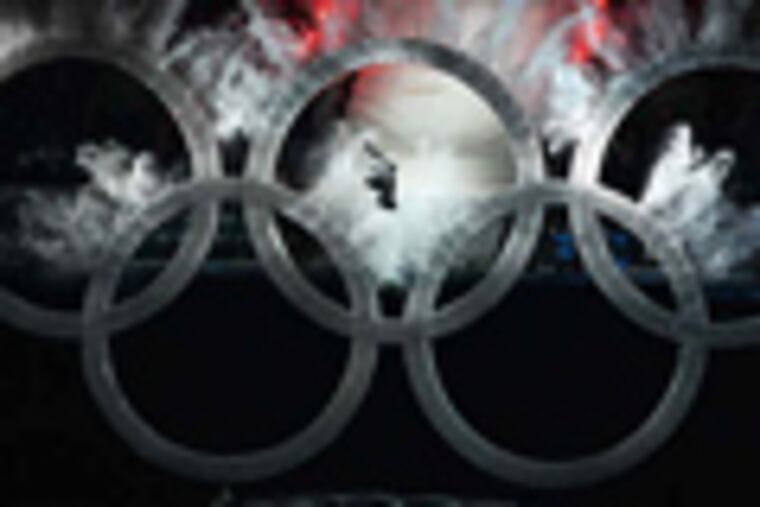
VANCOUVER - With the din of Canada's pride careening through domed BC Place like a Rocky Mountain storm, the 2010 Winter Olympics began last night with history's first indoor opening ceremony, an ethereal spectacle that - for a few hours anyway - obscured the troubles already besetting these Games.
Earlier on a day they had anticipated for nearly a decade, another unusually warm and rainy one in a spring-like Vancouver winter, local organizers suffered a blow. A Georgian sledder died in a violent crash during a practice run on the perilous luge course in Whistler, British Columbia. Nodar Kumaritashvili was the third competitor to die at a Winter Games, the first since 1992.
"This clearly casts a shadow over these Games," said a tearful Jacques Rogge, president of the International Olympic Committee.
So even before a single medal had been awarded at the XXI Winter Olympiad, which will conclude Feb. 28, officials here have had to cope with an athlete's death, a maddening lack of snow, and the daunting challenge of following the spectacular Beijing Olympics.
Vancouver officials did their best to downplay the inevitable comparisons to those 2008 Games, noting that their opening ceremony would be appropriate for such a young nation.
"Austrians can talk about Mozart, and the Korean culture goes back 10,000 years," said John Furlong, CEO of the Vancouver Organizing Committee. "We're trying to communicate the culture of tomorrow, the future, a young country. What we've been trying to do is really evolve that idea of the culture of the 21st century; why does Canada work? And to try to represent all of what Canada is culturally."
Last night's ceremony clearly was influenced by China's breathtaking opening, with a well-choreographed display that mixed technology, artistry, history, and music. That music included West Chester native Samuel Barber's "Adagio for Strings," a funereal piece that seemed particularly appropriate given the day's events.
The show might not have matched Beijing's but it, and the entrance of 2,500-plus athletes from 82 nations, delighted the 60,600 people inside the downtown football stadium, a majority of them wearing the national colors of red and white and waving the maple-leaf flag.
Greece, as usual, led the athletes parade and Canada, with speedskater Clara Hughes carrying the flag, marched in last to a thunderous reaction.
The enormous U.S. team, whose banner was lifted by luger Mark Grimmette, came in two nations from the end of the pack, a position that didn't diminish the thrill the athletes derived from this moving sporting ritual.
"I took a 6 a.m flight to get here, said American hockey player Jack Johnson. "I chartered a flight with my mom and dad and brother. It's an experience I'll never forget. Once in a lifetime."
Political leaders from around the world, including Georgia's president, were in the stadium. Also among them was Vice President Biden, who met with the U.S. delegation earlier.
"You," Biden told the 216 athletes, "will be the face of America for the next few weeks."
One mystery was solved when it was revealed that the other seven athletes on the Georgian team would march and compete.
"We cannot leave now," Irakli Japaridze, head of the Georgian Olympic delegation, told the Toronto Star. "This is a shock, a big tragedy, but we are going to stay."
Just before the ceremony began, an announcement was made dedicating them to Kumaritashvili's memory.
Beyond that, the crowd and an expected 3.5 billion TV viewers around the world were eager to see who would light the Olympic cauldron at the ceremony's conclusion.
One of the cauldron lights didn't work, however, so only three of the final torchbearers actually lighted the flame.
The four torchbearers were hockey legend Wayne Gretzky, NBA all-star Steve Nash, skier Nancy Greene and speedskater Catriona LeMay Doan, who was stuck posing and holding her torch.
The crowd inside the building that is home to the Canadian Football League's B.C. Lions wore white parkas they were given. The effect was to transform BC Place into a snowy landscape, a trick made more real later when white confetti rained from the ceiling.
Curiously, real snow hasn't been nearly as easy to conjure. Tons of it had to be shipped into nearby Cypress Mountain, where snowboarding and aerials are scheduled. A complete lack of it there has confounded organizers and meteorologists alike.
Canada's aboriginal people were honored – and performed in – the show's opening sequence, dancing in traditional colorful costumes beneath four gigantic ice-like totem poles.
Performances by Canadian-born singers such as Joni Mitchell and Bryan Adams provided the soundtrack for the various portions of the "Landscape of a Dream" theme. Mitchell's version of her own "Clouds" - accompanied by a an acrobat on a wire perched over a hologram prairie was a highlight.
Canada's provinces, people and culture also were spotlighted.
In Whistler, the resort 70 miles north of here that will host alpine skiing, thousands gathered in the rain in Village Square to watch the events and several Canadian athletes staged a mini-parade to coincide with their teammates' entrance into BC Placxe.
Not surprisingly, Italy's athletes, with stylish green topcoats and white slacks, were the most fashionable in a field whose typical attire was snow gear in the national colors. The Czech Republic attire, especially the busy, multi-hued pants that brought to mind a Salvadore Dali nightmare, was the oddest.
Among the notable flag-bearers was Sweden's Peter Forsberg, the former Flyers star, who will play hockey for the defending Olympic champions.
For the host nation, the goal at this third Canadian Olympics is clear. No native athlete won a gold medal at either Montreal in 1976 or Calgary in 1988, the only time that has happened in the modern movement's 114-year history.
In an effort to remedy that international embarrassment, the government has invested $66 million in a sports-development program called "Own the Podium."
Canadian athletes figure to contend in men's hockey and figure-skating, both freestyle and alpine skiing and curling. Nonetheless, they will face stern competition from traditional winter powers like Germany, Russia, Norway, Sweden and the U.S. team.
Germany led the medal count at the 2006 Games in Turin, with the United States second, four behind.
This American team might represent the nation's deepest winter team ever.
In addition to their anticipated success in the skating disciplines and the X-Games sports of snowboarding, aerials and moguls, U.S. athletes are expected to compete in several sports where they've typically been also-rans – Nordic combined, men's bobsledding and biathlon.
Minnesota-born skier Lindsey Vonn was expected to be the golden girl of these Games, but a serious shin injury suffered a week ago in Europe could make the blonde 25-year-old vulnerable in - or even absent from - some of the five events she had planned to enter.
Seven nations made their Winter Olympics debut last night, the Cayman Islands, Colombia, Ghana, Montenegro, Pakistan, Peru and Serbia.
But overshadowing everything, like the black clouds that hung ominously over BC Place all afternoon, was the death of the Georgian luger
"We are heartbroken beyond words to be sitting here," said Furlong. "It's not something that I had prepared for, or ever thought I would need to be prepared for."
The Georgian team wore black armbands and scarves and received a stirring ovation from the gathering, including Rogge and the other dignitaries in the IOC box.
In 1992, at Albertville, Nicholas Bochatay of Switzerland died after crashing into a snow grooming machine during training for the demonstration sport of speed skiing on the next-to-last day of the Games.
Australian skier Ross Milne died when he struck a tree during a training run shortly before the 1964 Winter Games in Innsbruck. British luger Kazimierz Kay-Skrzypecki also died during training in Innsbruck.