Death toll tops 700 in Chile devastation
Aftershocks renewed fears, and a curfew was ordered to stop looting. Rescue efforts continued.
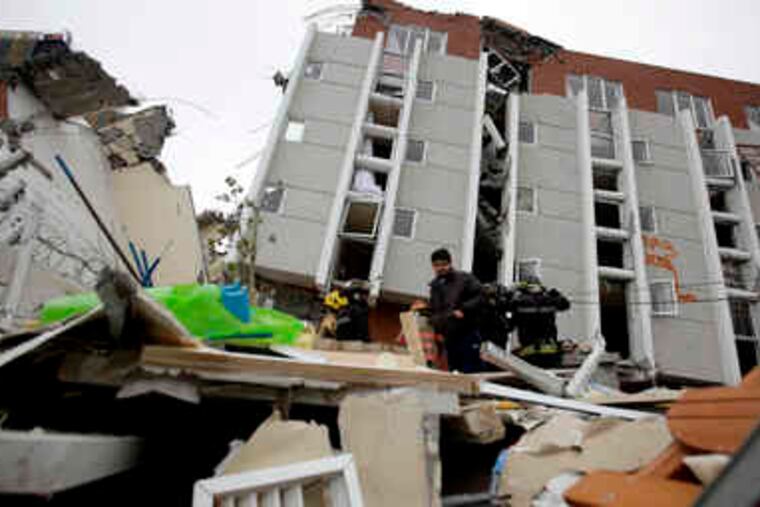
CONCEPCION, Chile - Heroism and banditry mingled on Chile's shattered streets yesterday as rescuers braved aftershocks to dig for survivors and the government sent soldiers and ordered a nighttime curfew to quell looting. The death toll climbed to 708 in one of the largest earthquakes in centuries.
In the hard-hit city of Concepcion, firefighters pulling survivors from a toppled apartment were forced to pause because of tear gas fired to stop looters, who were wheeling off everything from microwave ovens to canned milk at a damaged supermarket across the street.
Efforts to determine the full scope of destruction were undermined by an endless string of terrifying aftershocks that continued to turn buildings into rubble. Officials said 500,000 houses were destroyed or badly damaged, and President Michele Bachelet said "a growing number" of people were listed as missing.
"We are facing a catastrophe of such unthinkable magnitude that it will require a giant effort" to recover, Bachelet said.
She signed a decree giving the military control over security in the province of Concepcion, where looters were pillaging supermarkets, gas stations, pharmacies, and banks, and men and women were seen hurrying away with chicken, beef and sausages.
Virtually every market and supermarket had been looted - and no food or drinking water could be found. Many people in Concepcion expressed anger at the authorities for not stopping the looting or bringing in supplies. Electricity and water services were out of service.
"We are overwhelmed," a police officer said.
Bachelet said that a curfew was being imposed from 9 p.m. to 6 a.m. and that only security forces and other emergency personnel would be allowed on the streets. Police vehicles drove around announcing the curfew over loudspeakers.
As nightfall came, hundreds of people put up tents and huddled around wood fires in parks and the grassy medians of avenues, too fearful to return to their homes amid continuing strong aftershocks.
Bachelet said the country would accept some of the offers of aid that have poured in from around the world. She said Chile needs field hospitals and temporary bridges, water-purification plants, and damage-assessment experts - as well as rescuers to help relieve workers who have been laboring frantically since the magnitude-8.8 quake struck before dawn Saturday.
To strip away any need for looting, Bachelet announced that essentials on the shelves of major supermarkets would be given away for free, under the supervision of authorities. Soldiers and police will also distribute food and water, she said.
Although houses, bridges, and highways were damaged in Santiago, the national capital, a few flights managed to land at the airport and subway service resumed.
More chaotic was the region to the south, where the shaking was the strongest and where the quake generated waves that lashed coastal settlements, leaving sticks, scraps of metal, and masonry houses ripped in two.
In Concepcion, the largest city in the disaster zone, a new, 15-story apartment building toppled onto its side. Many of those who lived on the side that wound up facing the sky could clamber out; those on the other were trapped. About 60 people remained trapped in the 70-unit building.
Police Officer Jorge Guerra took names of the missing from a stream of tearful relatives and friends. He urged them to be optimistic because about two dozen people had been rescued. "There are people alive. There are several people who are going to be rescued," he said, though the next people pulled out were dead.
Concepcion's main hospital was operating, though patients in an older half of the building were moved into hallways as a precaution. Rescuers worked carefully for fear of aftershocks. Ninety jolts of magnitude 5 or greater shuddered across the region in the first 24 hours after the quake, including one nearly as large as the earthquake that devastated Haiti on Jan. 12.
Firefighters in Concepcion were about to lower a rescuer deep into the rubble of the toppled apartment building when the scent of tear gas fired at looters across the street forced them to interrupt their efforts. "It's sad, but because of the situation you have to confront the robberies and at the same time continue the search," Guerra said.
Across the Bio Bio River in the city of San Pedro, looters cleared out a shopping mall. A video store was set ablaze, two automatic teller machines were broken open, a bank was robbed, and a supermarket emptied, its floor littered with mashed plums, scattered dog food, and smashed liquor bottles.
"It was a mob. They looted everything," said Police Sgt. Rene Gutierrez, 46, who had his men guarding the now-empty mall. "Now we're only here to protect the building, what's left of the building."
In Talca, where old adobe buildings were flattened, many spent the night outside, huddled beneath blankets on lawn chairs, sleeping on a mattress hauled from a damaged home, or sheltering in camping tents.
Meanwhile, the devastating tidal surge that scientists had predicted after the earthquake for areas far from the epicenter never materialized. By yesterday, authorities had lifted the warning after waves half the predicted size tickled the shores of Hawaii.
Scientists acknowledged that they had overstated the threat, but defended their actions, saying they took the proper steps and erred on the side of safety.