In financial peril, troops find relief
N.J., Pa. grants help fill gaps when duty calls.
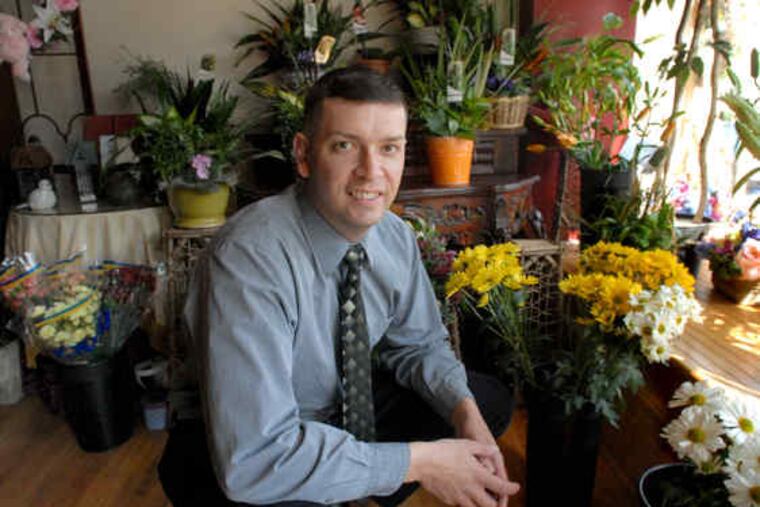
When he served in Iraq in 2008 and 2009, Army National Guard First Lt. D.W. Janszky was all business as he transported detainees to prisons near Baghdad, sometimes ducking bullets and mortar rounds on the way.
But the Woodlynne man worried about home - and his struggling shop, the Haddonfield Floral Co. How would it hold up without him? Would he lose customers and income during his long deployment?
With those concerns weighing on him, he turned to the National Guard State Family Readiness Council in New Jersey for financial help: a $10,000 grant that came through at a critical time.
Janszky, 39, who is unmarried, also received an $800 family grant to replace a water heater that broke while he was away.
"When I was leaving in the summer of '08, the economy was in a dramatic downward spiral. That put a lot of pressure on the employees" he left in charge, said Janszky, who followed his father and grandfather into military service. "Getting the grants was tremendous."
The nonprofit council was founded in 2004 by Linda Rieth, wife of Maj. Gen. Glenn Rieth, adjutant general of New Jersey and commissioner of the state Department of Military and Veterans Affairs.
Variations on the effort, which runs on donations, now exist in several states. Among them is Pennsylvania's Military Family Relief Assistance Program, begun in 2006 as the number of deployed soldiers and airmen continued to rise.
The grants help pay for utilities, repairs to cars and leaky roofs, overdue rent, and business reversals back home while service members are deployed.
In New Jersey, 349 grants of up to $5,000 each have been approved for families and 21 for as much as $10,000 have been authorized for businesses since the program began, Linda Rieth said. A total of $1.2 million has been disbursed.
In Pennsylvania, 58 grants of up to $2,500 each - a total of $112,000 - have been given to service members and their families.
Other groups also pitch in. The Veterans of Foreign Wars started its national Unmet Needs program in 2004 and has raised more than $2 million for hundreds of service members.
"Many soldiers take a cut in salary when they're deployed," said Linda Rieth, who teaches Spanish at Villa Victoria Academy, a Catholic school for girls in Ewing Township, N.J. "They could be making $100,000 in their civilian job and take a $50,000 cut in pay.
"Other soldiers own businesses that can go under because they weren't there to manage them," Rieth said. "And some come back to no jobs at all because their companies went under."
The grants can make a crucial difference, said Joan Nissley, a spokeswoman for the Pennsylvania Department of Military and Veterans Affairs.
"We want to take care of our soldiers and their families. When we come across a situation where they need assistance, we're there for them," she said. "Within 24 to 48 hours, we check their application and it's approved or disapproved."
For New Jersey National Guard Army Sgt. Deborah Cooke, the roughly $3,000 she received from the Family Readiness Council could not have come at a better time.
A radio transmission operator, she was sent to Baghdad in 2008 and left her two teenage girls and elderly mother at home. One of her daughters had a baby girl and the other gave birth to a son while she was away.
The council "gave me assistance with utility bills, but the biggest help was when I came back from Iraq on emergency leave," said Cooke, who had worked as a crossing guard and an in-home caregiver for seniors. "My mother died, and I had to use my savings to bury her.
The council "helped me get a rent security deposit for a larger home for my children and their children," she said. "It gave me a head start, and got me back on my feet."
The help "is not a handout," said Mike Hughes, a Family Assistance Center coordinator at the Pomona Air National Guard Base in Egg Harbor Township, N.J. "They have to show there is a need, that they fell behind on car or electric payments while deployed and need assistance.
"They send copies of the bills, and the State Family Readiness Council pays those bills directly."
The needs of guardsmen and airmen became increasingly obvious as more were deployed to Afghanistan and Iraq. With deaths, financial problems, and family issues, including divorces, putting growing stress on service members, the military ordered the creation of more than 400 Family Assistance Centers.
The centers provide marital and psychological counseling, information on medical benefits and child care, and leads on inexpensive auto and home repairs, sometimes from veterans.
"But there was one recurring theme: finances," Linda Rieth said. "The centers were able to provide services but didn't have money to give to the families when they needed it. Their hands were tied.
"Banks caught on and offered low-interest loans, but it didn't seem right for [soldiers] to have to pay back the money when they were sacrificing so much."
By 2004, she came up with the idea of New Jersey's Family Readiness Council. "We could put an umbrella over the entire state and help any way we saw fit," Rieth said.
"My dad was a career Army officer who had two tours in Vietnam and a tour in Korea. I saw a lot of what my mom had to do during those years with three kids, and it was hard," she said. "People are going through the same things right now and can use support from a morale and financial standpoint."
Family Assistance Center coordinators began to take grant applications from service members and their families and passed them along to the State Family Readiness Council for consideration.
Funding came from individual and corporate donations, pancake breakfasts, and spaghetti dinners. Companies donated food and drinks for the events, put on with help from about 25 volunteers.
"When a citizen-soldier transitions to soldier, many will have financial sacrifices in their lives," Maj. Gen. Rieth said. "If we will continue to fight a prolonged war with an all-volunteer force, and 50 percent of that force is made up of citizen-soldiers, then we have a moral responsibility to help. . . . It is the right thing to do."
For Information
New Jersey's National Guard State Family Readiness Council: 609-510-7742 or http://go.philly.com/njvetaid
Pennsylvania's
Military Family Relief Assistance Program: 1-866-292-7201 or http://go.philly.com/pavetaidEndText