Man's killing illuminates changes in Cedarbrook
Across from the sloping driveway where the body of George Greaves lay under a sheet last week, a trash can is chained to a street-sign pole.
Across from the sloping driveway where the body of George Greaves lay under a sheet last week, a trash can is chained to a street-sign pole.
Consider it a metaphor for the tension that has grown over the last few years between longtime homeowners like Greaves, who prided himself on good manners and his tidy garden, and the crime that has seeped into this once-serene community.
"It's still a good neighborhood, but it's not the neighborhood I once knew," Edward C. Nicholson Sr., 65, said of East Mount Airy or, as some call this section, Cedarbrook.
The retired employee of the Pennsylvania Turnpike Commission has lived for more than 30 years in a rowhouse on Pickering Street, two blocks from where Greaves was killed in an attempted robbery on Aug. 18. Two teenagers, 17 and 14, have been charged.
Nicholson remembers back in the 1960s and '70s when merchants swept the sidewalks outside their shops on Wadsworth Avenue. "They wouldn't allow people and children to hang out in front of their stores," he said. "And they gave jobs to kids after school."
He remembers, not nearly so long ago, when almost everyone he knew would walk around after dark without fear of muggings or murders.
And, most painfully, he remembers George Greaves.
That morning, on his way to buy a newspaper at the 7-Eleven on Ogontz, Nicholson drove past Greaves' house and saw the 87-year-old man working in his flower bed.
"Mr. George! You're making me look bad," Nicholson said he called out.
Greaves, a Navy veteran, looked up from his impatiens and laughed. Later that day, Nicholson would pass the house again. This time, he saw television news helicopters thumping overhead and police tape wrapped around the property.
"I was so heartbroken," Nicholson said.
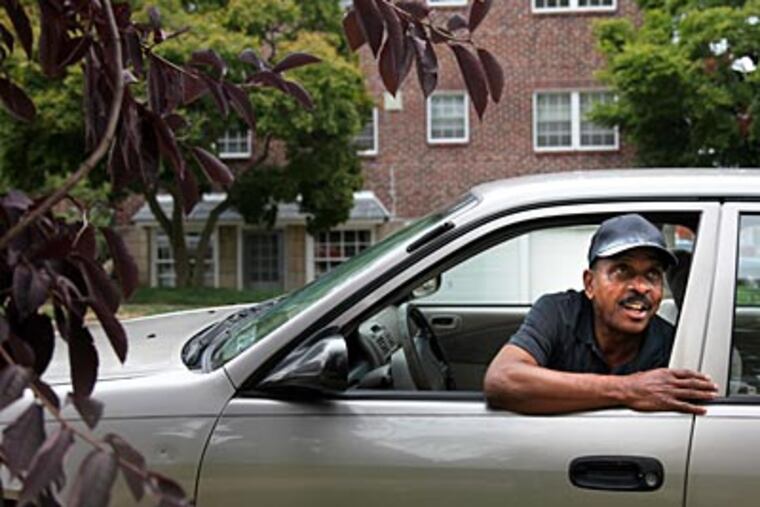
Yesterday, he and a friend, James Brown, ran into each other as they passed Greaves' house. They talked about the killing and how the neighborhood had changed.
Yes, there has been a shift in the racial balance, they said. Most of the Jewish and Catholic families gradually decamped to the suburbs or Northeast Philadelphia. But for decades afterward, it remained a stable, integrated, solidly middle-class community.
George Greaves was one of the few white men left, and for decades he lived among black neighbors who shared the same values. In more than a dozen interviews yesterday, they recalled the man they knew fondly as Mr. George. And in trying to understand why and how such a good man was slain, they spoke of issues that transcend race and geography. National economic policy. Public education. Drugs.
Brown, 48, an Army veteran, home health aide, car mechanic, and martial arts teacher, said he often offered to help Greaves with yard work. "But he always said, 'Thanks! But I've got it.' "
As the friends reminisced, a woman drove by, slowed down, lowered her window, and shouted, "Hi there!"
"Did you get the flier?" Nicholson asked.
He had stopped by the woman's house earlier to drop off information about a meeting Wednesday night at the 14th Police District to discuss the shooting and safety in the neighborhood.
When asked to explain the increasing violence - 16 shootings since January 2009 - many of the neighbors point to gentrification in other city neighborhoods.
At the Reformation Lutheran Church, sexton and former church secretary Margaret Garner said that when she and her late husband bought their brick rowhouse in the neighborhood, built as a bedroom community after World War II, it was an idyllic place.
"The neighborhood started to change when people went to the suburbs," she said. "The people who moved in weren't bad. But they didn't know how to manage their money or their children."
Her friend Larry Edwards Sr., 63, president of the church council, has lived in the neighborhood 37 years, 33 of them as a firefighter. He said that when he and his wife were raising their four children, the schools were excellent and Leeds Middle School, in particular, was considered one of the best in the city.
Frank Rizzo was their neighbor. The larger-than-life figure used to have a constant police presence near his house, and he would hand out fifty-cent pieces to trick-or-treaters on Halloween.
"His brother still lives here," said Edwards. "I used to see him walking his dog." Joseph Rizzo, the former fire commissioner, was once Edwards' boss.
About 30 percent of residents are 55 or older, a group that was increased by 29 percent between 2000 and 2010. The population as a whole decreased by 8 percent over the same time period.
More worrisome than the age of the residents, neighbors agreed, is attitude. Wholesome values and stability have been leached out of the community as decent jobs for people with high school diplomas disappeared.
Susan Johnson took her son, Elijah, out to Rollerblade yesterday. It's been 17 years since she bought her house in this neighborhood, she said, and it makes her sad to see how it's changed.
She was 28 at the time. "It was a beautiful place to live," Johnson said. Bit by bit, the edges frayed. "It's not as clean. People don't take as much pride in maintaining their property."
On her street, a pizza deliveryman was shot not long ago. "I was lying in my bed when I heard the gunshot. Then I heard screaming." She sighed.
Still, compared to many parts of the city, she said, Cedarbrook is still a good community. Just last weekend, two block parties were held. One of the biggest annoyances is the lack of parking when Enon Tabernacle Baptist and Bethel Deliverance draw in the crowds on Sundays.
"On my block, we know one another," said Johnson, a former auditor for the state. "We look out for one another's children. We had a cookout on Saturday. Everybody came."
Now Johnson said she's thinking more about selling. "Communities change, don't they?" she said. "I lock my windows now. . . . And I'm starting to feel that I don't want to be out too late."
Thirty years ago, when Nicholson was raising his two children, he said, there was no such anxiety. The kids are grown now. His daughter, 30, is a chemist. His son is a Philadelphia police officer. Among his longtime neighbors, Nicholson said, Greaves was well respected.
"When the neighborhood went into transition 20, 25 years ago, his family wanted him to move," he said. "But he loved his house. And he loved his neighbors."