Final closeout of rug war
Selling business, brothers turn to archrival.
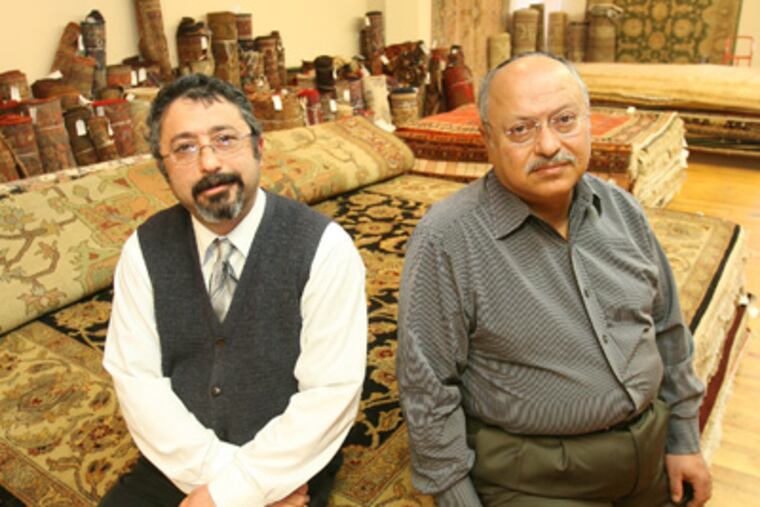
It's hard to imagine that the Main Line's fiercest rivals in the cutthroat world of Oriental carpets - Jerry Sorkin and the three Tehrani brothers - were ever friends, worshiping in the same synagogue and going to their kids' bar mitzvahs.
But that was years ago - before the lawsuit and the bitter allegations and countercharges of shady business practices, and before the competitors who ran rug shops just down the street from each other in Wayne for years finally stopped speaking to each other.
"Mortal enemies - they couldn't stand one another," said Ray Albed, yet another Oriental-rug dealer in Wayne, speaking of Sorkin and the Tehranis - fifth-generation rug dealers from Iran - as if he were relating an ancient tribal feud simmering in the dusty heat of a Persian desert town.
Which makes the concluding episode of this Byzantine soap opera all the more surprising.
When the Tehranis finally decided in the fall to close up shop in Wayne and at a second location in Bryn Mawr after 34 years, they turned the marketing of their going-out-of-business sale over to the one man they had decided could get the biggest bang for their final bucks: Jerry Sorkin.
But just because the Tehranis and their liquidator, Ofer Ben Aharon, are working with Sorkin doesn't mean the longtime enemies are suddenly saying nice things about each other. Indeed, Sorkin's promotional mailing for an auction this month to start the liquidation seemed to almost gloat over the brothers' downturn and blamed their failure on the fact that Sorkin, who closed his own store in 2006, was no longer down the street luring shoppers.
"They don't talk to each other," said Ben Aharon, the liquidator caught in the middle. "There's a lot of bad blood between each other."
Benjamin Tehrani, the middle brother, confirmed that assessment. "I'm surprised he's working for us. . . . It's a joke."
Sorkin insisted he was working not for the Tehranis but for Ben Aharon, who bought the business.
"I've done my best to keep an arm's length from these guys," asserted Sorkin, who said he was stunned to learn how poorly the Tehrani Bros. Oriental Rugs business had performed in recent years. He has made it clear "they're not to come in the store" when he's there, he said.
Then he added, "They're desperate."
The entire Oriental-rug industry is in disarray, not just on one stretch of Lancaster Avenue but across America, where the purchase of a Persian rug was once a brightly woven badge of upward mobility.
That all changed with the Great Recession and the aggressive entry of lower-cost mass-marketers such as Costco into the rug business. The Tehranis, who had grossed as much as $1 million a year at the start of the century, sold just $100,000 worth of carpets from their two stores last year, Ben Aharon said.
"It's a tough time," said Mike Joseph, president of the Oriental Rug Retailers of America. In recent months, membership in his association has dropped 20 percent, weavers in the Middle East or China have walked away from the looms because of the lack of business, and a major dealer in New York has liquidated his inventory for what amounted to $500 a rug.
Things were different in 1977, when the oldest brother, Reuben Tehrani, who had come to America five years earlier with a scholarship from the Iranian government, graduated from Kutztown State College. He started rug-dealing as a student and, two years later, with most of his family having fled the Iranian revolution, set up shop in Wayne.
The brothers bought their current building in 1998 and their Bryn Mawr store in 2001, just before the business began its prolonged slump – exacerbated, the Tehranis believe, by anti-Iranian sentiment after the 9/11 terror attacks.
Sorkin, originally from St. Louis, also dabbled in rug-dealing in the late 1970s and early 1980s while earning a degree from the University of Pennsylvania in Middle Eastern studies - a subject he would later teach there. He said he loved "the behind-the-scenes rug business, but the people in it I always disliked."
The rise of his business was tightly woven with his other interest, tourism. Since the 1980s, he had been organizing cultural tours of Tunisia and other countries in the region with his company, now called TunisUSA.
In the early years, the Tehranis and Sorkin became friendly through Berwyn's Congregation Or Shalom. "When he lost his father-in-law, we went to his house," Reuben Tehrani said. Sorkin also recalled the period, but was more cynical, saying: "I used to speak with their wives and the kids at the synagogue. The kids are not guilty for the sins of the fathers."
But religion became one of the issues driving a wedge between the merchants. Reuben Tehrani contended that Sorkin had been jealous that the Tehranis, who are Orthodox Jews, closed their shops on Saturdays and Jewish holy days. "He worked seven days a week," Tehrani said, "and he couldn't make it, with all the things he put into advertising and auctions."
Sorkin said it was the Tehranis who had been "irate" that "Sorkin gets all this business from the Jewish community."
The turning point in their relationship was a 2001 lawsuit. On Oct. 26, 1999, contractor Bruce Irrgang had his employee pick up four antique Oriental rugs, which he had bought from Sorkin for $377,000, and take them to the Tehranis, who reported finding substantial defects.
When Sorkin refused to return his money, Irrgang sued, and three appraisers testified that the rugs were worth no more than $125,000; the most valuable even had urine stains and dry rot, and had been cut and patched together, they said. One of the appraisers was Reuben Tehrani. The judge ruled against Sorkin.
To Irrgang, the whole affair revealed the unseemly underbelly of the rug world. "I've come to the conclusion that . . . it's impossible to find someone who is honest and forthright" in the Oriental-rug business, he said recently.
Sorkin and the Tehranis also accuse each other of faulty ethics. "The Oriental-rug business is a business that is filled with very sleazy people," Sorkin said, singling out the Tehranis as "constantly doing things that damaged the industry, and I know they did things to intentionally damage my business."
Reuben Tehrani didn't exactly return the fire - "I have no hate for Sorkin," he said - but did toss the jealousy accusation and said he saw a rich irony in Sorkin's working on his liquidation sale.
"There's an expression in Persia: You put honey in the mouth of a person, and after he sucks all the honey, he bites you," the eldest Tehrani said. "That's why he's marketing for me. He's making money."
Accusations of shady tactics are nothing new in the rug business, and none is more controversial than the going-out-of-business sale. Joseph, of the Oriental-rug association, said retailers often inflate prices ridiculously high, then "mark down" to still-profitable levels. Inferior merchandise is brought in from wholesalers, and sales can go on for months.
In fact, the Tehranis had "a retirement sale" about six years ago when Reuben Tehrani decided to move to Israel. But after a few months, he said, things didn't work out, so he returned and resumed business. This time, Ben Aharon insisted, the shops will really close this year. So far, the company has yet to obtain the going-out-of-business-sale permit from Radnor Township that's required by law.
What remains of the two once-thriving businesses is a legacy of bitterness that has outlasted customers. Sorkin recalled that in agreeing to work for him, he had told Ben Aharon, "If you tell me the Tehranis are closing, I would be happy to bring the shovel."