Journalists at NJN TV prepare for last sign-off
After 40 years, the state's public station is unlikely to get a reprieve.
TRENTON - Legislators met in a raucous hearing room to consider extraordinary cuts to public-employee benefits. Protesters were arrested en masse. One union leader called Gov. Christie a Nazi.
Thursday was a busy day in Trenton. Reporters were scrambling in and out of the Statehouse, filing stories, photos, and videos.
But for one media outlet, which had more people on the ground than any other, this may have been the last big story of their journalistic careers.
New Jersey Network will be shut down at the end of the month after 40 years as the state's public station unless the Democratic Legislature provides a reprieve. In what is called a cost-saving move, Christie, a Republican, is transferring the TV operations to WNET, a New York public broadcasting outlet. NJN's nine FM radio licenses also are to be sold, including five to WHYY in Philadelphia.
In the meantime, NJN and its already depleted crew continue to report the news in a way no one else does, out of a studio that hasn't had a makeover in 15 years.
The story that led Thursday's 6 and 11 p.m. newscasts about the showdown at the Statehouse lasted five minutes - a length virtually unheard of in today's slice-and-dice coverage. It was more than twice as long as the segment on Philadelphia's 6ABC Action News.
Designed for a state divided between the New York and Philadelphia markets, NJN is the only media entity that covers "every corner" of New Jersey, as anchor Jim Hooker says. Its saturation was on display Thursday as 10 staff members were deployed to the Statehouse, including two cameramen to film the hearing live for TV and online.
WNET promises that the new network, NJTV, will provide even better New Jersey-centric news. Nightly newscasts will continue with more of an interview focus and less on-the-spot news, the station says. But it has not guaranteed positions to NJN's 130 state workers, who stand to be laid off, transferred, or forced to retire.
Among the most recognizable faces whose fate remains unknown is senior political correspondent Michael Aron, a tall, mild-mannered, and deep-voiced former Rolling Stone editor with two Ivy League degrees and more institutional knowledge than almost anyone under Trenton's gold Statehouse dome.
Known as the dean of the Statehouse press corps and the host of Reporters Roundtable, Aron is a modern-day Walter Cronkite - trusted, comforting, a consummate reporter.
"He is a New Jersey treasure," said Assemblyman Lou Greenwald (D., Camden). "He could have gone many, many other places, but he believed in what he was doing here, about promoting public-policy initiatives and ideas, some controversial, some good, some bad, but to give the public insight on what they were about."
In the 1970s, Aron was a left-wing print journalist running around New York City's Lower East Side with the band Talking Heads (until one of his Rolling Stone reviews angered band members).
Drawn to New Jersey - "gritty, colorful, interesting, a land of hard knocks, ethnic, soulful" - Aron took a job running New Jersey Monthly magazine. In 1982, he was fired, due in part to six libel suits (all of which he won, and one of which led to a state Supreme Court decision protecting reporters' sources).
With no TV experience, in 1984, he was hired at NJN to do five-minute question-and-answer segments. When he moved on to reporting, he said, Gov. Tom Kean's administration tried to persuade his boss to fire him for being too liberal.
"I let it hang out more in those days than I do now," Aron said.
He no longer has any interest in opinion.
"I just want to capture the dialogue," he said, "and NJN facilitates dialogue."
On Thursday, Aron is the welcoming face at the hearing, greeting legislators by first name. Soon enough, State Sen. Barbara Buono (D., Middlesex) pulls him aside to whisper in his ear.
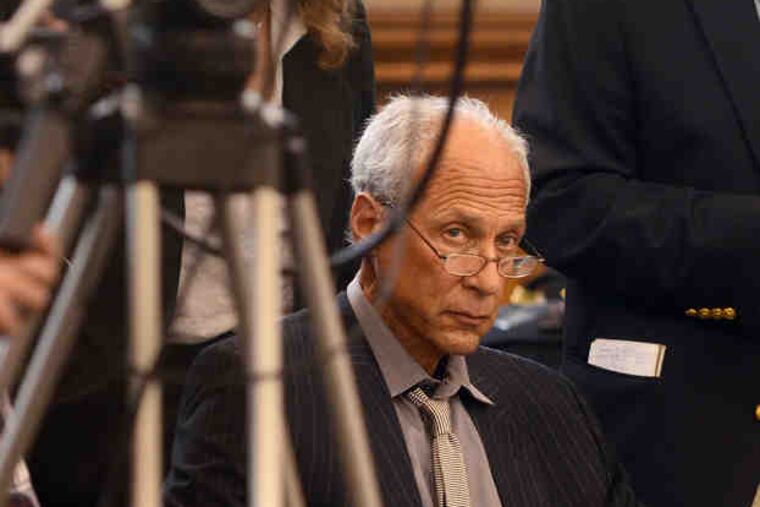
He sits in the front, wearing his typical pin-striped suit and tie that goes long below the belt, white hair slightly mussed, and legs crossed. A reporters' notepad rests on his lap.
He listens - for hours. Immediately after the union activists are arrested, Aron rushes back to the studio to piece together his segment. "It's still a challenge every night," says Aron, 65.
Outside the Statehouse, 24-year NJN veteran Jerry Henry, 55, covers the union rally.
"I learn every day I work," Henry says. "I logged 400 miles . . . to tell the story about the girl who fell off" the Ferris wheel in Wildwood.
Henry's cameraman, Tim Stollery, won an Emmy with Aron in 1986. Aron "lifts our game with his level of knowledge," Stollery says. "He is always looking for more information; he always has his ears open."
At the studio, Aron is in one of several glass-walled editing bays going through tapes, snapping his fingers, and saying "boom" at the spots where he wants to cut a sound bite.
"The process for me is still fascinating," Aron says.
He needs to know the names of the Democrats who voted for the benefits bill, so the anchor, Jim Hooker, e-mails a Democratic spokesman and runs over a list. Forty minutes until showtime.
Aron begins his voice-over: "A crowd of union members packed Room 4 at the Statehouse Annex. . . . To the unions it's about further belt-tightening for their members, and what feels like a dose of disrespect."
When he reads those words - dose of disrespect - is he talking about himself, too? Aron seems befuddled by the question. Instead, he muses: "This is going to be a good piece. The sound bites are wonderful."
Hooker opens the newscast, just as he has since 2008, in front of a bank of eight screens, next to a table hidden from the camera with Aqua Net and a notebook. Hooker is a former newspaper reporter who doesn't know what's next for him.
"It's like having a decent meal with all the veggies as opposed to fast food," Hooker says, "and I haven't had fast food, journalistically, in 16 years."
On this day, Hooker anchors not just coverage from the Statehouse, but also reports about state unemployment, natural gas prices, a food festival in Jersey City, and special hospital rooms for Alzheimer's patients.
But it is political coverage that NJN is known for, and that came through two weeks ago during live coverage of the primary election. It might have been the last election NJN covered, and so the panel of experts and operatives who assembled in the studio heaped praise on the network at the broadcast's close.
Hooker offered Aron a chance to give his own comments on NJN's situation.
"I think it's all been said," Aron said. "I think it's time to say good night."
Hooker looked at the camera: "In Michael's way - that's the way we do it here."
Then NJN faded to black.