Quiet protest marks Barnes galleries' last day in Merion
A mixture of wistfulness and loss seemed to wrap itself around North Latchs Lane in Merion on Sunday, the last day the galleries of the Barnes Foundation there will be open to the public.
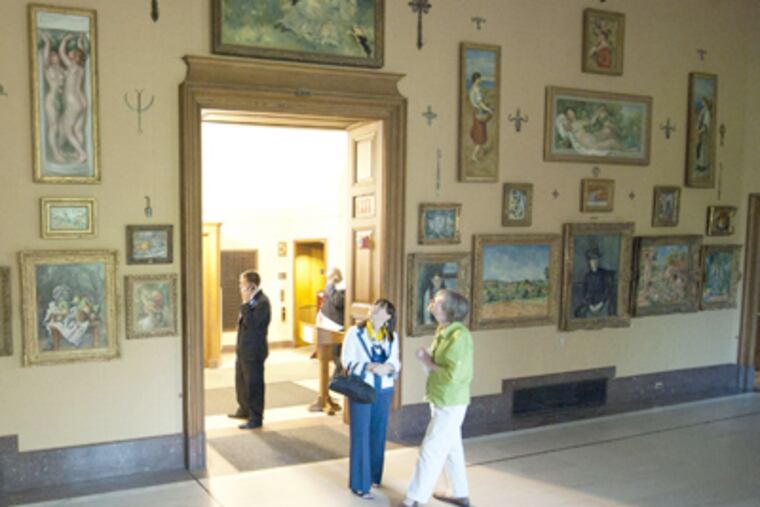
A mixture of wistfulness and loss seemed to wrap itself around North Latchs Lane in Merion on Sunday, the last day the galleries of the Barnes Foundation there will be open to the public.
Since 1922, visitors and students have made the trek to the Paul Cret-designed building, a simple Renaissance palazzo of French sandstone set amid 12 leafy acres near City Avenue, to see and study the miraculous collection of Impressionist and early Modern works inside, the legacy of patent-medicine millionaire Dr. Albert C. Barnes.
With visitation strictly controlled, 450 tickets to view the Renoirs, Van Goghs, Cézannes, and Matisses on this last day have been sold out for quite some time. By late spring 2012, the paintings are expected to be on view roughly eight miles away in a museum under construction on the Benjamin Franklin Parkway in Philadelphia.
That move, brought on by perilous foundation finances over the last two decades, has often triggered protest demonstrations at the foundation's black iron gates.
So it was Sunday, with a couple of dozen quiet protesters out on Latchs Lane to greet early gallerygoers. Not unfamiliar signs were held aloft:
Don't dim the lights to hide your lies.
Merion Barnes Accessible Sustainable Real.
Nancy Herman, long opposed to the Philadelphia move, characterized the day as "bittersweet," but pointed out that opponents were still fighting in Montgomery County Orphans' Court to keep the paintings in their longtime home. Barnes died in 1951.
Inside the Barnes building, emotions were muted but strong.
"I know it's a big day," said Nick Miller, an Irish artist from County Sligo, who was visiting the Barnes for the first time. "I love museums like this where you have to make the pilgrimage to see the work in its context."
Miller, who has an exhibition at the Concord Art Association outside of Boston, was staggered by the sheer volume of Cézannes and Van Goghs at the Barnes. Even though the second floor of the galleries closed several months ago to facilitate conservation work, Cézannes and Renoirs and Seurats seemed to dot every wall.
The Barnes reminded Miller of the Isabella Stewart Gardner Museum in Boston. Both galleries reflect the unique perspectives of their founders.
In that sense, he said, the Barnes Foundation is more than the paintings in the collection.
"It's not just the individual paintings," Miller said. "It's the collection and the context. It really works, I think. I'm sure it will be beautiful in its new venue [in Philadelphia]. But there's something very special about having to make the effort to see it here, rather than hopping off a tour bus in town and seeing it on the Parkway."
Miller was standing in the main gallery, Seurats to the left, Renoirs to the right, Cézannes dead ahead. The room was dim, despite the tall windows.
"I was just blown away by seeing the famous paintings. Seeing the Van Gogh Postman was just wonderful to see. It's such an amazing painting. But what really struck me was the numerous small Cézannes, the bathers. . . . They are fantastic, intense little studies, amazing little paintings, like that one over there, and in each room there are a couple of them. The amount of Cézanne is shocking. It took me completely aback to see so many."
Ralf and Jutta Uhl, who live in Wiesbaden, Germany, but are in the United States for an extended period of work, lucked into tickets to this, the Barnes' last day in Merion.
"We are very lucky to have the tickets," Jutta Uhl said. "We love Renoirs; we've been in Paris for a long time."
Her husband said they were quite familiar with French Impressionist work, a major feature of the Barnes Collection.
"This is an outstanding place," said Ralf Uhl, adding that he had "split feelings" about the move of the pictures from Merion to Philadelphia. He was not sure that the unique configuration of paintings on the walls would be duplicated in the new location.
Told that it would be, Jutta Uhl jumped in and said the new location might not have "the same spirit."
Ralf Uhl pointed out, however, that there was resistance to renovation of the Musée de l'Orangerie in Paris. But once the galleries reopened in 2006, the renovation was deemed by many a success.
"People were reluctant, like here, at the very beginning, but when they saw it the first time, the pictures were assembled in the same way, there was more light, so it was progress," he said.
Nick Wilberg, from Germantown, Md., visiting the Barnes for the first time, said he was dubious about the new Philadelphia location but pleased to be able to get into the Merion galleries on the last day.
"It's going to be sad," he said, standing before Van Gogh's Postman. Wilberg said something of Barnes would vanish in Philadelphia.
"Probably part of his voice will be lost when these paintings are taken somewhere else," he said. "It seems like they're attached to the gallery, and having them divorced from the gallery will change it a bit, even though they tried to have the same configuration."
Around 5, gallery closing time, a group of about a dozen visitors lingered. Mike Urdanick, the very last to leave the galleries, took a long last look at Cézanne's Card Players before leaving.
"It is the last opportunity to see it in its natural setting," he said. "The way Dr. Barnes intended it to be seen."
Urdanick, from Lawrenceville, N.J., said he had visited the galleries three or four times and is not happy to see the paintings moved. Nevertheless, he said he would visit them in Philadelphia as well.
"You can't boycott beauty," he said, before turning away.
See a video of the Barnes collection's last day in Merion at www.philly.com/barnes
EndText