N.Y. Occupy feels the heat
NEW YORK - Crackdowns against the Occupy Wall Street encampments across the country reached the epicenter of the movement Tuesday, when police rousted protesters from a Manhattan park and a judge ruled that their free-speech rights did not extend to pitching a tent and setting up camp for months at a time.
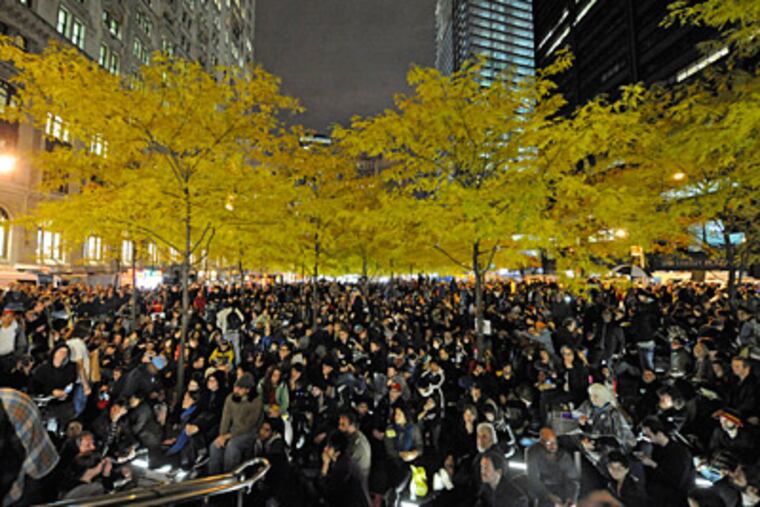
NEW YORK - Crackdowns against the Occupy Wall Street encampments across the country reached the epicenter of the movement Tuesday, when police rousted protesters from a Manhattan park and a judge ruled that their free-speech rights did not extend to pitching a tent and setting up camp for months at a time.
It was a potentially devastating setback. If crowds of demonstrators return to Zuccotti Park, they will not be allowed to bring tents, sleeping bags, or other equipment that turned the area into a makeshift city of dissent.
But demonstrators pledged to carry on with their message protesting corporate greed and economic inequality, either in Zuccotti or a yet-to-be-chosen new home.
"This is much bigger than a square plaza in downtown Manhattan," said Hans Shan, an organizer who was working with churches to find places for protesters to sleep. "You can't evict an idea whose time has come."
State Supreme Court Justice Michael Stallman upheld the city's eviction of the protesters after an emergency appeal by the National Lawyers Guild.
The protesters have been camped out in the privately owned park since mid-September. Mayor Michael Bloomberg said he ordered the sweep because health and safety conditions had become "intolerable" in the crowded plaza. The raid was conducted in the middle of the night "to reduce the risk of confrontation" and "to minimize disruption to the surrounding neighborhood," he said.
By early Tuesday evening, some protesters were being allowed back into the park two by two. But each could take only a small bag.
Still, some protesters believed the loss of Zuccotti Park may be an opportunity to broaden and decentralize the protest to give it staying power.
"People are really recognizing that we need to build a movement here," Shan said. "What we're dedicated to is not just about occupying space. That's a tactic."
But without a place to congregate, protesters will have a harder time communicating with each other en masse. The leaders of the movement spent most of Tuesday gathering in small groups throughout the city and relaying plans in text messages and e-mail.
Robert Harrington, owner of a small importing business in New York, stood outside the barricade with a sign calling for tighter banking regulations.
"To be effective, it almost has to move out of the park," Harrington said. "It's like the antiwar movement in the '60s, which started as street theater and grew into something else."
"The issues," he added, "are larger than just this camp."
The raid seemed to mark a shift in the city's dealings with the Wall Street protests. Only a week ago, Bloomberg privately told a group of executives and journalists that he thought reports of problems at the park had been exaggerated and did not require immediate intervention.
The New York raid was the third in three days for a major American city. Police broke up camps Sunday in Portland, Ore., and Monday in Oakland, Calif.
The timing did not appear to be coincidence. On Tuesday, authorities acknowledged that police departments across the nation consulted with one another about nonviolent ways to clear encampments. Officers in as many as 40 cities participated in the conference calls.
Across the country, in Berkeley, Calif., a day of demonstrations by students and anti-Wall Street activists was disrupted Tuesday when a campus police officer shot a man with a gun about a half-mile from the main protest site at the University of California campus.
The shooting took place inside the Haas School of Business as hundreds of demonstrators left a plaza at the university for a march to demonstrate outside a bank.
Officials did not immediately know if the suspect was part of the Occupy Cal movement, said Ute Frey, a spokeswoman for the university.
The suspect raised the gun and was shot by an officer, according to the school. The condition of the 33-year-old suspect was not immediately known. His name was not released.
Protesters descended on the university after ReFund California, a coalition of student groups and university employee unions, called for a campus strike, and protesters marched and rallied to protest banks and budget cuts to higher education.
The Occupy protest in New York has inspired demonstrations around the world. Police in Australia swooped down on the Occupy Melbourne camp, arresting three protesters as they enforced city orders requiring demonstrators to take down tents and tarpaulins. A Melbourne spokeswoman says campers were not evicted Wednesday morning, but were issued notices giving them an hour to remove the shelters.
In New York City, when police began their crackdown at 1 a.m., most of the protesters were sleeping.
Officers arrived by the hundreds and set up powerful klieg lights to illuminate the block. They handed out notices from Brookfield Office Properties, the park's owner, and the city saying that the plaza had to be cleared because it had become unsanitary and hazardous.
About 200 people were arrested, including a member of the City Council and at least a half-dozen journalists.
"The law that created Zuccotti Park required that it be open for the public to enjoy for passive recreation 24 hours a day," Bloomberg said. "Ever since the occupation began, that law has not been complied with, as the park has been taken over by protesters, making it unavailable to anyone else."