Missouri Gov. Nixon: 'Lawlessness' will be stopped amid Ferguson unrest
FERGUSON, Mo. - Missouri Gov. Jay Nixon vowed on Tuesday to halt further "lawlessness" in a still-smoldering St. Louis suburb as residents and business owners tried to make sense of the destruction that has followed a grand jury's decision not to indict a police officer for the shooting death of unarmed teenager Michael Brown.
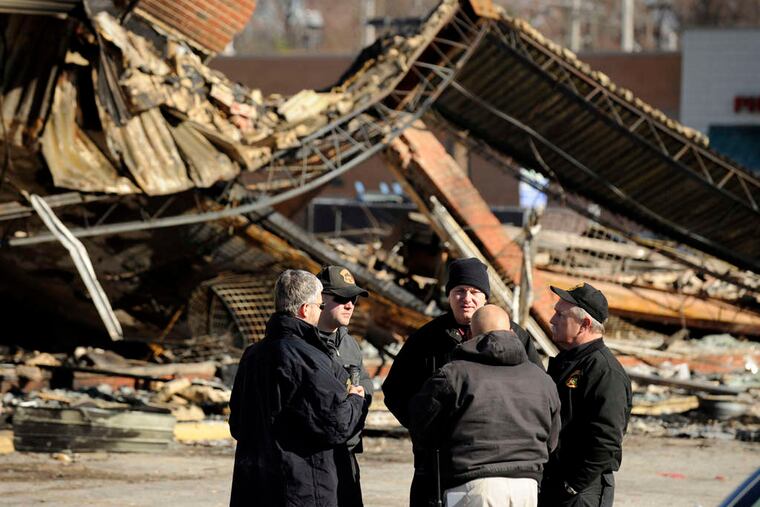
FERGUSON, Mo. - Missouri Gov. Jay Nixon vowed on Tuesday to halt further "lawlessness" in a still-smoldering St. Louis suburb as residents and business owners tried to make sense of the destruction that has followed a grand jury's decision not to indict a police officer for the shooting death of unarmed teenager Michael Brown.
Nixon said more than 2,200 National Guard troops - triple the number from a night earlier - would take to the streets to prevent another round of arson and rioting. By Tuesday evening, some crowds had gathered in parts of greater St. Louis - and in Philadelphia, Atlanta, Boston, and several other American cities - but the demonstrations were peaceful.
President Obama criticized the violence, saying that "nothing of benefit, nothing of significance results from destructive acts." Speaking in Chicago, Obama said he had asked Attorney General Eric H. Holder Jr. to convene a "series of regional meetings focused on building trust in our communities" that would focus on how to make law enforcement fairer.
The damage Monday night was severe enough that several of Ferguson's downtown blocks on Tuesday were designated as a crime scene. While Ferguson's mayor and Missouri's lieutenant governor bristled that authorities hadn't done enough to stop the rioting, others said the destruction to businesses was a case of anger spiraling out of control after a panel of jurors decided not to indict Officer Darren Wilson.
"I feel like I could collapse on the floor," said Kim Yeon-sook, an employee at the half-burned and looted Beauty World, where the cash register was missing and ceiling fans had wilted under the flames.
Since mid-August, this middle-class and predominantly black suburb has become accustomed to tense standoffs between police and protesters. But what happened Monday far exceeded - in cost and damage - everything that had come before, and it left Ferguson bracing for further waves of unrest. At least a half-dozen businesses were torched Monday alone. Some 61 arrests were made, 32 of them for felony charges.
"This is a man-made disaster and an economic one," said Rebecca Zoll, president and chief executive of North County Incorporated, a community development organization that deals with a broad area that includes Ferguson. "I'm heartsick."
At a news conference early Tuesday afternoon, Ferguson's mayor, James Knowles, criticized state officials for not doing enough to protect property. Though police had trained for months to better handle mayhem and Nixon a week earlier had declared a state of emergency, the National Guard all but ignored the major commercial areas of Ferguson, running along both South and West Florissant Avenues.
In a phone interview, Missouri Lt. Gov. Peter Kinder said that Nixon and his lieutenants were inaccessible Monday night to authorities on the ground, including Knowles. That led to a situation in which Knowles was begging for National Guard assistance but couldn't get authorization. Knowles and Kinder spoke in the morning, said Kinder, a Republican and Nixon political opponent.
"It is dumbfounding and unfathomable that a governor who called out [the National Guard] would hold them back at a time of direst need," Kinder said, practically screaming. "Mayor Knowles sat on his back porch and watched businesses burn. There are 12 businesses gone today, which wouldn't be the case if there had been 50 guardsmen standing in front."
Nixon vowed at a news conference with a half-dozen other law enforcement officials that there "will not be a repeat" of what happened Monday.
"Last night was a disaster. It's very disappointing," Nixon said. "Criminals intent on lawlessness and destruction terrorized this community. I am deeply saddened for the people of Ferguson who woke up this morning to see parts of their community in ruins.''
Wilson has been largely out of public view since the shooting, but he broke his silence Tuesday in an exclusive interview with ABC News' George Stephanopoulos, saying he had done nothing wrong. "I know I did my job right," Wilson said.
The officer said Brown had charged toward him and reached into his squad car to grab his gun, leaving him no choice but to fire. Wilson told ABC that he was sorry that Brown had died but said he would not have done anything differently and has a clean conscience.
Stephanopoulos asked whether Brown's hands had been raised. "That would be incorrect," Wilson replied. "No way."
Meanwhile, attorneys and representatives for Brown's family took aim at the grand jury proceedings, saying evidence presented was flawed and biased. They also called the decision to release the grand jury's findings at night irresponsible. "It was unnecessarily provocative, but I think it only cleared up why many of us said 'let's go to the federal government' in the first place," said the Rev. Al Sharpton.
Holder, meeting with reporters Tuesday afternoon, expressed his disappointment in the outbreak of violence and said the Justice Department would seek to determine who was responsible.
"The way in which we make progress in this country is when we have seen peaceful, nonviolent protests," Holder said.
Ferguson Developments
The weeks of anxious waiting and hours of deliberating ended Monday, but the grand jury's decision not to indict Police Officer Darren Wilson in the fatal shooting of Michael Brown will likely reverberate throughout the community and nation for days to come.
The Latest
Wilson remains on administrative leave, which has been the case since the Aug. 9 shooting, Ferguson Mayor James Knowles said Tuesday afternoon. Meanwhile, a protest took place in downtown St. Louis, with participants stopping traffic. Earlier Tuesday, attorneys for Brown's family and the Rev. Al Sharpton criticized St. Louis County Prosecutor Bob McCulloch's decision to take the case in front of a grand jury and not appoint a special prosecutor.
The Beginning
Wilson shot and killed Brown, who was unarmed, shortly after noon Aug. 9 in the middle of the street after a scuffle. Brown's body lay there for hours as police investigated and an angry crowd of onlookers gathered. Several days of tense protests in the predominantly black community followed, prompting Missouri Gov. Jay Nixon to call in the National Guard. McCulloch decided to present the case to a grand jury.
The Announcement
Made up of nine white people and three black people, the grand jury met 25 days over three months, and heard more than 70 hours of testimony from 60 witnesses. McCulloch held a prime-time news conference Monday to reveal the decision.
The Public Response
Thousands waited in the streets of Ferguson and in other major U.S. cities on Monday, and responded with shouts of anger. In Ferguson, some began throwing objects at police, and soon began to smash windows and set fire to businesses and cars. Authorities lobbed tear gas to disperse the crowd. Twelve commercial buildings were destroyed by fires, many along a stretch of West Florissant Avenue in the north St. Louis suburb, and there were 12 vehicle fires. Sixty-one people were arrested in Ferguson, and 21 were arrested in the Shaw neighborhood of St. Louis. Eighteen people had protest-related injuries.
The Documents
More than 1,000 pages of grand jury documents were released Monday, including Wilson's full testimony in which he described the scuffle in his patrol car and recognizing the cigars in Brown's hand as possibly being connected to a report of a convenience store robbery. Wilson also said that Brown approached him: "And when he gets about ... 8 to 10 feet away ... all I see is his head and that's what I shot."
The Final Say?
The U.S. Justice Department has its own investigation into possible civil rights violations that could result in federal charges for Wilson, but investigators would need to satisfy a rigorous standard of proof. The department also has launched a broad probe into the Ferguson Police Department. - AP
EndText