At ballpark, hits are in the air, on the ground
Fly balls and infield singles can vie for attention with snowy owls and multicolored blossoms at Citizens Bank Park.
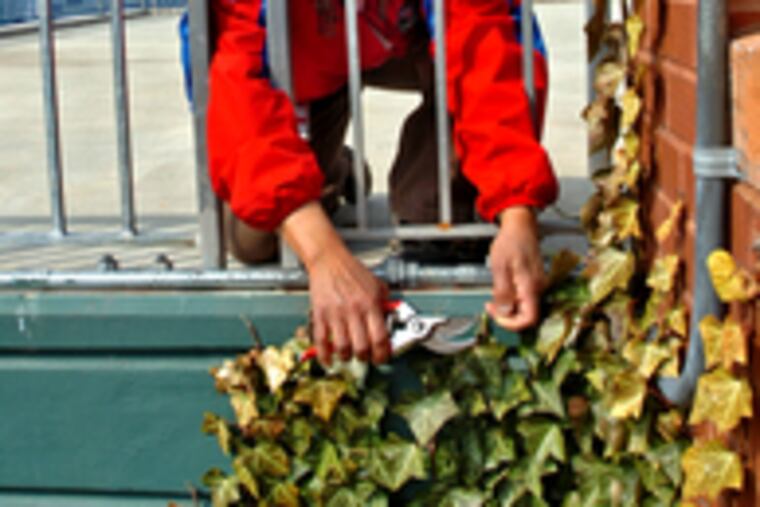
Pamella Hall isn't at all worried about someone's hitting a baseball into her flower bed.
"If Ryan Howard wants to hit one in my pansies, he's welcome. Chase Utley, too," said Hall, who, as landscape manager for the Phillies, spent the fall supervising the planting of 6,000 of those pansies all along the left-field wall and around the bullpen areas of Citizens Bank Park. When fans come to the park once the season starts in a couple of weeks, they will see the maroon, yellow, white and lavender annuals among more than 10,000 trees, plants and shrubs at the stadium under Hall's care.
Watching baseball is a different experience than viewing other major sports. Often, it is merely an excuse for a nice afternoon or evening out in the air.
For instance, the initial thought behind bringing binoculars may be to watch Aaron Rowand make one of his classic wall-banging catches. But say that Jamie Moyer is holding the Astros to two hits and it's already 8-0, Phils. Maybe it's time to watch the bird life around the park.
"Because it is so close to water, just around dusk when night games are starting, there are a lot of birds moving from marshes to open water and back. It wouldn't be unusual to see some egrets and blue herons, not to mention the usual mallards and black ducks and Canada geese," said Bill Buchanan of the John Heinz National Wildlife Refuge at nearby Tinicum.
While visitors might see a football-type Eagle up in the owner's box, the eagle-eyed might actually find a bald eagle or two flying above. Buchanan said several bald eagles have been hanging around South Philadelphia, the Delaware River, and Tinicum of late. They are opportunist fisher-birds, so they might fly by the stadium on their way to dinner on the river.
Real birding opportunists might see, early in the season, a rare snowy owl.
"They have been wintering farther south, especially by the Jersey Shore," said Buchanan, but the pure white owls - of cigar fame - have been known to perch on lampposts in the lesser-populated parts of South Philadelphia.
More likely, though, the birds around the stadium when it is populated will be gulls, sparrows, pigeons and starlings. Three different types of gulls buzz over the park - the smaller ring-billed gull with a black band around its bill; the medium-size herring gull with a red spot on its yellow beak; and the greater black-backed gull, which is black instead of the typical white gulls native to the area. The pigeons at the stadium sometimes attract peregrine falcons, which have taken to nesting under local bridges that mock their usual habitats in mountain escarpments. Those falcons can race across the stadium at up to 200 m.p.h., snatching a pigeon for dinner in midair, Buchanan said.
They aren't yet serving pigeon at the park's concession stands, but fitness guru Pat Croce said a baseball-watching outdoorsy thing to do would be to walk to a far-off concession stand, rather than wait for the hot-dog vendor to come by the seat.
"It's a party coming to the park, so you can't go non-caloric," said Croce, "but you can mitigate the calories by getting off your butt and jogging over to the stand for your beer and hot dog."
Croce has a formula for the seventh-inning stretch, too.
"You've been sitting for, what, two hours by that point, so you need to get up!" he said, shouting in the Croce manner. Clasp hands above the head and turn palms out. Bend left and right to get good shoulder stretches. Then put a foot on the top of the seat and grasp toward it, stretching the back and legs. "You can put your foot on the bald head of the guy in front if he is a Mets fan."
Or look out at Hall's plantings. The pansies will give way to Phillies-red-and-white petunias in a couple of months. "Annuals you are changing all the time," said Hall. Outside, around the stadium, and on the inside entrances are 2,000 trees and 5,000 shrubs. In front of all the windows are potted plants, mostly evergreens. The areas at the first base, third base, and left-field entrances are planted with low shrubbery.
"We've done some redesigning and are planting more perennials this year," said Hall, one of the few landscape specialists for baseball teams. The grass on the field is still Kentucky blue, trucked in from the Tuckahoe Turf Farm in Hammonton, N.J.
The seeds from the turf can attract some lawn-type birds, said Buchanan, but probably not of the National and American League variety.
"Though they show up in the Philadelphia area elsewhere, I don't think you are going to find any orioles, blue jays or cardinals flying around at the park," he said.